
Does Canine Communication Help Train Puppies?
When you bring home a new dog, you expect a loyal companion ready to follow your every command. You soon find yourself dealing with chewed shoes, sudden barks, and a creature completely ignoring your frustrated shouts. You keep repeating verbal commands louder and louder, hoping the dog will magically understand English. Dogs actually spent over 30,000 years evolving to read our physical gestures, turning into experts of non-verbal cues. We force them into a completely backwards system. We demand they comprehend human speech while we completely ignore their extensive physical vocabulary. Learning canine communication offers the ultimate shortcut to effective puppy training. You turn frustrating standoffs into seamless cooperation when you understand their physical cues and decode their vocalizations. You must learn to read dog body language correctly. This article explores exact methods to read and respond to your dog's signals.
The Basics of Canine Communication for New Owners
Dogs constantly transmit detailed information about their emotional state long before they ever let out a single bark. To build an unbreakable bond, owners must become completely fluent in this visual vocabulary. You might wonder, how do dogs communicate with humans? According to a study published in ScienceDirect, dogs communicate with humans primarily through a combination of physical shifts—involving the ears, face, teeth, and tail—along with scents and vocalizations to express their emotions.
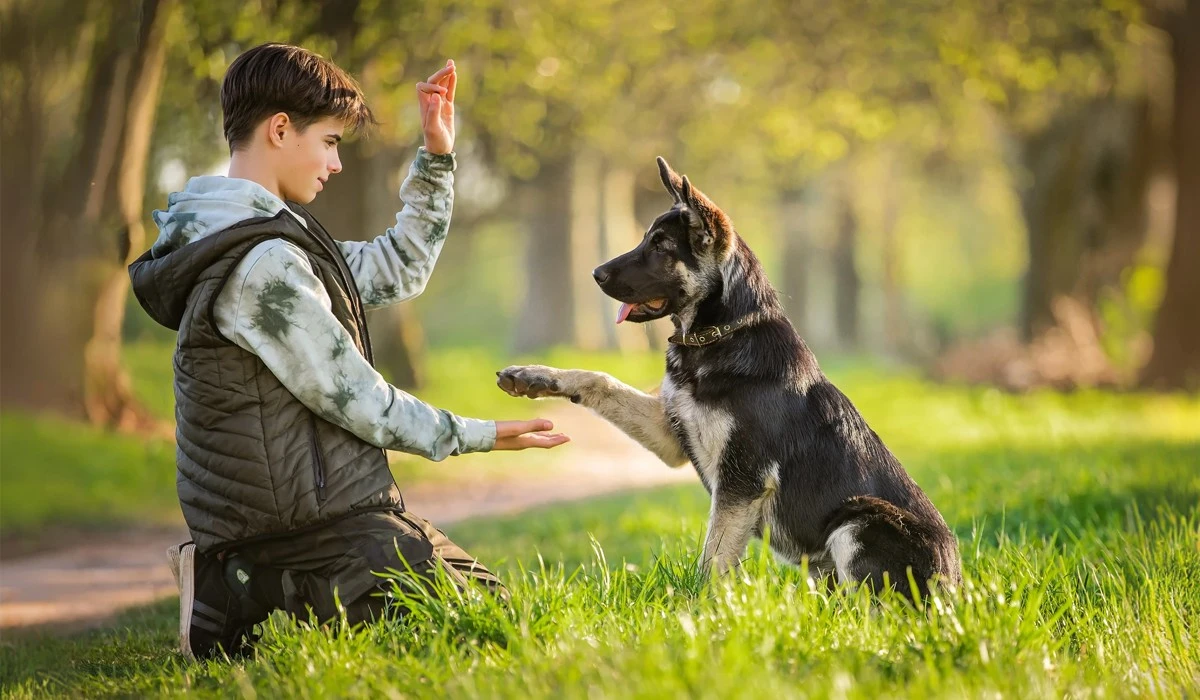
Owners cause massive frustration on both ends of the leash when they rely entirely on verbal commands without observing these physical shifts. Dr. Patricia McConnell conducted an interesting study where she gave puppies conflicting visual and auditory signals simultaneously. Twenty-three out of twenty-four puppies followed the visual hand motion. A related publication in ScienceDirect confirms that dogs prioritize gestural signals from familiar humans over spoken words. Expecting species-specific translation from a puppy only causes unnecessary stress and ruins training sessions.
Decoding Dog Body Language from Nose to Tail
You gain a clear visual dictionary for reading dog body language when you observe your dog's anatomy systematically. A dog's eyes and ears reveal their exact emotional state at any given second. Relaxed dogs hold their ears in a neutral position, while anxious dogs pin their ears flat against their skull. You must also watch for "whale eye," a condition where a dog turns its head away but keeps its eyes fixed on a target, exposing the white sclera. This prominent indicator reveals extreme stress. "Hard eyes" feature a glassy, intense stare with dilated pupils, signaling high arousal or potential aggression. Conversely, "soft eyes" have heavy, relaxed eyelids and indicate a comfortable, receptive dog. Enlarged pupils in a round, wide eye always indicate high autonomic nervous system arousal, independent of the room's lighting. These visual details dictate your training success.
The Truth About Tail Wagging
Many people falsely believe that a wagging tail always signifies a happy, friendly dog. Certified applied animal behaviorist Dr. Patricia McConnell clarifies the actual science behind this common myth. According to VCA Hospitals, a high, stiff, rapid wag indicates an assertive posture that can progress to an intense aggressive display. Conversely, research published in The Guardian notes that a tail held high signifies confidence or a dog's willingness to play. Meanwhile, a low, slow, or tucked wag signals deep insecurity and fear.
A genuinely happy dog exhibits a loose, sweeping, circular wag that engages their entire rear end. You prevent dangerous misinterpretations during interactions when you recognize these tail differences. Owners frequently suffer sudden, preventable bites when they ignore the stiffness of a wag. You build a safer environment for everyone involved when you evaluate the entire body to avoid just staring at the isolated tail. Fluent canine communication requires you to piece together these individual anatomical signals into one cohesive emotional picture before you ever issue a command.
How Posture Shapes Puppy Training Success
Visual cues connect directly to active puppy training outcomes every single day. You dictate whether a training session will succeed or fail miserably when you read a dog's weight distribution and overall posture. A "ready to learn" posture features a loose, wiggly body with the dog's weight evenly distributed across all four paws. This stance comes with a soft, open mouth and neutral ears, showing the dog feels safe and receptive. When you spot this green light posture, you have a perfect window to introduce new commands or shape positive behaviors. You guarantee faster retention and deeper engagement when you initiate training during this relaxed state. Dogs in this mindset process information quickly and eagerly seek your guidance. You save countless hours of repetitive drilling when you recognize this exact moment. You maximize your training effectiveness when you simply wait for the right physical invitation from your dog.
Spotting Overtired and Overstimulated Pups
You permanently damage the training bond and destroy trust when you push past a dog's mental capacity. A stiff, rigid body with weight shifted heavily over the front legs indicates defensive or offensive arousal. In reality, a dog in this red light state possesses zero mental bandwidth to process new instructions. Sometimes pups tuck their limbs, crouch low to the ground, or expose their belly during a session. Owners often label this as stubbornness, yet the dog actually exhibits submissive deflection due to feeling utterly overwhelmed. You only escalate their panic and ruin your progress when you force an overstimulated puppy to comply. You must immediately recognize these frantic or avoidant postures as clear stop signals. You prevent behavioral fallout when you end the session on a positive note. You practice proper canine communication when you respect these boundaries and allow the dog's nervous system to fully recover.
Vocalizations as a Key Pillar of Canine Communication
Auditory signals add an essential layer of context to how your dog currently feels. A study in Animal Cognition proves dogs physically modulate the acoustic structure of their barks based entirely on context. They actively vary pitch, duration, and frequency to signal different emotions. Dr. Sophia Yin demonstrated that domestic dog barks serve as highly specific requests. A high-pitched, rhythmic bark almost always invites playfulness and engagement. A deep, sharp, rapid bark serves as a serious alarm or a sign of deep frustration.
According to a study published in ScienceDirect, dogs growl under a variety of circumstances, including during social conflict, as a threat signal, while guarding food, or during social play. Research from UC Berkeley also found that lower-pitched growls signal a much higher perceived threat level. As noted by Best Friends Veterinary Group, punishing a growl decreases your dog's ability to communicate their feelings and removes their warning signals before a sudden bite. You rapidly improve your daily interactions and completely change your understanding of basic dog behavior when you treat these vocalizations as vital information.
Decoding the Puppy Whine
New owners frequently struggle with constant vocalizations and biting during the early months. Why does my puppy bite me so much? Puppies usually bite due to teething or as a normal part of play and exploration, often accompanying this behavior with playful growls or sharp yips. You help them learn boundaries without stifling their natural curiosity when you redirect this energy toward appropriate chew toys. Whining also carries deep meaning in early development. Veterinary behaviorist Dr. Sophia Yin categorizes whining into distinct functions like soliciting attention, expressing anxiety, or indicating intense physical discomfort. You must read the accompanying body posture to accurately diagnose the root cause of the whine. A whine at the door means a bathroom break, while a high-pitched whine near an empty bowl shows impatience. Proper puppy training requires you to address the specific need behind the emitted sound.
Calming Signals: Recognizing When Your Dog Needs a Break
Norwegian dog trainer Turid Rugaas coined the term "calming signals" to describe over thirty specific micro-behaviors dogs use to de-escalate tension. These tiny gestures prevent conflict and act as clear cries for help during stressful moments. How do I know if my dog is stressed? According to an article in The Guardian, you can tell a dog is stressed if they exhibit signs like showing the whites of their eyes (also known as 'whale eye'), yawning, and nose licking.
You can remove them from overwhelming situations before they panic when you catch these early signals. A rapid flick of the tongue over the nose serves as a primary appeasement gesture. An exaggerated yawn from a dog that recently woke up shows immense social discomfort. Whale eye clearly indicates a desperate need for space. You achieve fluent canine communication when you spot these precise micro-expressions and immediately adjust your approach to reduce pressure.
The "Shake Off" Reset
Dogs utilize interesting physical routines to release internal tension after enduring a stressful encounter. The psychological "shake off" remains one of the most recognizable and important calming signals you will observe. A completely dry dog will suddenly perform a vigorous, full-body shake from head to tail. This action serves as a biological reset button to clear adrenaline and relieve pressure following an intense training repetition. Dogs also use a tactic called "splitting up," physically maneuvering their bodies between two other dogs or humans to diffuse perceived tension. You know your dog successfully processed a difficult moment and feels ready to move forward when you recognize the shake off. You must give your dog space to complete this physical reset. You significantly elevate your overall success rate in any puppy training program when you observe and respect these natural coping strategies.
Preventing Behavioral Issues Before They Start
You prevent minor fears from escalating into lifelong phobias or dangerous reactivity when you proactively read early warning signs. Resource guarding always begins with subtle physical warnings long before a dog actually snaps at someone. You will notice a sudden, rigid freeze in movement when you approach their prized possession. The dog will adopt a stiff, hovering stance directly over the item to block your access. They will then deliver a hard stare or exhibit whale eye directed precisely at the approaching human. You intervene safely using positive trade games when you catch this specific sequence of dog body language. You force the dog to escalate to a growl or a bite to protect their treasure when you ignore these rigid postures. You eliminate the need for harsh corrections and keep the household entirely safe from aggressive outbursts when you intervene early based on accurate observation.
Navigating Fear Periods
Puppies undergo major developmental stages that permanently shape their view of the world. The first fear period occurs between eight and eleven weeks, coinciding exactly with a pup leaving its mother. Negative experiences during this brief three-week window activate evolutionary survival programming, often resulting in permanent phobias. Adolescent dogs experience a second fear stage tied to brain reorganization between six and fourteen months of age. Owners step back and counter-condition successfully when they recognize the subtle fear signals during these vulnerable windows. You guarantee a lifetime of severe anxiety when you force a terrified pup into overwhelming situations during a fear period. You must act as a confident guide and strictly protect them from traumatic encounters. Learning canine communication ensures you guide them safely through these turbulent neurological phases without causing any irreversible psychological damage to your dog.
Applying Your New Skills to Everyday Commands
You turn your basic obedience routines into flawless performances when you apply this behavioral theory to everyday practice. You use a dog's physical responses to perfectly time your clicker, treats, or verbal markers. You dramatically accelerate their comprehension when you deliver a reward the exact second a dog shifts its weight back into a "sit" posture. You confuse the dog and reinforce the wrong movement when you delay the reward by even two seconds. Meanwhile, you completely change how you issue commands when you recognize spatial pressure. Approaching a dog head-on or looming over them acts as an intensely threatening signal. You remove this spatial pressure instantly when you turn your body sideways and kneel. This simple adjustment makes your puppy infinitely more receptive to a recall command. Small shifts in your timing and posture create massive breakthroughs in your daily puppy training exercises and general household management.
Adjusting Your Own Body Language
Communication operates as a two-way street between you and your animal companion. Dogs instinctively manage boundaries and stop other dogs using subtle physical "body blocks." During a typical training session, humans instinctively step backward when saying "No" to a wildly jumping pup. In canine language, retreating actually translates to an invitation for the dog to come forward and continue jumping. You communicate the boundary effectively and stop the jumping immediately when you stand your firm ground or step slightly into the dog's space. You must remain highly aware of what your own limbs and posture convey to your dog. You remove confusion and build mutual respect when you align your physical actions with your verbal commands. Your dog constantly watches your every move, so you must purposefully control your body to reinforce the exact behaviors you wish to see.
The Lifelong Rewards of Learning Canine Communication
Learning to read dog body language demands intense daily observation, deep patience, and tremendous consistency. The incredible payoff completely justifies the time you invest in studying these vital non-verbal signals. True success in puppy training requires you to achieve mutual understanding. You abandon outdated dominance and endless repetitions. You end sessions before the dog fails when you recognize subtle stress signs, like pacing or panting with tightly drawn lips. You actively lower your dog's heart rate during stressful events when you simply mimic their calming signals, such as softening your eyes or turning your head away. Understanding canine communication turns your entire relationship around, and you replace constant frustration with complete clarity and deep trust. Spend ten uninterrupted minutes today just quietly observing your dog's natural movements, and you will see a completely new language unfolding right before you.
Recently Added
Categories
- Arts And Humanities
- Blog
- Business And Management
- Criminology
- Education
- Environment And Conservation
- Farming And Animal Care
- Geopolitics
- Lifestyle And Beauty
- Medicine And Science
- Mental Health
- Nutrition And Diet
- Religion And Spirituality
- Social Care And Health
- Sport And Fitness
- Technology
- Uncategorized
- Videos

