

Myofascial Release Therapy: Melt Tissue Glue
You wake up feeling like you are wearing a suit of armor three sizes too small. You stretch your hamstrings, but the tightness returns within minutes. You get a deep tissue massage, and while it feels good for an hour, the same nagging pull in your shoulder blade greets you the next morning. It feels as though your body has been shrink-wrapped from the inside.
This happens because you are fighting a biological web that has turned into glue. Most people blame their muscles for stiffness, but the muscles actually sit inside a tough, protective casing. When this casing dries out or sticks together, it creates a physical straightjacket that no amount of traditional stretching can fix. You need a way to melt that glue.
Myofascial Release Therapy offers a direct solution for this persistent restriction. Applying slow, sustained pressure allows your internal tissues to soften and lengthen again. This process provides lasting fascia tension relief and helps you reclaim the fluid movement you had years ago.
The Fascial Web and Why It Locks Up
Fascia works like a three-dimensional web that wraps around every muscle, bone, and organ in your body. According to research published in the NCBI Bookshelf, a healthy fascial web requires hyaluronic acid to remain slippery and hydrated, allowing your muscles to slide past each other without friction. However, things change when you experience physical trauma, poor posture, or chronic dehydration.
The web begins to lose its moisture and binds together. Imagine pouring syrup on a silk scarf; the fibers no longer slide, they stick. These "glued" areas create massive internal pressure. Healthy fascia can withstand up to 2,000 pounds of pressure per square inch, but when it tightens, it exerts that same crushing force on your nerves and blood vessels.
The Collagen-Elastin Connection
Your connective tissue relies on two main proteins: collagen and elastin. Collagen provides the strength, while elastin provides the stretch. Myofascial Release Therapy targets the specific way these fibers interact. An article in Frontiers in Physiology suggests a proposed mechanism where sustained pressure or stretch from sitting at a desk for eight hours may deform collagen, causing fibers to break apart or form aberrant cross-links in a slumped position.
What does fascia tension feel like? It often presents as a dull, spreading ache or a restrictive pulling sensation that limits your normal range of motion. This tension creates a cycle of pain where your body compensates for one tight spot by straining another. The physical separation of those fused fibers through Myofascial Release Therapy breaks this cycle.
The 3-to-5 Minute Sustained Pressure Rule
Most therapies fail because they move too fast. Fascia is viscoelastic, meaning it acts like thick honey or silly putty. If you pull it quickly, it snaps or resists. If you apply slow, steady pressure, it slowly deforms and stretches. John F. Barnes, a leader in this field, found that the body needs time to let go.
The first two minutes of a hold only affect the elastic part of the tissue, which just snaps back like a rubber band. Research on the effectiveness of myofascial release from the Bowen Therapy Professional Association notes that practitioners generally hold slow, sustained pressure for roughly two to five minutes to reach the plastic component of the fascia. This duration initiates a permanent change in the tissue structure, ensuring the relief actually lasts.
Piezoelectricity and Tissue Rehydration
When a therapist applies sustained pressure during Myofascial Release Therapy, something remarkable happens at a cellular level. According to a review in ScienceDirect, fascia has piezoelectric properties, meaning this physical compression changes mechanical force into a tiny electrical energy charge. This signal tells the body to send fluid back into the "glued" areas of the tissue.
The same review notes that some clinical therapies claim this generates thixotropy, the process of moving your tissue from a thick, viscous gel state to a fluid, hydrated sol state. This rehydration allows your fibers to slide again. Instead of simply stretching a muscle, you change the physical state of your internal environment.
Beyond the Temporary Fix of Traditional Massage
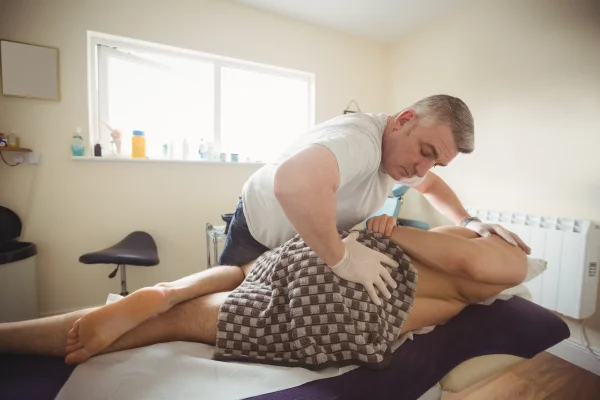
Traditional massage often uses oils to slide over the skin and knead the muscles. While this feels relaxing, it often misses the deeper restrictions. As noted in Frontiers in Physiology, therapists use very little lubricant to maintain traction, helping them hook into the fascial system rather than gliding over the skin. Myofascial Release Therapy uses no oils specifically, so the therapist can maintain a firm grip on the connective tissue layers.
Instead of rubbing the surface, the therapist sinks deep into the restriction. A study published in Nature describes the interstitium as a previously unrecognized fluid-filled space within and between tissues like fascia, which this approach targets. Targeting this space helps you achieve true fascia tension relief that affects the whole body instead of a single muscle group.
The Cumulative Power of Consecutive Sessions
Your body has a physical memory of its injuries. Every time you sprain an ankle or slouch at a computer, your fascia records that position. One session starts the process of melting these patterns, but the body often tries to return to its old, "safe" habits.
How long does it take for fascia to release? Most practitioners find that sustained pressure for at least three to five minutes is required to allow the tissue to physically lengthen and reorganize. Over several sessions, your nervous system learns to accept this new, open posture. Each appointment builds on the last, eventually making your newfound mobility your permanent state.
The Physical Sensation of Spontaneous Release
During a session, you might feel your body wanting to move in strange ways. You might twitch, shake, or feel a limb move on its own. This is somatic tissue unwinding. It is the body's way of discharging stored kinetic energy from past accidents or repetitive stresses.
Your brain often blocks these movements to protect you, but in the safety of a therapy session, the body finally lets them go. This "unwinding" helps the tissue return to a neutral, relaxed position. It signals that the deep, protective bracing patterns in your nervous system are finally dissolving.
The Emotional Component of Tissue Memory
While acknowledging it as a controversial topic in manual medicine, a PubMed paper explores the idea that tissues may possess a memory, suggesting fascia records both physical movement and the stress associated with that action. When you experience somatic tissue unwinding, you might feel a sudden rush of heat or a sense of emotional lightness. This happens because the tissue is releasing the chemical signals of old stress.
Letting go of these physical memories yields a deep sense of psychological relief. A randomized trial published in ScienceDirect found that clinical anxiety levels can be reduced using manual myofascial techniques as physical tension vanishes. You are essentially cleaning out the "cellular filing cabinet" of your body, leaving you feeling lighter and more present.
Reversing the Effects of Tech Neck and Sedentary Habits
According to a study in ScienceDirect, extended use of electronic devices often results in a sustained static and flexed spinal position, forcing us into a forward-curling position, such as staring at phones or leaning into steering wheels. This causes the fascia in the front of the neck and chest to shorten and harden. Myofascial Release Therapy excels at opening these specific areas to restore an upright, effortless posture.
When you release the front of the body, the back muscles no longer have to work overtime to keep you upright. This ends the chronic burning sensation between your shoulder blades. You stop fighting gravity and start working with it, which drastically reduces your daily fatigue.
Balancing the Body’s Tensegrity
Your body operates on the principle of tensegrity, or tensional integrity. This means your bones don't actually touch; they float in a sea of fascial tension. If you pull a string on one side of a tent, the whole structure leans. Your body works exactly the same way.
A restriction in your hip can pull on the fascia all the way up to your jaw. Using Myofascial Release Therapy to find these distant "pulls" allows a therapist to resolve a headache by working on the pelvis. This whole-body approach ensures that you aren't chasing symptoms but fixing the actual source of the problem.
No Oils, No Gliding, Just Connection
Deep tissue massage often involves sliding over the skin to find knots. In contrast, Myofascial Release Therapy requires a dry, firm connection. The therapist uses their hands, elbows, or forearms to "sink" into the tissue until they hit a barrier. They then wait patiently at that barrier.
This lack of lubricant allows the therapist to feel the subtle "pulls" in the web. They can follow the restriction as it moves and changes under their hands. This focused connection creates a much more targeted treatment than a general massage ever could.
Working With the Body Instead of Against It
Many people think a massage has to be painful to work. They grit their teeth while a therapist digs into a knot. Myofascial Release Therapy takes the opposite approach. If you brace against the pain, your fascia actually tightens to protect itself.
Is myofascial release therapy painful? While you may experience intense pressure or a burning sensation as the tissue stretches, it should always feel like a therapeutic, productive release rather than sharp pain. The therapist waits for the body to give permission to go deeper. This cooperative approach prevents the "rebound" soreness often associated with aggressive bodywork.
Hydration and the Flushing Process
After a session, your tissues are like a sponge that has been wrung out and is ready to soak up fresh water. Drinking plenty of water is essential to keep the newly released fascia hydrated. This prevents the tissue from "gluing" back together as it settles into its new position.
Hydration also helps the body process the metabolic waste that was trapped in the restricted areas. Think of it as a house cleaning for your internal systems. Proper fluid intake ensures that the fascia tension relief you achieved during the session becomes a permanent part of your physical makeup.
Recognizing the Signs of Post-Session Integration
Your nervous system needs time to figure out how to move in its new, more open body. Over the 24 to 48 hours following a session, you might feel a bit clumsy or unusually tired. This is normal. Your brain is recalibrating your center of gravity and your sense of where your limbs are in space.
Listen to your body during this time. Avoid heavy workouts immediately after a session and instead choose gentle movements like walking. This allows the results of the somatic tissue unwinding to fully integrate into your daily life, ensuring long-term success.
Reclaiming Your Mobility with Myofascial Release Therapy
Chronic pain is not a life sentence that you must accept as you age. Often, what feels like permanent damage is simply a fascial system that has lost its elasticity and fluid nature. When you address the connective tissue directly, you remove the "straightjacket" that has been holding you back.
Myofascial Release Therapy provides a path out of chronic stiffness by respecting the time and pressure your body needs to heal. Engaging in this process ends symptom management and changes the very fabric of your physical being. Seek out a qualified practitioner to experience somatic tissue unwinding and reclaim the freedom of movement you deserve. You can live a life defined by ease and fluidity rather than the constraints of chronic tension.
Recently Added
Categories
- Arts And Humanities
- Blog
- Business And Management
- Criminology
- Education
- Environment And Conservation
- Farming And Animal Care
- Geopolitics
- Lifestyle And Beauty
- Medicine And Science
- Mental Health
- Nutrition And Diet
- Religion And Spirituality
- Social Care And Health
- Sport And Fitness
- Technology
- Uncategorized
- Videos

