

Psychological Anthropology and Social Conflict
You walk into a meeting and sit close to a colleague. They immediately lean back. You feel rejected. They feel crowded. Neither of you said a word, yet tension fills the room. This friction happens because your brain follows a set of rules you never chose. You learned these rules before you could even speak. Most people spend their lives hitting these walls without knowing why. While they blame "personality clashes" or "rudeness," the reality is that your habits collide with their habits.
You grew up in a world that taught you how to stand, when to speak, and how to show respect. They grew up in a different one. These different worlds live inside your heads. If you want to stop the fighting, you must look at the roots of human behavior. Psychological Anthropology offers the tools to do this. This field helps you see the rules that govern everyone’s mind. When you evaluate culture and personality studies, you can stop taking social friction personally and start managing it with skill.
Defining the Lens: What is Psychological Anthropology?
Psychological Anthropology serves as a bridge between the individual mind and the surrounding world. It asks a big question: How does your neighborhood, your family, and your country change how you think? Most psychologists look only at the brain. Most anthropologists look only at the group. This field looks at both at the same time. It examines the "psychic unity of mankind." This means all humans share the same basic mental hardware, but our environments upload different software.
The Intersection of Mind and Society
Melford Spiro, a famous researcher in the field, argued that we internalize our surroundings. We don't just live in a culture; the culture lives in us. We create mental representations of the world. These images guide our social behavior. If your world taught you that "time is money," your brain reacts to a broken rule rather than simply a late friend. According to research published in PubMed, this biopsychological approach shows that social stressors like exclusion or hierarchy can actually change your brain chemistry by causing chronically high cortisol levels and a dysregulated hypothalamic-pituitary-adrenal axis.
The Legacy of Culture and Personality Studies
The roots of this work go back to the early 20th century. During the 1920s through the 1950s, the culture and personality studies school changed how we view human nature. These researchers moved away from the idea that people are born with a fixed "national character." Instead, they argued that our childhood experiences shape who we become as adults. They believed the way parents feed, hold, and discipline children creates a shared foundation for an entire society.
From Ruth Benedict to Modern Cognitive Theory
Ruth Benedict wrote a famous book called Patterns of Culture. She suggested that cultures are "personality writ large." A society picks a few human traits and makes them the goal for everyone. One group might value calm and quiet. Another might value excitement and competition. What is the main focus of psychological anthropology? This discipline primarily examines how the cultural environment shapes an individual's mental processes, emotions, and overall cognitive development.
Margaret Mead added to this by studying teenagers in Samoa. She proved that the stress of being a teen isn't a biological requirement. It depends on the expectations of the community. How does culture affect personality development? Culture provides the blueprints for behavior and values, which are internalized during childhood to form the core traits of an individual's personality. Later, Cora Du Bois introduced the "Modal Personality." She used statistics to find the most common personality types in a group without assuming everyone was the same.
Decoding Social Friction through Psychological Anthropology
Social friction often happens because of "Cultural Schemas." Think of a schema as a mental template. Your brain uses these templates to predict what will happen next. When you go to a restaurant, you have a schema for ordering food. If the waiter sits down at your table and starts eating your fries, your schema breaks. You feel angry because the reality did not match your mental map.
The "Normal" Trap
We often think our way of doing things is just "normal." Pierre Bourdieu called this "Habitus." These are the habits we learn so well that they feel like common sense. When someone acts differently, we assume they are "wrong" or "weird." This leads to the Misattribution Error. You might see someone avoid eye contact and think they are lying. In their world, avoiding eye contact might be the highest form of respect for your authority. Psychological Anthropology teaches you to stop and question your own map before judging theirs.
Rewiring Your Cross-Cultural Communication
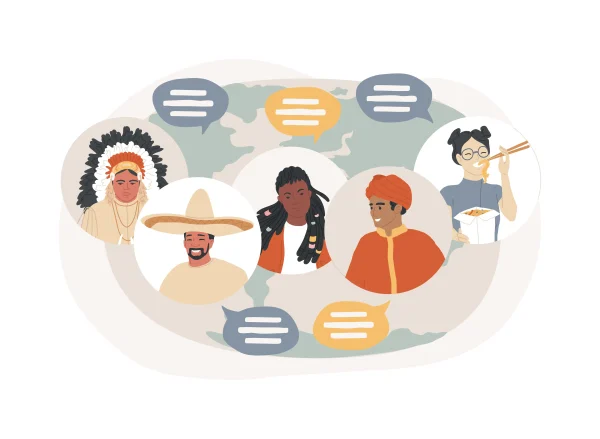
Communication styles cause massive friction. Edward T. Hall identified "High-Context" and "Low-Context" styles. A report published by SAGE notes that people from High-Context groups (like Japan or many Arab nations) rely on hints and non-verbal cues. This source also explains that many high-context cultures are collectivistic, including China, North and South Korea, Vietnam, and several African cultures. People from Low-Context groups (like Germany or the USA) want explicit, clear words. When these two styles meet, the High-Context person thinks the other is blunt and rude. The Low-Context person thinks the other is being sneaky or confusing.
Reading Between the Lines
When you spot these styles early, you can reduce friction. If someone gives you a vague answer, they might be trying to "save face" or avoid a direct "no." This serves as a social tool rather than a lie. Another layer involves Proxemics, or how we use space. As noted in research published in PMC, humans have four zones of space: intimate (0–46 cm), personal (45–120 cm), social (1.2–3.5 m), and public (3.5 m+). Friction occurs when your "social" distance overlaps with someone else's "intimate" distance. If you feel someone is standing too close, they likely grew up in a world where that distance signaled friendliness, not a threat.
Navigating Individualism vs. Collectivism in Daily Life
One of the biggest divides in culture and personality studies is the "I" versus the "We." This is known as the Self-Construal Theory. Research found in PubMed describes how some people have an "Independent Self" and see themselves as stable individuals who orient toward personal-goal pursuit. It notes that others have an "Interdependent Self" and see themselves as a part of a web of relationships, prioritizing in-group goals above personal ones.
Resolving the "I" vs. "We" Conflict
Friction spikes when an "Independent" person tries to solve a problem directly. They focus on the facts. The "Interdependent" person focuses on how the solution affects the group's harmony. This relates to Face Negotiation Theory, as documented in the SAGE Encyclopedia of Communication Theory, in many groups, protecting the group's dignity (saving face) is more important than being right. This source defines self-face as concern for one’s own image, while other-face or mutual-face involves concern for the other party or both parties. Understanding this helps you choose your battles. Sometimes, letting someone "save face" solves the friction faster than winning the argument.
Applying Psychological Anthropology to De-escalate Conflict
To stop a fight, you must use "Thick Description." This is a method from Clifford Geertz. As highlighted by research in PMC, this approach recognizes that only in a specific context will a blink be recognized as a wink rather than a meaningless twitch of the eye. Instead of just seeing an action, you look for the meaning behind it. When someone frustrates you, ask yourself: "What does this action mean in their world?" This shifts you from being an angry participant to a calm observer.
Active Listening as an Ethnographic Tool
You can treat every interaction like an ethnographic study. Robert Levy used "Person-Centered Ethnography" to look at the private self. He found that people often struggle with the roles their culture gives them. Why is psychological anthropology important currently? It is important because it encourages global empathy and provides the analytical tools necessary to resolve misunderstandings in a society that is increasingly diverse. When you listen for the "cultural logic" behind a comment, you stop reacting to the words and start responding to the person.
Building Sustainable Social Intelligence
True social intelligence requires "Reflexivity." This means you look at your own cultural baggage. You must admit that your "common sense" is just one version of the truth. When you realize that you were "programmed" by your upbringing, you become more flexible. This is called Cognitive Flexibility. You gain the ability to "frame-switch." You can look at a problem through your own eyes, and then quickly switch to see it through the eyes of a stranger.
Emotional Intelligence Meets Cultural Awareness
Understanding Psychological Anthropology leads to better mental health. According to PubMed, some problems, called "Culture-Bound Syndromes," only exist in certain societies. For example, Hikikomori is frequently described in Japan as a form of severe social withdrawal. Recognizing that these issues are tied to cultural pressure allows us to offer better support. You become a bridge-builder. You no longer see "difficult people." You see people navigating their own learned maps, just like you are.
Harmonizing Your World with Psychological Anthropology
Social friction indicates that two different sets of learned rules have met, rather than being a sign that something is broken. You don't have to agree with everyone, but you should understand where their behavior starts. When you apply the insights from culture and personality studies, you stop being a victim of social awkwardness. You start seeing the patterns in the chaos.
Every person you meet carries a world inside them. They have been learning how to be a person since the day they were born. Their "rudeness" might be their version of "respect." Their "closeness" might be their version of "warmth." Through the use of Psychological Anthropology, you gain a significant advantage. You see the rules of the game while everyone else is just playing it. This perspective turns every conflict into a chance to learn. It replaces anger with curiosity. When you change how you see people, people change how they react to you. When you recognize the different worlds we all inhabit, you can end the friction.
Recently Added
Categories
- Arts And Humanities
- Blog
- Business And Management
- Criminology
- Education
- Environment And Conservation
- Farming And Animal Care
- Geopolitics
- Lifestyle And Beauty
- Medicine And Science
- Mental Health
- Nutrition And Diet
- Religion And Spirituality
- Social Care And Health
- Sport And Fitness
- Technology
- Uncategorized
- Videos

