
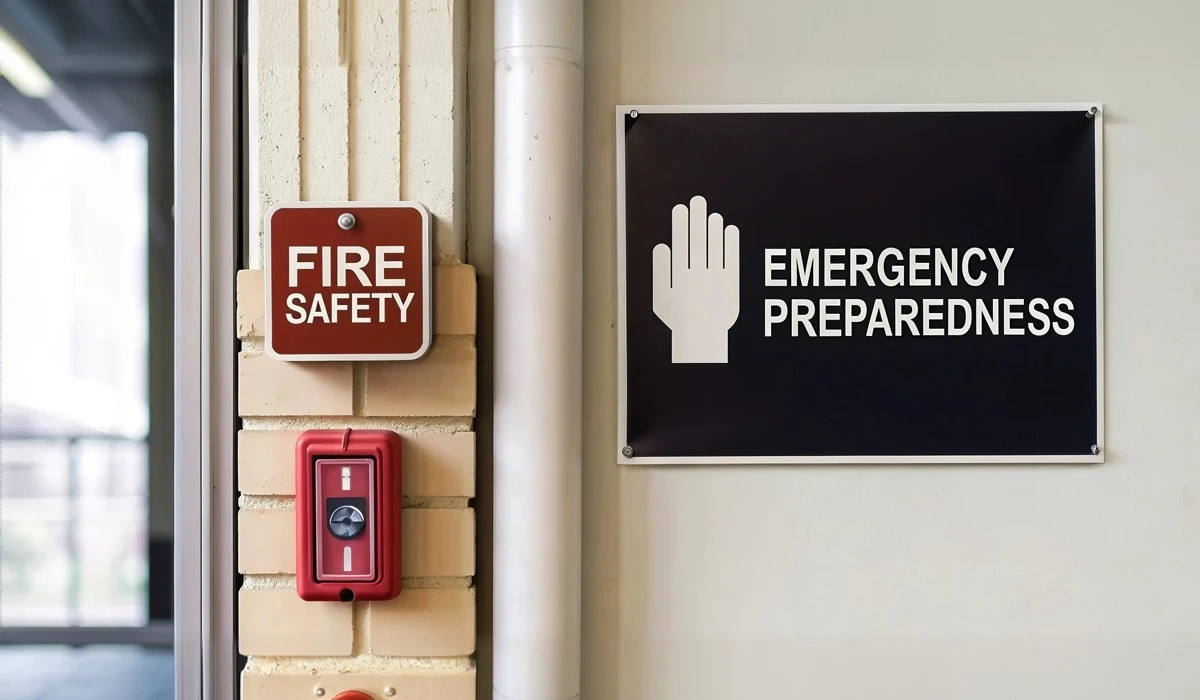
Charting Safe Exits By Fire Safety Risk Assessment
During a sudden building fire, occupants predictably ignore the closest exit doors. People experience immediate tunnel vision under intense stress. Research published in Environment and Behavior indicates that evacuees head toward familiar people and places during emergencies, causing them to instinctively route themselves back toward the main entrance they used to enter the facility. This psychological response, known as affiliation theory, creates deadly bottlenecks in hallways. Heavy smoke drops visibility to zero, and rational thinking plummets.
A comprehensive fire safety risk assessment completely overrides this dangerous human instinct. This vital document maps out highly specific, intuitive pathways for survival. Facility managers rely on these assessments to ensure all emergency exits stand fully optimized for rapid, unobstructed evacuation. Organizations prevent mass casualties when they replace chaotic reactions with pre-planned routes. Establishing these clear egress channels also guarantees companies remain perfectly prepared for the next rigorous building inspection, avoiding massive fines while prioritizing human life and operational continuity.
Why a fire safety risk assessment is the ultimate survival plan
The United Kingdom Home Office and international safety bodies mandate a strict five-step methodology for a fire safety risk assessment. Assessors must identify hazards, identify people at risk, reduce those risks, record findings, and review the data regularly. According to the UK Regulatory Reform (Fire Safety) Order 2005 legislation, the designated responsible person bears the legal onus and must conduct a suitable and sufficient assessment of the risks to correct specific layout deficiencies. A core principle of the process involves isolating the fire triangle. Safety experts map the physical proximity of heat sources, like overloaded electrical panels, away from combustible packaging materials. They also account for oxygen flow from air conditioning systems. Separating these three elements drastically reduces ignition probabilities. Organizations must treat these assessments as active life-saving tools. Managers protect occupants when they proactively eliminate hazards before a single spark occurs within the facility.
The psychology of panic and clear pathways
Popular media frequently depicts crowds losing self-control during disasters. Sociologist Enrico Quarantelli debunked this panic misconception in 1954. Modern researchers consistently prove that mass panic and anti-social flight rarely happen during building fires. Human behavior remains highly rational, though people base their actions on incomplete environmental information. Studies indicate that approximately eighty percent of individuals exhibit normalcy bias during an emergency. People actively deny the immediate threat and waste precious escape minutes finishing routine tasks. During the 2001 World Trade Center attacks, 70% of survivors delayed evacuation to speak with colleagues and gather social proof. Clear egress maps counteract this deadly hesitation. Property managers install highly visible directional cues to break through normalcy bias. Intuitive floor plans force occupants to move decisively. These pre-planned routes bypass difficult decision-making processes when smoke thickens and critical seconds slip away.
How emergency exits dictate the overall floor plan
When mapping out a space, egress paths must always take priority over aesthetic design. Planners and managers often wonder, how many emergency exits are required in a commercial building? Most commercial spaces need at least two distinct and well-separated exits, though large or high-occupancy buildings will require several more. Evaluating these routes early ensures that daily foot traffic avoids obstructing the vital escape lanes. Safety engineers structure the entire facility around these critical thresholds. A comprehensive fire safety risk assessment identifies spatial conflicts long before construction begins. Architects align corridors specifically to feed occupants toward the exterior doors. They eliminate confusing turns that slow down moving crowds. Daily operations must respect these unmarked safety boundaries. Facilities teams maintain wide clearances around every designated doorway, guaranteeing rapid egress during sudden alarms or a strict building inspection by local authorities.
Calculating occupancy limits and egress capacity
The National Fire Protection Association sets strict mathematical formulas for egress capacity through the NFPA 101 Life Safety Code. Assessors calculate maximum occupancy when they divide net floor space by specific load factors. Commercial office layouts require one hundred square feet per person. Standing-room bars and dense dance areas restrict this limit to just seven square feet per occupant. Following these calculations, safety planners measure exit width requirements. The code dictates allowing one person for each two-tenths of an inch of doorway width. This allowance increases to three-tenths of an inch per person if stairs form part of the escape route. Property owners use these exact metrics during a fire safety risk assessment to determine spatial limits. Establishing accurate occupancy thresholds prevents deadly crushes and ensures smooth crowd flow toward the emergency exits during severe panic situations.
Eliminating dead ends and bottlenecks
Structural traps regularly force people into dangerous bottlenecks during mass evacuations. Fire safety planners apply the forty-five-degree rule to resolve this major structural threat. This principle guarantees multiple exit paths sit far enough apart so a single blaze cannot block all escape routes simultaneously. The International Building Code establishes rigid standards for these egress pathways. Inspectors demand that emergency doors swing outward precisely in the direction of travel. Inward-swinging doors cause immediate pile-ups when panicked crowds press against the hardware. Meanwhile, local fire marshals occasionally grant Authority Having Jurisdiction modifications. These specific documents provide dimensional relief for older buildings, provided the primary facility usage type remains entirely identical. A thorough fire safety risk assessment spots non-compliant dead ends quickly. Identifying these choke points allows managers to restructure hallways and satisfy the strictest building inspection requirements.
Steps to execute a rigorous fire safety risk assessment
The evaluation process requires a methodical approach to document every potential hazard and vulnerable population within the facility. Property owners frequently ask, how often should a fire safety risk assessment be reviewed? As outlined in Article 9 of the UK Regulatory Reform (Fire Safety) Order 2005 legislation, the responsible person must regularly review the evaluation to keep it current, and facilities must assess the documentation at least annually or immediately after any structural, operational, or occupancy changes to the premises.
Keeping this document up to date forms the backbone of an ongoing corporate safety strategy. Evaluators conduct walk-throughs to physically inspect the condition of all emergency exits. They document missing signage, worn panic hardware, and failing emergency lights. Management teams compile this raw data into actionable maintenance requests. Regular reviews catch minor issues before they compound into massive life-safety failures. Maintaining this strict timeline proves essential for compliance. Consistent updates demonstrate proactive responsibility and guarantee excellent results during a rigorous, surprise building inspection.

Identifying ignition sources and fuel loads
A compliant assessment categorizes and maps specific hazard loads across the property. Evaluators separate physical fuel sources from localized ignition points. Fuel sources include common items like cardboard packaging materials, foamed plastics, and industrial cleaning fluids. Ignition sources encompass heating systems, naked flames, and friction-heavy manufacturing equipment. Safety teams chart the exact locations of these items on the official floor plan. Isolating these elements starves potential fires of their required fuel. Managers relocate combustible storage boxes away from primary emergency exits to prevent rapid flame spread along the escape route. Assessors also inspect electrical panels for overloaded circuits and frayed wiring. Identifying these concealed dangers mitigates severe risks immediately. A thorough fire safety risk assessment turns a disorganized warehouse into a highly controlled environment, minimizing ignition probabilities and drastically improving overall building safety metrics.
Evaluating the people at risk
A professional evaluation must explicitly document clear provisions for vulnerable populations requiring additional assistance. Facility managers account for disabled individuals, the elderly, and young children in their evacuation plans. Temporary contractors and visiting clients also present high-risk profiles. These individuals lack basic spatial awareness of the facility layout. They do not know the location of the nearest emergency exits. Planners assign dedicated staff members to guide these visitors outward during sudden alarms. Building codes require specialized evacuation chairs near stairwells to assist mobility-impaired occupants. Safety teams incorporate these specialized rescue devices into the primary fire safety risk assessment. Recognizing these human factors guarantees inclusive protection. A comprehensive strategy leaves no individual behind, ensuring every occupant reaches the exterior safely regardless of their physical abilities or familiarity with the building layout.
Spotting layout hazards before a building inspection
An impending audit often forces facility managers to look closely at their daily operations and layout discipline. People often ask, what do building inspectors check for fire safety? Inspectors typically focus on verifying that alarm systems function, fire extinguishers hold current service tags, and egress routes remain completely unobstructed. Addressing these specific points internally before an official building inspection saves time, money, and stress. Routine operations frequently breed severe complacency.
Workers gradually push storage boxes into hallways, shrinking the viable escape width. Janitors prop open heavy fire doors with wooden wedges to make cleaning easier. These minor conveniences critically compromise the structural fire barriers. As mandated by OSHA standard 1910.37, which dictates that exit paths must stay clear and fire-protection safeguards must function properly at all times, a rigorous fire safety risk assessment consistently corrects these dangerous habits. Management teams train employees to respect clearance zones. Maintaining a permanently spotless egress path ensures seamless regulatory compliance and immediate evacuation readiness.
Clutter, locked doors, and blocked corridors
Municipal data from the Seattle Fire Department reveals that blocked passageways generate the most common daily citations. Initial penalties start at three hundred seventy-three dollars and escalate rapidly to one thousand dollars per day for ongoing non-compliance. Clutter destroys escape times. A physically clear pathway also means nothing if the hardware fails upon physical contact. Fire marshals penalize facilities heavily for malfunctioning panic hardware on exit routes. Security teams sometimes lock exterior doors illegally using padlocks, keypads, or combination chains to prevent theft. These security measures trap occupants inside during a blaze. A thorough fire safety risk assessment audits every single mechanical latch. Evaluators press every push-bar to guarantee the latches release instantly without special knowledge or excessive force. Securing the perimeter against intruders must never compromise the internal emergency exits during a life-or-death evacuation scenario.
Flammable materials near egress paths
Storing combustible materials near primary corridors creates a catastrophic trap. Employees often stash cardboard recycling or excess pallet inventory in stairwells to save warehouse space. A stray spark can ignite this fuel load and instantly sever the only vertical escape route. Inspectors issue immediate closure orders when they spot these hazards during a building inspection. Mitigating this risk requires relentless documentation and daily discipline. The Texas Fire Marshal checklist demands concrete proof of active maintenance for all egress systems. Facility teams log monthly thirty-second functionality tests and annual ninety-minute battery discharge tests for emergency lights. These strict records prove that management actively protects the escape routes. A professional fire safety risk assessment establishes these recurring maintenance schedules. Regular reviews ensure no flammable debris ever obstructs the paths leading out of the facility.
Mapping fast escape routes during a fire safety risk assessment
The evaluation process visually translates hazard data into perfectly safe, designated pathways. Modern commercial construction frequently utilizes open-plan office layouts. The British Standard 5266-7 officially classifies these vast, partition-free spaces as anti-panic areas. Without defined hallways, occupants easily lose their orientation during an active alarm. Effective wayfinding designs guide individuals outward naturally. Facility managers install unbroken photoluminescent signage and floor-level glowing lines to mark the safest travel directions. These visual cues cut through thick smoke when ceiling visibility drops to zero. Planners align workstation desks parallel to these glowing tracks to accelerate movement. Employees follow the floor markers instinctively toward the closest emergency exits. A thorough fire safety risk assessment prioritizes this intuitive movement psychology. Designing routes that require zero difficult decision-making ensures mass evacuations proceed rapidly and securely under extreme psychological distress.
Installing fail-proof emergency lighting and signage
Power failures accompany almost every major facility blaze. A dark, smoke-filled corridor immediately induces severe spatial disorientation. According to the UK Regulatory Reform (Fire Safety) Order 2005 legislation, safety planners must provide adequate emergency lighting for any escape routes and exits requiring illumination. Additionally, the National Fire Protection Association Code 101 mandates strict technical requirements for illuminated escape paths. Emergency egress routes must maintain a minimum initial average illumination of one foot-candle, equal to 10.8 lux.
Code enforcers stipulate that no single point along the path can drop below zero point one foot-candles. Meeting these precise measurements requires strategic light fixture placement. Safety engineers angle battery-operated spot beams specifically to highlight stairs, tight corners, and final exit doors. Evaluating these metrics forms a central pillar of any professional fire safety risk assessment. Technicians measure light output thoroughly using specialized lux meters. Satisfying these hard numerical targets guarantees optimal visibility and secures immediate approval during the strictest building inspection.

Aligning staff training with the evacuation map
Even the most thoroughly drafted fire safety risk assessment holds zero value if occupants fail to execute the physical plan. According to OSHA's evacuation plans and procedures eTool, standard twenty-nine CFR nineteen-ten point thirty-eight requires employers to create a written emergency action plan and train employees, though the agency advises conducting drills as frequently as necessary rather than enforcing a universal annual requirement. The NFPA scales these drill frequencies upward based on specific occupancy risks. Healthcare facilities and educational campuses conduct mandated evacuations on a quarterly or monthly basis.
Managers use these recurring exercises to field-test the designated emergency exits. Evaluators measure the exact time the entire workforce takes to clear the premises. Slow evacuation times reveal structural bottlenecks or confusing directional signage. Safety committees review this drill data actively. Modifying the escape routes based on live drill performance permanently improves the overall response strategy. Realistic simulations convert theoretical maps into fast, lifesaving muscle memory.
Appointing and training fire wardens
Psychological studies supporting the Role Rule Model show that people defer entirely to established authorities during extreme emergencies. Without clear leadership, occupants freeze in place or debate the validity of the alarm. A strict fire safety risk assessment addresses this behavioral paralysis when it establishes a dedicated fire warden network. Safety guidelines heavily recommend appointing one highly trained warden for every twenty to thirty employees. These leaders wear high-visibility vests and carry bullhorns to direct traffic. Wardens sweep assigned zones, confirm empty bathrooms, and forcefully guide hesitant workers toward the nearest emergency exits. They also conduct accurate roll calls at external assembly points. After clearing the building, head wardens deliver vital status reports directly to the arriving Incident Commander. This structured chain of command eliminates deadly confusion and guarantees swift, orderly movement toward complete safety.
Adapting a fire safety risk assessment as a building evolves
Commercial spaces evolve constantly to meet expanding business demands. According to the UK Government's 2024 fire risk assessment checklist, organizations need to regularly evaluate and update their safety documentation whenever significant structural or operational changes occur. The government guidance also notes that the law utilizes performance-based review parameters rather than setting rigid expiration dates for evaluations. Moving a single interior partition wall changes the physical properties of smoke travel and alters required escape times.
Facility directors must launch a new fire safety risk assessment immediately following any significant structural alteration. Adding closed offices into a formerly open workspace introduces dangerous new dead ends. Construction teams often unknowingly block established emergency exits with permanent fixtures. Evaluators trace the newly constructed paths to calculate revised egress travel distances. Updating the schematics captures these spatial shifts accurately. Presenting an obsolete floor plan during a formal building inspection results in severe citations, making ongoing documentation essential for regulatory approval and physical safety.
Upgrading capacity and changing usage
Changing a quiet corporate office into a highly populated telemarketing call center mandates a complete recalculation of safety needs. The Building Safety Act of 2022 enforces much stricter rules regarding operational alterations. Facility owners must maintain an ongoing, unbroken record of safety information throughout the property lifespan. Increasing the daily headcount places massive stress on existing escape routes. Older doors lack the required width to process dense crowds swiftly. A detailed fire safety risk assessment recalibrates these occupancy formulas mathematically. Evaluators determine if the current emergency exits possess enough sheer capacity to handle the sudden personnel influx. Installing additional outward-swinging doors often becomes legally necessary. Addressing these capacity upgrades proactively shields the business from liability. Maintaining precise alignment between current building usage and approved escape capacity prevents catastrophic bottlenecks during a chaotic mass evacuation event.
Securing Peace of Mind and Total Compliance
Human instinct naturally fails under the terrifying pressure of an unexpected blaze. People freeze, look for social cues, and rush back toward familiar entryways, creating deadly structural jams. An expertly crafted fire safety risk assessment permanently short-circuits this predictable panic. Detailed evaluations isolate ignition sources specifically while mapping out intuitive, fast escape routes. Property managers use this vital data to separate heat from fuel and guarantee the physical safety of every vulnerable occupant. Ensuring clear egress turns a potentially tragic disaster into a highly coordinated, successful evacuation. Facilities teams use these spatial insights to implement strict daily discipline. They banish clutter from corridors and verify that every latch releases flawlessly. This ongoing preparation anchors the entire organizational safety culture, leaving absolutely zero room for fatal errors or overlooked hazards when critical seconds tick away.
Relentless Fire Safety Preparedness
Protecting human life demands ongoing vigilance as business environments continually evolve and expand. Modifying floor plans safely requires treating the evaluation documentation as an adaptable framework rather than a static checklist. Safety directors review spatial metrics actively after every minor renovation to maintain perfect mathematical alignment with required occupancy capacities. They empower designated wardens to conduct relentless drills, turning strict structural guidelines into fast, reliable muscle memory. Properly maintained emergency exits provide the ultimate physical defense against uncontrollable flames. Following strict technical standards guarantees unshakeable readiness. A rigorous approach to spatial safety ultimately turns the next official building inspection into a completely stress-free administrative formality. Companies secure lasting peace of mind knowing they possess a bulletproof evacuation strategy capable of guiding every single employee safely outward toward the designated exterior assembly zones.
Recently Added
Categories
- Arts And Humanities
- Blog
- Business And Management
- Criminology
- Education
- Environment And Conservation
- Farming And Animal Care
- Geopolitics
- Lifestyle And Beauty
- Medicine And Science
- Mental Health
- Nutrition And Diet
- Religion And Spirituality
- Social Care And Health
- Sport And Fitness
- Technology
- Uncategorized
- Videos

