
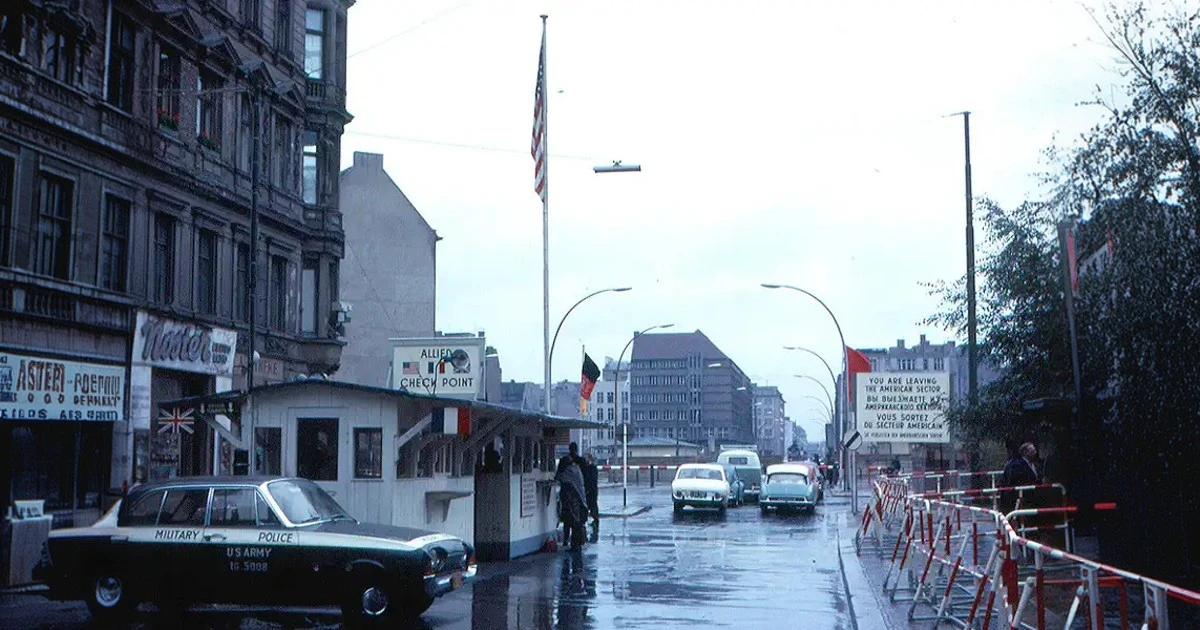
Image Credit - By Roger Wollstadt, Wikimedia Commons
James Bond Movie Stunt Froze The Deadly Stasi
Most spy agencies operate in the shadows, but sometimes bright lights paralyze them. When a movie crew set up cameras at the world’s most dangerous border, the deadliest police force in history froze. They documented every second of the filming but missed the actual threat right under their noses. This movie stunt accidentally exposed the rigid cracks in a totalitarian wall. The agents watched a fictional spy break their strictest laws while they stood by and took notes.
The Camera Crew at the Kill Zone
Dictatorships rely on strict boundaries, yet simple confusion often renders their guards powerless. On August 10, 1982, the Cold War tension at Checkpoint Charlie shifted for a brief, bizarre window. Euronews reports that men from the Stasi recorded 12 vehicles driving to the Friedrichstrasse and Zimmerstrasse border crossing between 07:30 and 08:30. This location had served as a strictly designated crossing for Western powers since 1961. The Stasi files show that East German agents immediately began tracking every movement.
The same report notes that at 08:15, 3 men with 2 cameras pushed a handcart onto Kochstraße and started their work. They set up their equipment in full view of the border guards. The Stasi prided themselves on strictness, and their logs reflect a minute-by-minute obsession with the film crew. They recorded the arrival, the setup, and the locations. The agents treated the camera operators like enemy combatants, yet they did not intervene. People often ask, how close did James Bond get to the Iron Curtain? Roger Moore’s stunt team and the crew filmed directly at the white demarcation line at Checkpoint Charlie, just meters from East German rifles. The fictional world of 007 collided with the gritty reality of a divided Berlin.
Crossing the Line Without Consequence
Rules meant to kill escaping citizens suddenly bend when a luxury car rolls up. During the primary filming window between 09:34 and 11:25, a black Mercedes defied the lethal logic of the border. According to the Stasi document cited by Euronews, a black Mercedes violated the state border 4 times by four to five meters. In any other context, a vehicle breaching the zone by this distance set off alarms, arrests, or gunfire.
The Stasi files document these violations with dry precision. The agents noted the distance and the frequency but took no action. A strange reality emerged where a British spy character could violate East German sovereignty while real refugees faced death for trying the same thing. The narrator of the film later noted that the agent succeeded where many refugees failed. The border crossing occurred without any official consequences. The Stasi stood down. They watched the fictional spy exercise a "license to kill" while their own license to shoot remained holstered.
The Diplomatic Shield
Bureaucracy often values paperwork over actual security. A diplomatic loophole caused the Stasi's inaction. A diplomat had previously explained the situation to the authorities. The files suggest the agency treated the shoot as a classified exception. They labeled the border breach as part of a film shoot. This explanation pacified the guards. They accepted the presence of the "enemy" because a piece of paper told them to. The movie plot involved a nuclear threat and disarmament, mirroring the very real tensions of the Cold War. Yet, the Stasi allowed the West to turn their fortified border into a movie set. The filming concluded at 13:33 with zero effect on official cross-border travel. The Bond files reveal that the dreaded secret police preferred to document the event causing an international incident over a movie star.
The Weight of the Archive
Total surveillance creates so much noise that the watchers eventually drown in their own data. The Stasi functioned as a massive organization founded in 1950 on the Soviet model. Reuters reports that the Stasi had approximately 91,000 full-time staff and a network of around 200,000 informants at the time of the collapse. This created a mountain of paper. Reuters notes that Germany planned to merge 111 kilometers of files collected by the secret police, while the Bundesarchiv specifies that nearly 50 kilometers of material reside specifically in the Berlin archive.
The Stasi files are just a tiny fraction of this collection. The agency hoarded information on everything from film shoots to private bedroom conversations. They believed that knowledge gave them total control. However, the sheer volume of data made it difficult to process everything in real-time. Students of history often wonder, what did the Stasi do with their files? They archived millions of documents in vast warehouses and later tried to destroy them in industrial machines or by hand when the regime fell. The obsession with recording life eventually became a burden that the state could not manage.
Shredding the Evidence
Destroying history requires more effort than making it, especially when machines break down. As the East German regime collapsed, officers rushed to hide their actions. Reuters states that the authority holds 15,000 sacks of shredded files, though the Bundesarchiv records that the material filled a total of 16,000 bags. Initial attempts used industrial shredders, but the volume of paper burned the motors out. Desperate officers switched to tearing the documents by hand to avoid leaving evidence behind.
Recovery teams have spent decades trying to fix this damage. Wired reports that the Fraunhofer Institute earned a contract for a 400-bag pilot project to digitally reconstruct torn sheets, yet the Bundesarchiv notes that the computer-assisted program only reassembled about 91,000 pages from 23 bags. Hand-reconstruction remains slow. Workers have manually pieced together 1.7 million sheets. Somewhere in those 16,000 bags, more details related to the Bond files or similar western observations might still wait for discovery.

Image Credit - By Stasi-Museum, Wikimedia Commons
The Foreign Intelligence Loop
Secrets stolen by one empire often end up sold back to the victim years later. The Stasi watched their own people and spied on the world. The HVA, their foreign intelligence branch, kept detailed records known as the Rosenholz files. These files contained the real identities of spies working abroad. In the chaos of the wall falling, these records did not stay in Germany.
The Guardian reports that the CIA obtained these records and finally returned the cache to Germany in 2003 after long negotiations. These records provide a different perspective than the domestic reports. They show how the Stasi viewed external threats like the British film crew. The files gain more context when viewed alongside these foreign intelligence records. It highlights that the Stasi knew exactly who was crossing their borders, even if they pretended to look the other way.
The Human Cost of Surveillance
Reducing people to paper files turns neighbors into data points and erases their humanity. While the story of Roger Moore crossing the line is amusing, the reality of the Stasi was grim. Modern retrospectives sometimes call the agency a "toothless paper tiger," but museum curators reject this label. They define the Stasi as a "perfidious instrument of repression." The agency used their files to manipulate careers, destroy reputations, and imprison dissidents. Access to these files became a battleground.
Since the Stasi Records Act of 1991, over seven million people have applied to see their files. Many ask, can regular people see their Stasi file? Yes, over seven million people have applied to access their personal records since 1991 to understand how the state spied on them. This transparency revealed uncomfortable truths. A 2007 investigation found that 79 former Stasi members were actually working for the BStU, the agency in charge of the archives. The files are an entertaining historical footnote, but they sit on a shelf surrounded by millions of tragedies.
The Lens of Control
The Stasi believed they could capture reality in a file folder, but they only captured their own paranoia. They watched a fictional spy cross their border and did nothing because their orders constrained them. The James Bond Stasi files prove that even the most rigid systems have blind spots. The camera crew captured a fun movie scene, while the Stasi captured evidence of their own hesitation. In the end, the film unit packed up and left, taking the magic of Hollywood with them. The secret police remained, guarding a wall that would eventually fall, leaving behind only mountains of paper to tell their story.
Recently Added
Categories
- Arts And Humanities
- Blog
- Business And Management
- Criminology
- Education
- Environment And Conservation
- Farming And Animal Care
- Geopolitics
- Lifestyle And Beauty
- Medicine And Science
- Mental Health
- Nutrition And Diet
- Religion And Spirituality
- Social Care And Health
- Sport And Fitness
- Technology
- Uncategorized
- Videos

