Textile Engineering
£199.00
Description
Textile Engineering Diploma Course
The Textile Engineering course brings a modern understanding of fabric science, production methods and advanced industry practices straight to your screen. You learn through a fully online learning experience that fits around your life. You stay in control of your pace, your routine and your goals. You explore every major area of textile production through clear lessons, practical tasks and structured guidance. You also gain a sense of how this fast-moving sector shapes global manufacturing, design and innovation. Many learners choose the Textile Engineering course because they want skills that lead to careers in fabric technology, apparel production, quality control or advanced material innovation. This course gives you that path.
You begin your journey by understanding the foundations of the textile industry. You look at how fibres transformed early craft traditions and eventually shaped global production networks. You see how natural, synthetic and regenerated fibres respond to heat, pressure, moisture and mechanical stress. This helps you understand the behaviour of every fabric you encounter later in the course. Furthermore, you study the characterisation of textile raw materials, and you learn how fibre length, fineness and structural properties influence yarn strength and fabric performance. This early knowledge prepares you for the more technical areas that follow.
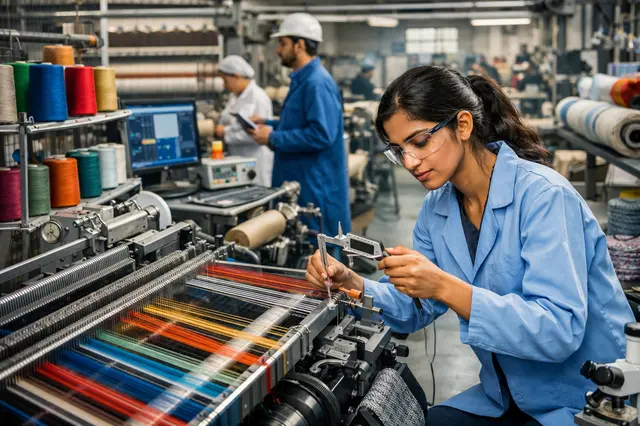
As you progress, you move into the mechanics of yarn formation. You study how twisting, drafting, tension and speed change the properties of yarn. You also learn where modern engineering brings huge efficiency gains. In addition, you explore how ring spinning, rotor spinning and air-jet spinning systems create specific yarn qualities for particular industry needs. These lessons help you see why yarn characteristics matter in fabric construction. The Textile Engineering online course ensures that you can study this material through animations, guided activities and practice questions that check your understanding.
After that, you examine woven fabric production. You learn how looms create structure, stability and design in fabric. You study warp and weft interactions and explore dobby, jacquard and shuttle-less weaving technologies. You understand why the weaving sector demands accurate planning, timing and machine calibration. Then, you look at nonwoven technologies, which play a crucial role in filtration, hygiene products and medical textiles. You explore bonding methods such as thermal, mechanical and chemical processes. Every section explains the logic behind fabric behaviour, which strengthens your technical reasoning skills.
The Textile Engineering Diploma course also guides you into knitting and braiding architectures. Here, you study loop formation, needle mechanisms and fabric elasticity. You explore why many sportswear and medical textiles rely on knitted structures. You also learn how braided materials support cables, ropes and advanced composite applications. Because this is a Textile Engineering online course, you can replay demonstrations as often as you need, allowing you to learn comfortably at your own pace.
Soon after, you approach wet processing and coloration. You gain clear knowledge of preparation, dyeing, printing and finishing. You see how colourfastness, brightness and chemical handling shape quality outcomes. Transitioning from theory to application, you also understand why sustainability matters in every stage, particularly in water management, chemical discharge and energy consumption. Every module connects scientific principles with real industry practices, making your learning experience both relevant and practical.
You then move into apparel manufacturing systems. You follow the journey from pattern development to garment assembly. You learn how workflow, line balancing, cutting technologies and automated systems shape productivity. At the same time, you explore how digital tools reshape modern production spaces. You see how clothing brands rely on product development platforms, real-time communication tools and automated pattern systems. Since the Textile Engineering course focuses on online learning, you gain case studies from global fashion and textile hubs, which helps you understand the broader landscape.
As your confidence grows, you step into the world of technical textiles. This field covers aerospace, defence, automotive, medical, geotextile and protective applications. You explore high-performance fibres, engineered fabric structures and innovative material systems. You learn why modern industries look beyond conventional clothing applications and turn towards functional textiles with engineered properties. The Textile Engineering Diploma course offers examples that show how these innovations evolve and why technical textiles continue to grow as a global market.
Towards the final part of the course, you explore textile testing principles. You study strength, elongation, dimensional stability, abrasion resistance and colourfastness. Each method helps you understand how fabric performance changes with use, strain and environmental exposure. Moreover, you learn how quality management and digitalisation reshape the modern textile workflow. You see how automated systems track production data, reduce errors and improve consistency across manufacturing units. These lessons help you think like an industry-ready professional.
Sustainability and future trends form a key part of the Textile Engineering online course. Here, you study circular design, ethical sourcing, eco-friendly dyes, biodegradable fibres and low-impact manufacturing. You understand how climate goals and consumer expectations push the industry towards greener models. You also explore how recycling technologies, digital sampling and predictive analytics reduce waste and speed up decision-making. This prepares you for a future where innovation and responsibility work together.
Every unit concludes with a multiple-choice examination. This exercise helps you recall the major aspects covered in the unit and ensures that you have not missed anything important in the unit. The results are readily available, which helps you see your mistakes and look at the topic once again. If the result is satisfactory, it gives you a green light to proceed to the next chapter. This system offers a clear sense of progress and keeps you motivated as you move through the course.
What you will learn
1:The Foundations of the Textile Industry
2:Characterisation of Textile Raw Materials
3:Mechanics of Yarn Formation
4:Technology of Woven Fabric Production
5:Nonwoven Fabric Technologies
6:Knitting and Braiding Architectures
7:Wet Processing and Coloration
8:Apparel Manufacturing Systems
9:Advanced Technical Textiles
10:Principles of Textile Testing
11:Quality Management and Digitalization
12:Sustainability and Future Trends

Tutor Support
Course Outcomes
After completing the course, you will receive a diploma certificate and an academic transcript from Elearn college.
Assessment
Each unit concludes with a multiple-choice examination. This exercise will help you recall the major aspects covered in the unit and help you ensure that you have not missed anything important in the unit. The results are readily available, which will help you see your mistakes and look at the topic once again. If the result is satisfactory, it is a green light for you to proceed to the next chapter.
Accreditation
Elearn College is a registered Ed-tech company under the UK Register of Learning( Ref No:10062668). After completing a course, you will be able to download the certificate and the transcript of the course from the website. For the learners who require a hard copy of the certificate and transcript, we will post it for them for an additional charge.