
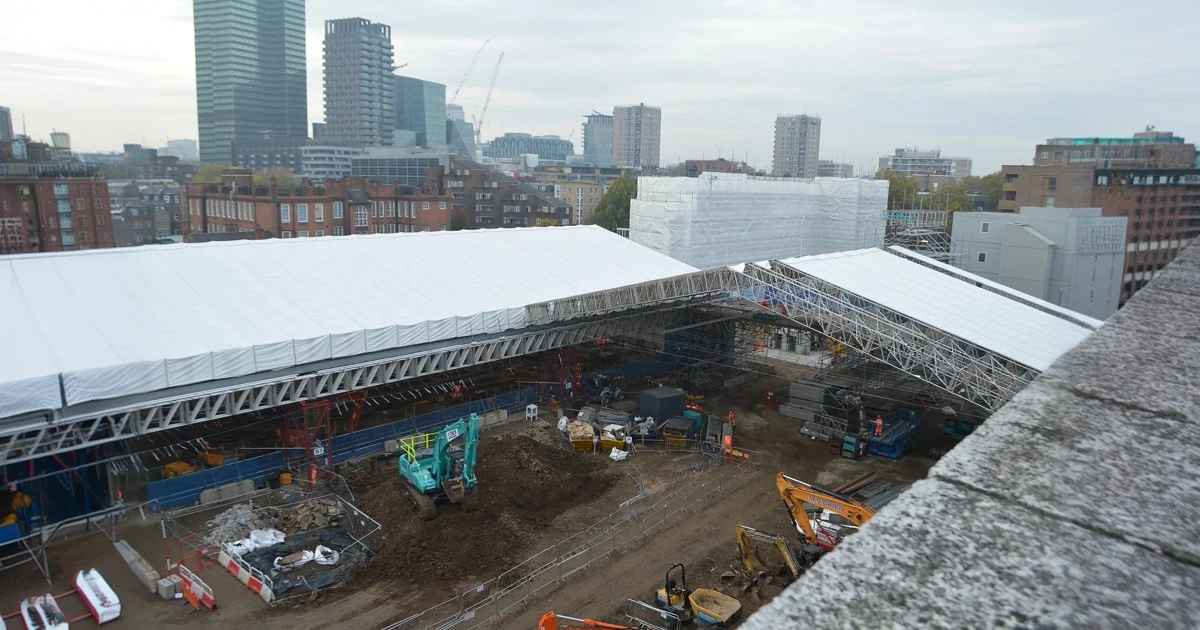
Image Credit - By Matt Brown, Wikimedia Commons
S2 Archaeological Discoveries: 450,000 Secrets
Building a high-speed future requires tearing open the ground that holds the past. When engineers carve a jagged line across a country, they inadvertently perform a massive autopsy on the land itself. This creates a strange situation where the construction of a futuristic railway becomes the largest archaeological dig in a nation's history. The soil does not care about timelines or eras; it simply holds everything that was ever dropped, buried, or lost in that exact spot.
This massive excavation forces a confrontation between modern engineering and ancient life. The HS2 archaeological discoveries reveal that a simple construction project can strip away the grass and expose thousands of years of human activity. It is a cross-section of time. The project does not just move people from London to Birmingham; it moves the modern world face-to-face with the people who walked the same mud centuries ago.
A Cross-Section of Time
Drawing a straight route through a landscape creates a random sample of history that no museum could ever plan. The linear nature of the construction forces archaeologists to look at sites they would never usually touch. This approach provides a snapshot of how life changed across the entire landscape over 10,000 years, rather than just focusing on one famous castle or battleground.
A massive team of 1,000 archaeologists currently works alongside the bulldozers. They have opened up 60 distinct sites and pulled 450,000 artifacts from the dirt. Neil Redfern from the Council for British Archaeology notes that this sheer scale offers a completely new way to understand the land. Instead of looking at a single dot on a map, the team sees the entire web of history. The HS2 archaeological discoveries provide a rare chance to see the full picture of British life, from the Stone Age to the Industrial Revolution.
Touching the Stone Age
Physical objects often bridge the gap between species better than any textbook. When you hold a tool made by another human, you physically connect with their survival. The team found a flint hand axe that dates back more than 40,000 years. This tool did not belong to a modern human; a Neanderthal crafted it.
The stone still fits perfectly into a human palm. Dr Sara Machin, an archaeologist on the team, explains that the ergonomic fit creates an immediate tactile bond with the maker. This was a butchery tool, used to strip meat from bone. How old is the oldest HS2 find? The oldest item is a Neanderthal flint hand axe dating back over 40,000 years. It reminds us that the route of the high-speed train was once a hunting ground for a different kind of human entirely.
The Roman Obsession with Luck
We often assume ancient civilizations were serious and stoic, but their garbage tells a story of superstition and play. People in the Roman era constantly tried to bargain with fate. In a cremation vessel, the team found a fascinating piece of bone with a message carved into it. It was a tag for a gladiator.
The inscription reads, "Lord Victor, may you win and be lucky." This small object suggests that someone, perhaps a fan or the gladiator himself, wanted to ensure victory in the arena. It humanizes them. They worried about winning and losing just as sports fans do today. The sheer volume of HS2 archaeological discoveries allows us to see these personal anxieties. The Romans built roads and walls, but they also carried lucky charms and hoped for the best.
Rail History Beneath the Rails
Innovation often sits directly on top of the very history it tries to replace. In a twist of irony, the site for the new high-speed station in Birmingham sits on the exact location of the world's oldest railway roundhouse. Engineers found the foundations of the Curzon Street roundhouse, built in 1837. This structure serviced locomotives and used a turntable to move trains, a design by the famous Robert Stephenson.
Jon Millward, an advisor for the project, points out the link between the past and future of rail. The new trains will run over the bones of the engines that started it all. Where is the oldest railway roundhouse? The world's oldest roundhouse was found at the Curzon Street site in Birmingham, dating to 1837. This discovery proves that the desire to move things quickly across the country is not a new idea; we are just building faster versions of the same dream.

Image Credit - By Wikimedia Commons
Storms Reveal What Shovels Miss
Careful planning often fails to find what chaotic weather exposes in seconds. While the archaeologists followed a strict schedule, nature decided to help out in Hillingdon. A violent storm caused soil erosion, washing away the dirt that hid a hoard of Iron Age "potin" coins. The green-blue discoloration of the oxidized metal caught the eye of the team immediately.
These coins date back to the 1st Century BC. They feature a head of Apollo on one side and a charging bull on the other, showing the influence of Marseille and French design. Emma Tetlow, a contractor on the site, noted that the identification happens instantly when you see that specific color in the soil. The HS2 archaeological discoveries rely on systematic digging, but sometimes a heavy rainstorm does the best work.
Gold Teeth and Porcelain Pugs
We leave the truest parts of our personalities in the small, odd items we drop or bury. History books focus on wars and laws, but the character of a nation hides in its lost toys and medical equipment. The excavation of a 19th-century church in Stoke Mandeville produced a set of gold dentures. They still have six teeth attached.
These dentures tell a story of wealth and vanity. In another grave near Euston, the team found a porcelain pug figurine. It was buried with an unnamed woman. The white glaze and black details are still sharp. What weird things did HS2 dig up? The team found oddities like gold dentures, a porcelain pug, and an asymmetrical medieval die. These items, along with an Anglo-Saxon spindle whorl made from a cattle femur, show that people have always loved games, pets, and looking good.
The Price of Preservation
Saving the past always burns through the budget for the future. The sheer number of finds creates a logistical nightmare. Every hour spent brushing dirt off a Roman pot is an hour the train line does not get built. Critics like MP Greg Smith argue that the project wastes billions of taxpayer dollars and causes excessive destruction.
There is a tension here. Graham Evans, a historian, argues that building without archaeology would be a tragedy, but the cost is undeniably high. The HS2 archaeological discoveries fill 7,300 boxes in a secret storage warehouse in Yorkshire. The future of these objects remains undecided. They sit in limbo while the government and landowners argue over who owns them. The goal is to donate them to local museums, but for now, they wait in the dark.
The Final Destination
The train line cuts through the earth to save time for travelers, but it has forced the country to take a long pause and look at its history. The 450,000 artifacts sitting in those Yorkshire boxes represent real lives, from the gladiator praying for luck to the woman who loved her porcelain pug.
We build infrastructure to move forward, yet the ground forces us to look back. The HS2 archaeological discoveries prove that you cannot touch the British landscape without disturbing the ghosts of the people who shaped it. The high-speed rail will eventually open, but the most interesting part of the journey might be the things we pulled out of the way to build it.
Recently Added
Categories
- Arts And Humanities
- Blog
- Business And Management
- Criminology
- Education
- Environment And Conservation
- Farming And Animal Care
- Geopolitics
- Lifestyle And Beauty
- Medicine And Science
- Mental Health
- Nutrition And Diet
- Religion And Spirituality
- Social Care And Health
- Sport And Fitness
- Technology
- Uncategorized
- Videos

