
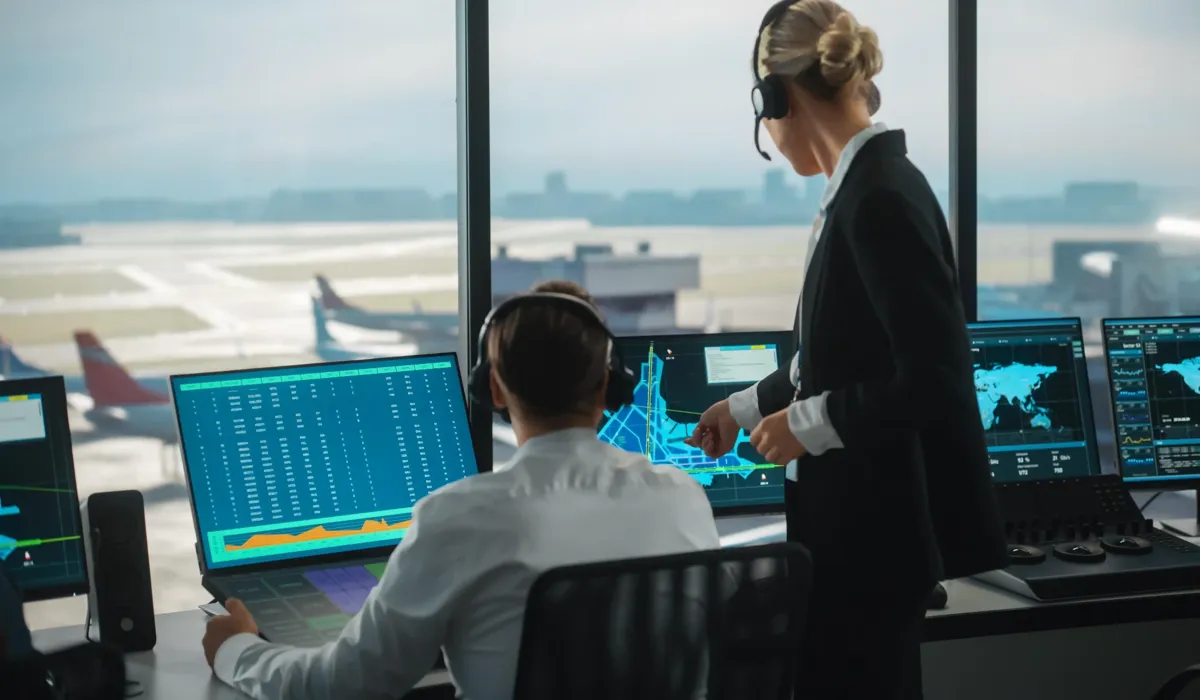
Airport Management And Operations Meet ATC AI
Every traveler knows the frustration of sitting in a plane on the hot tarmac while the pilot says the gate is occupied. You look out the window and see empty space, yet the aircraft does not move. This happens because the person guiding the plane in the sky does not always know exactly what the person loading the bags on the ground is doing. When these two worlds fail to communicate, schedules fall apart, and fuel burns for no reason.
Modern airport management and operations now rely on Artificial Intelligence to bridge this gap. Turning air traffic control into a predictive tool allows hubs to stop reacting to problems and start preventing them. The goal is simple: make sure the ground is ready before the wheels ever touch the dirt. As noted by the FAA, total effectiveness requires every department to share situational awareness of the airport surface at the same time.
The Evolution of Modern Airport Management and Operations
For decades, airport leaders relied on whiteboards, radio calls, and manual spreadsheets to track flights. This worked when skies were quiet, but current traffic makes manual tracking impossible. North America now holds 46.5% of the market share for AI in aviation because old ways cannot keep up. Leaders at Tier-1 hubs now realize that digital upgrades are the only way to survive.
Moving Beyond Legacy Terminal Systems
Traditional systems only look at what is happening right now. If a flight is late, the system marks it as late, but it does nothing to fix the next three flights waiting for that gate. AI-driven systems look ahead by hours or even days. This shift in airport management and operations allows staff to move resources before a bottleneck even forms. Without this change, a single storm in one city can ruin schedules across an entire continent.
The Interconnectivity of Tower and Tarmac
According to Eurocontrol, air traffic control manages the sky, while ground teams manage the gates, and although historically these groups operated in silos, operators and handlers are now working more transparently and collaboratively. Ironically, the tower might land a plane early, only for it to sit for twenty minutes because the ground crew was still on a break. Better connectivity ensures that every touchdown sends a digital alert for the cleaning, fueling, and loading teams. When the tower and tarmac share a brain, the entire airport moves faster.
Improving Air Traffic Control through Predictive Machine Learning
Predictive tools are changing how we view the sky. Instead of just watching dots on a radar, controllers now use algorithms to analyze weather and flight paths. For example, according to NASA, the CDDR air traffic management planning tool at Dallas-Fort Worth saved over 24,000 pounds of jet fuel in just a few months through more accurate runway availability predictions. Research published by NATS on Project Bluebird indicates that these systems advise controllers, helping them make better decisions under pressure in real-world situations.
How does AI improve air traffic control safety? AI enhances safety through the prediction of potential trajectory conflicts and runway incursions before they occur, providing controllers with a necessary multi-second buffer for intervention. This extra time allows humans to focus on difficult decisions while the computer handles the routine math. Systems like NATS Project Bluebird in the UK use 10 million flight records to simulate what-if scenarios, making the sky much safer for everyone.
Synchronizing Ground Handling with Real-Time ATC Data
Ground handling is the pulse of any airport. If the bags don’t move, the plane doesn’t leave. Using real-time data from air traffic control allows ground teams to prepare for a plane’s arrival with total precision. They no longer have to guess when a flight will actually reach the gate. This saves time and reduces the physical stress on employees who often rush to meet unexpected arrivals.
Precision Turnarounds and Gate Management
Platforms like Assaia’s ApronAI use cameras to watch every move on the ground. According to Assaia's Turnaround Report, these systems have helped major airports cut ground delays by 6% between 2023 and 2024. Knowing the exact touchdown time allows crews to be in position the moment the engines cut. The report also notes that a four percent decrease in turnaround time can add up to millions of dollars in savings over a single year. Assaia's 2024 Turnaround Benchmark Report analysis further suggests that gate productivity improves from four turns a day to five, representing up to a 25% increase, essentially creating more space without building new gates.
Reducing Apron Congestion via Intelligent Tug Routing
Moving a massive aircraft on the ground is a slow, dangerous process. Intelligent routing helps tug drivers find the fastest, safest path to the runway. What is the role of ground handling in airport effectiveness? As outlined by Eurocontrol, effective ground handling focuses on pre-departure processes to ensure that the last mile of a flight, from the runway to the gate, is as fast and safe as the flight itself, preventing domino-effect delays. Coordinating tugs and fuel trucks through AI helps airports avoid the traffic jams that often happen near busy terminals.
Data-Driven Airport Management and Operations Strategies

Data is the new fuel for modern aviation hubs. Analyzing every second of a flight’s route helps managers find tiny errors that cause big delays. According to a report by Fortune Business Insights, using management and operations software to track these details reflects a shift toward intelligent, passenger-centric operations that reveal where the system is failing. Sometimes, a slow refueling truck or a missing baggage handler causes a delay rather than a storm.
Solving Unseen Delay Factors
Small delays often exist in plain sight. A three-minute lag in refueling doesn't seem like much, but it can push a flight out of its departure slot. Can artificial intelligence reduce flight delays in airport management? Yes, according to IATA, real-time data sharing and collaborative decision-making allow systems to identify and resolve logistical friction points, helping hubs better anticipate and respond to potential disruptions while recovering lost minutes that typically accumulate into significant departure delays. Fixing these micro-delays allows an airport to keep its entire schedule on track.
Enhancing Sustainability via Optimized Taxiing Patterns
Aviation faces massive pressure to go green. Research published in an academic study notes that one of the best ways to achieve this is through strategic management of surface traffic flows, which stops planes from idling on the taxiway, thereby reducing emissions and optimizing capacity. When air traffic control uses AI to sequence departures, planes spend less time with their engines running while waiting to take off. This simple change has a massive effect on the environment and the bottom line.
Fuel Conservation through Smarter Sequencing
According to NASA, testing of the ATD-2 project at Charlotte-Douglas International Airport provides a perfect example. The agency also notes that participating airlines saved more than 1.1 million gallons of fuel over this period. Metering the traffic kept planes at the gate with their engines off until a clear path to the runway was ready. This saved over 6,000 hours of engine run time. It proves that better scheduling is one of the fastest ways to reduce carbon emissions.
The Environmental ROI of Operational Effectiveness
Effectiveness reduces waste rather than focusing purely on speed. Better airport management and operations lead to a lower carbon footprint for both the airline and the city. The ATD-2 project alone prevented as much CO2 as 170,000 trees can capture. When operations are tight, everyone wins. Airports save money, airlines save fuel, and the planet gets a break from unnecessary pollution.
The Economic Effect of Intelligent Flight Sequencing
Money follows effectiveness in aviation. For an airport handling 25 million passengers, saving just five minutes on a turnaround can generate $11 million in new annual revenue. These numbers are too big to ignore. Intelligent flight sequencing allows airports to do more with the tools they already have.
Maximizing Runway Throughput
Runways are the most valuable real estate in aviation. If a runway sits empty for sixty seconds, that is a lost opportunity. AI manages the gaps between landings and takeoffs with more precision than any human could. This allows more flights to land every hour without compromising safety. As the automated systems market grows toward 67.6% of the total revenue, runway throughput will be the primary metric for success.
Reducing Labor Waste in Ground Logistics
Labor is a huge expense for any ground handling company. When schedules are unpredictable, workers spend hours sitting around waiting for planes to arrive. Predictive scheduling ensures that crews are only on the clock when there is work to be done. This reduces labor waste and ensures that staff are not burned out by sudden bursts of chaotic activity. It makes the job more sustainable for the people doing the heavy lifting.
Implementing AI Without Disrupting Live Operations
You cannot shut down an airport to install new software. Implementation must happen while thousands of people are moving through the terminal. This is why most airports use a shadow approach to testing new technology. They run the AI in the background to see what it would recommend before they give it any real power.
The Shadow Mode Deployment Strategy
In shadow mode, the AI watches live traffic and makes ghost decisions. Managers then compare these decisions to what actually happened. This builds trust in the system. Project Bluebird used this methodology to ensure that its AI could handle the heavy traffic of UK airspace. It allows for a smooth software rollout where the risk to daily airport management and operations is almost zero.
Training the Human Element for AI Collaboration
Technology is only as good as the people using it. AI is a tool designed to assist air traffic control experts rather than replace them. Training programs now focus on how humans and computers can work together. NATS is even using digital twin technology to recruit and train the next generation of controllers. Focusing on collaboration ensures that airport staff feel empowered by the new technology rather than threatened by it.
The Future of Smarter Skies
The future of travel depends on how well we manage the space between the gate and the clouds. Combining air traffic control data with ground handling logistics helps eliminate the dead time that plagues modern travel. This integration creates a smoother experience for passengers and a more profitable model for airlines. Success in modern airport management and operations requires a commitment to these smart tools. As global travel continues to grow, only the airports that embrace predictive technology will be able to handle the pressure. The days of manual scheduling are over, and the time of the intelligent airport has officially arrived.
Recently Added
Categories
- Arts And Humanities
- Blog
- Business And Management
- Criminology
- Education
- Environment And Conservation
- Farming And Animal Care
- Geopolitics
- Lifestyle And Beauty
- Medicine And Science
- Mental Health
- Nutrition And Diet
- Religion And Spirituality
- Social Care And Health
- Sport And Fitness
- Technology
- Uncategorized
- Videos

