
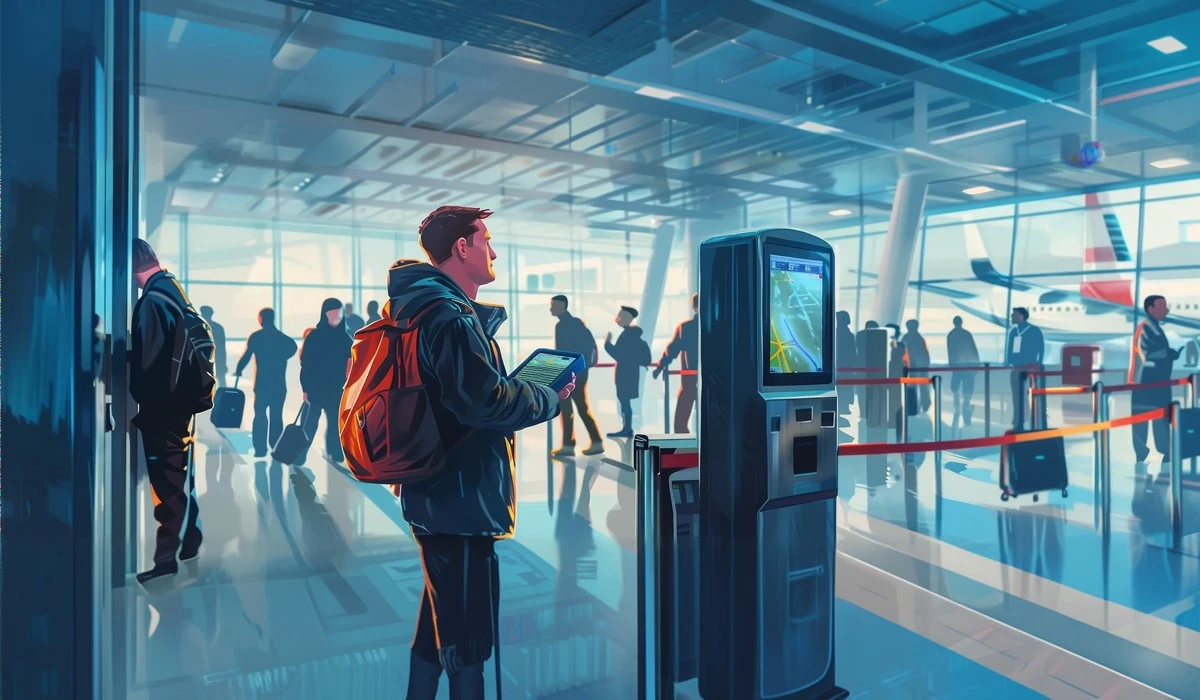
Aviation Security: The End Of Static Checkpoints
We all feel that familiar sink in our stomachs when walking into a terminal and seeing a line snaking back and forth a dozen times. Millions of us endure this bottleneck every single day, waiting to empty our pockets and strip off our shoes. A 2025 International Civil Aviation Organization report states that global passenger traffic topped 4.5 billion last year, causing manual airport screening to hit a physical wall.
The Transportation Security Administration notes that 55,000 officers protect over two million travelers daily across more than 430 federalized airports using thousands of aging machines. You probably stand in these queues assuming the delay comes from strict safety measures. The reality is far more practical: human eyes take time to process detailed images on a screen. Today, artificial intelligence changes aviation security from a slow, rule-based chore into a fast, data-driven operation. Reading baggage scans instantly allows this technology to speed up the queue while vastly improving threat detection.
The Evolution of Aviation Security: From Manual Checks to Smart Algorithms
Traditional checkpoint scanners created massive delays because they relied completely on vertical scanning beams. Older two-dimensional machines beamed X-rays straight down through your carry-on luggage. This top-down view created dangerous blind spots on the monitor. A sharp knife lying perfectly on its flat edge could look exactly like a thin, harmless piece of wire to the human eye. Security administrators historically tracked how long human operators spent looking at each individual bag. Whenever a human screener took more than six seconds to manually analyze a single piece of luggage, the entire checkpoint line experienced a severe logistical bottleneck. Officers had to squint, guess, and frequently open bags by hand to verify confusing shapes. This incredibly slow, precise process forced travelers to arrive hours early just to navigate the resulting traffic jams at the terminal entrance.
Enter Artificial Intelligence
To solve these constant delays, the TSA launched the Checkpoint Property Screening System program. They designed this initiative specifically to replace those aging two-dimensional X-ray machines with next-generation smart algorithms. As travelers notice new scanners popping up at their local terminals, many naturally wonder, how does AI improve airport security? Simply put, AI analyzes baggage scans in milliseconds to instantly flag prohibited items, drastically reducing human error and speeding up the line. This allows security personnel to spend less time staring at screens and more time resolving actual flagged issues. Instead of agonizing over confusing gray shapes, officers receive clear digital alerts the moment a restricted item enters the tunnel. The software cuts the required analysis time down to a fraction of a second, letting passengers collect their belongings and head to their gates faster.
How AI-Powered Threat Detection is Redefining Aviation Security
According to a Transportation Security Administration fact sheet, modern medical-grade Computed Tomography systems create three-dimensional volumetric images of every piece of luggage. This technology allows operators to digitally rotate high-definition baggage images three hundred and sixty degrees to spot concealed weapons or novel liquid explosives. Programmers train deep-learning computer vision models aggressively on vast datasets containing over three million images of various everyday items. Because modern CT scanners provide such detailed, layered images of our bags, travelers frequently ask, can AI detect weapons in luggage? Yes, AI algorithms process millions of images to instantly recognize the distinct shapes, densities, and material compositions of firearms, explosives, and other banned items. Highly precise threat detection ensures officers catch dangerous items immediately without bringing the entire queue to a halt. Officers confidently identify concealed dangers from any angle while keeping the conveyor belts moving smoothly.
Slashing the False Alarm Rate
Older airport screening technologies routinely caused false alarms whenever they encountered thick, harmless items. A dense block of cheese or a large stack of books frequently caused machines to alert operators, forcing them to manually dig through the luggage. Machine learning algorithms drastically lower these frustrating false alarm rates. Advanced surveillance systems utilizing smart filtering currently see up to eighty percent fewer false positives compared to traditional motion-detection equipment. Innovative vision-language models combine sophisticated image understanding with text-based descriptions to accurately classify anomalies. Instead of blindly activating a loud alarm over a chocolate bar, the software actively contextualizes the X-ray data and dismisses the harmless object immediately. This dramatic reduction in unnecessary bag searches directly translates into a much faster checkpoint experience. Passengers grab their bags quickly, and officers focus only on legitimate safety concerns.
The Seamless Passenger Experience: Reclaiming Time at the Checkpoint
The immediate benefit of these intelligent systems falls directly onto the weary traveler. A Reuters report on Heathrow Airport and the Transportation Security Administration note that airport screening technology moves rapidly toward advanced automation and 3-D imaging to reduce physical bag checks. The Reuters report additionally indicates that because smart CT scanners automatically calculate material densities as your bag passes through the tunnel, administrators increasingly exempt travelers from the frustrating divestment bottleneck of removing liquids, laptops, and large electronics from their carry-on bags.
Passengers simply place their backpack in the bin and walk through the metal detector. Furthermore, the introduction of ‘Image on Alarm’ protocols means perfectly clean bags bypass human monitors entirely. The software displays images to Transportation Security Officers only when the system identifies a suspected problem. If a bag contains nothing dangerous, it rolls right out without any human screener ever glancing at its contents. This targeted approach prevents unnecessary conveyor belt stoppages and reclaims valuable minutes for every single passenger waiting in line.

Biometrics and Frictionless Identity Verification
Artificial intelligence reaches far beyond the baggage scanning hardware to streamline passenger verification. Frictionless identity verification scales rapidly across the country, permanently changing how you prove who you are. According to the Transportation Security Administration and Reuters, over two hundred and fifty major airports currently utilize biometric facial comparison technology at check-in desks, bag drops, and security podiums. Instead of an officer carefully comparing your physical face to an old passport photo, a high-resolution camera instantly matches your features digitally. This process shaves valuable seconds off every single passenger's interaction at the front podium. When you multiply those saved seconds by thousands of travelers per hour, the overall wait time drops dramatically. You spend less time fumbling for your physical identification documents, and the officers move the crowd forward at a consistent, optimized pace that prevents sudden traffic jams near the scanning lanes.
Overcoming the Limitations of Human Attention
Staring at cluttered, overlapping shapes on a monitor for hours naturally induces intense cognitive exhaustion. Security professionals call this intense cognitive exhaustion screen fatigue, and it creates a serious vulnerability at the checkpoint. This mental drain occasionally allows non-metallic explosives, advanced plastics, and dense ceramics to bypass traditional Walk-Through Metal Detectors unnoticed. Without smart software assisting them, nonstop manual monitoring severely degrades human focus over long shifts. Aviation security administrators historically solved this problem through heavy rotation of their agents every thirty minutes just to maintain acceptable threat detection metrics. Constant rotation disrupts the workflow and briefly stalls the conveyor belts while teams swap positions. Human attention spans simply cannot handle the endless barrage of gray, overlapping visuals without taking frequent breaks. Resolving this deep mental strain required a technological upgrade to help screeners maintain perfect vigilance all day.
AI as the Ultimate Co-Pilot
Accessible Property Screening software acts as a highly reliable digital co-pilot during the airport screening process. It superimposes brightly colored, three-dimensional bounding boxes directly over suspected prohibited items on the agent's high-resolution monitor. Because automation takes over the heavy lifting of image analysis, a common concern is will AI replace airport security guards? Developers design AI specifically to assist human officers and highlight anomalies on a screen, ensuring that highly-trained experts make the final, targeted decisions. This collaborative approach guarantees that the aviation security process remains rigorous, empathetic, and human-led. The computer instantly flags the dangerous object, and the officer uses their extensive training to safely resolve the situation. This powerful partnership eliminates second-guessing, reduces stress, and allows security teams to confidently process thousands of weary travelers at maximum speed every shift.
Predictive Analytics: Stopping Threats Before the Airport
Modern threat detection begins long before you even drop your bags onto the conveyor belt. Advanced AI surveillance platforms utilize behavior-based analytics to secure the entire facility. These systems monitor live camera feeds to quickly flag unusual activities like excessive loitering, wrong-way escalator movement, or unattended stationary baggage via real-time multi-sensor correlation. Furthermore, advanced sensor-fusion platforms actively cross-validate interior terminal camera data with exterior perimeter fence sensors. This comprehensive approach achieves near-zero missed intrusions along the vulnerable tarmac areas. If an unauthorized individual attempts to breach a restricted zone, the software instantly dispatches physical guards to intercept them. Security teams resolve these external anomalies immediately, ensuring that the main passenger areas remain safe and uninterrupted. Neutralizing potential risks at the perimeter allows administrators to prevent massive terminal evacuations and keep the boarding processes running completely on schedule.
Smart Resource Allocation
Artificial intelligence also functions as a primary scheduling tool for busy administrators. Smart predictive analytics analyze years of historical flight and checkpoint data to forecast massive passenger traffic peaks. With this information, managers proactively adjust gate assignments and staffing levels long before the crowds actually arrive. A recent discrete event simulation and optimization study demonstrated the incredible value of this foresight. The research proved that proactively allocating security officers right before an AI-predicted passenger surge reduces the maximum passenger waiting time per hour by thirty-three percent. People spend less time standing motionless in a crowded hall because the airport already knew they were coming. Supervisors open extra lanes and position their best agents exactly where the demand dictates. This flexible resource allocation keeps everyone moving smoothly, turning a chaotic holiday rush into a totally manageable operational flow.
Privacy and Ethics: Balancing Safety with Passenger Rights
Deploying widespread cameras and facial verification naturally raises valid concerns regarding personal privacy. Aviation security leaders take these worries seriously and implement extremely strict data protection protocols. To align seamlessly with strict FAA, TSA, and GDPR mandates, modern smart surveillance systems analyze crowd density and movement patterns without actively storing any biometric identifiers. The software registers you as a generic, moving shape to count the length of a line, but it instantly discards your specific facial data after completing the check. The Transportation Security Administration confirms that your personal information securely verifies your identity at the podium and then immediately deletes from the local cache without ever serving surveillance purposes. Security administrators focus entirely on maintaining physical safety and refuse to build permanent databases of traveler movements. This ethical approach ensures that your legal rights remain fully protected while you benefit from the tremendous speed of modern automated processing.
Addressing Algorithmic Bias
Developers also actively work to eliminate algorithmic bias from automated screening tools. They train advanced deep-learning models on highly diverse datasets to ensure the software never inadvertently profiles specific passenger demographics. To protect anatomical privacy and completely eliminate profiling bias, modern body scanners utilize sophisticated millimeter-wave Automated Target Recognition. This technology uses a specific Coordinate Transform Function to project potential threat locations onto a completely generic, gender-neutral representative human figure on the monitor. The officer viewing the screen never sees the actual physical outline of your body. They only see a cartoon-like avatar with a colored box indicating where you might have forgotten a set of keys in your pocket. This standardized display method successfully balances rigorous threat detection with total passenger dignity, creating an entirely neutral and fair environment for every single person traveling.
The Future Roadmap for Smart Airport Checkpoints
Looking five to ten years ahead, aviation security plans to completely eliminate the requirement to stop and stand still. Future "screening in motion" technologies will aggressively replace those static podiums with expansive walk-through corridors utilizing multistatic millimeter-wave transmitters and receivers. Instead of pausing inside a loud machine, you simply walk down a brightly lit hallway carrying your bags. These futuristic walk-through systems utilize a specialized RGB-D video sensor to actively track the natural motion of walking subjects. This tracking creates an inverse synthetic aperture that completely eliminates the need for aggressive mechanical scanning. Passengers experience flawless threat detection without ever breaking their stride. The technology seamlessly clears passengers while they walk toward their gate. This zero-stop approach represents the ultimate goal for travel convenience, blending maximum physical safety with a completely frictionless passenger experience.
Active Learning Networks
The true power of tomorrow's airport screening relies entirely on networked, adaptive machine learning. Future aviation security systems will connect globally through incredibly secure cloud infrastructures. If officers find an anomalous zero-day attack vector concealed in a bag at an airport in London, the main algorithms instantly update. They then distribute the brand-new threat profile to interconnected systems in New York within minutes, completely removing the need for slow manual patches. Terminals utilize phased upgrade paths, allowing IT teams to install modular, cloud-based software updates constantly without replacing massive fleets of physical hardware. The scanners effectively get smarter every single day as they learn from every bag scanned worldwide. A localized physical threat immediately hardens the digital defenses of the entire global travel network, ensuring that dangerous items never slip through the cracks twice during travel surges.
The Next Age of Aviation Security
We no longer have to view the checkpoint as a massive, frustrating hurdle at the beginning of our vacations. The days of standing frozen in endless lines while officers manually dig through overloaded backpacks officially belong to the past. Implementing three-dimensional volumetric analysis, frictionless biometric processing, and predictive resource allocation allows modern aviation security to successfully bridge the massive gap between stringent safety requirements and everyday passenger convenience. Smart algorithms shoulder the exhausting cognitive burden, allowing highly trained human experts to make precise, empathetic decisions. The technology works tirelessly to keep the conveyor belts moving while catching dangers with unmatched accuracy. Ultimately, the future of air travel delivers a significantly faster, entirely seamless experience that respects your time. You walk directly to your gate feeling relaxed, knowing an incredibly advanced digital shield protects your flight.
Recently Added
Categories
- Arts And Humanities
- Blog
- Business And Management
- Criminology
- Education
- Environment And Conservation
- Farming And Animal Care
- Geopolitics
- Lifestyle And Beauty
- Medicine And Science
- Mental Health
- Nutrition And Diet
- Religion And Spirituality
- Social Care And Health
- Sport And Fitness
- Technology
- Uncategorized
- Videos

