
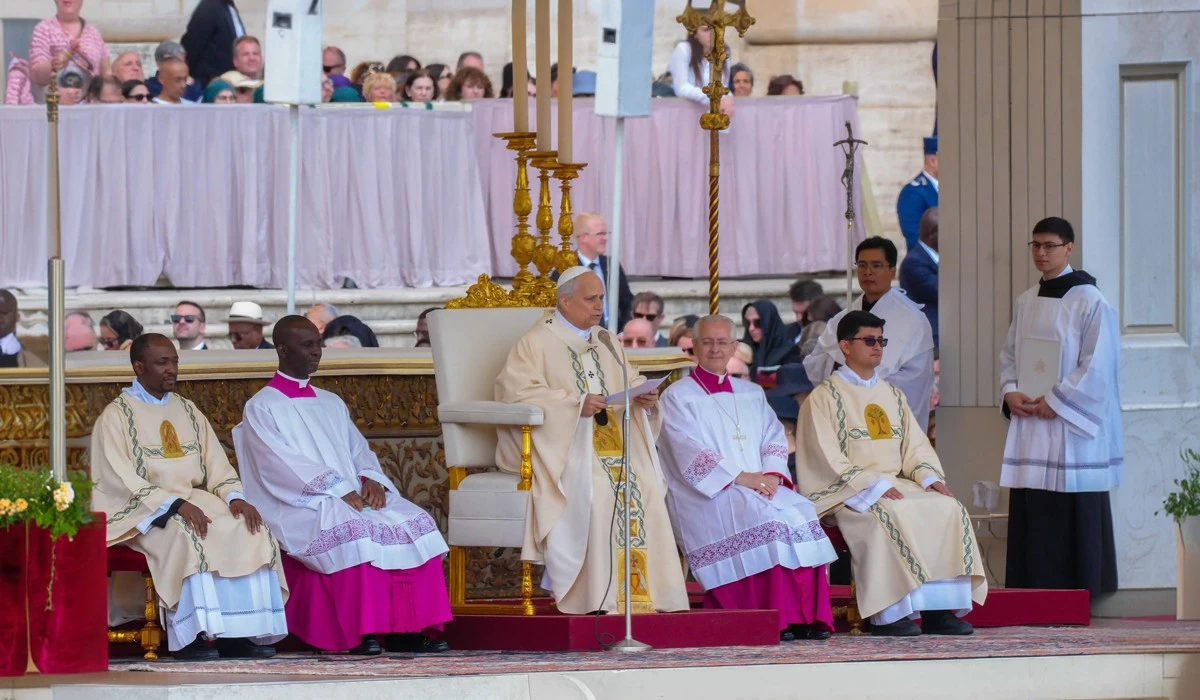
How Pope Leo XIV’s Africa Tour Shifts Power
Pope Leo XIV just landed in Algeria with 25 speeches planned, five languages to speak, and 11,185 miles to cover in just over a week. That alone tells you this is not a routine pastoral visit. The Africa tour spans four nations, cuts through active war zones, and places the pontiff face-to-face with authoritarian leaders his own words have condemned. Cardinal Robert Prevost took the name Leo XIV last May and became the first U.S. pope in history. He is no stranger to this continent.
According to Vatican News, he served as a priest in Kenya, Tanzania and Algeria, which gives him real ground-level experience here. But his personal history is only part of the story. Reuters confirms this is the 24th papal visit to Africa since the late 1960s. The frequency is not accidental. The Africa tour is the Vatican acting on cold, hard numbers, and those numbers are pointing south.
Shifting Demographics Drive the Africa Tour
Africa now holds 288 million Catholics. That figure represents more than 20% of the global Catholic total, based on 2024 data, and it keeps rising. In 2023 alone, the continent recorded 8.3 million new baptisms. No other region comes close to that pace.
Why Is The Catholic Church Growing So Fast In Africa?
The continent has high birth rates, strong cultural ties to spirituality, and active community-based pastoral outreach. That combination accelerates growth in a way that stagnant Western congregations simply cannot match. The surge in new worshippers has also produced a surge in new clergy. Data from a Vatican press bulletin shows Angola currently supports 2,366 major seminarians and Cameroon 2,218. Cardinal Michael Czerny has publicly called the tour a deliberate shift of the international gaze toward African realities. A Vatican official went further, stating outright that the Church must redirect its global focus toward the African continent. African Catholic demographic growth now sets the pace for the entire worldwide Church. The Vatican is not visiting Africa out of goodwill alone. It is following its own membership.
Strategic Diplomacy in an Islamic Stronghold
Algeria was the first stop, and it was the most unexpected one. Reuters notes the country has fewer than 10,000 Catholics inside a nation of 48 million mostly Sunni Muslims. Yet this stop carries more strategic weight than almost any other on the itinerary. The pontiff kicked off his Monday schedule in Algiers with a major speech directed at political leaders. The visit marks the first time a pope has set foot in Algeria. The theological roots run deep here.
Algeria is the birthplace of St. Augustine, the figure at the foundation of Leo XIV's own theological order. At the Basilica of Our Lady of Africa, an inscription calls for mutual spiritual intercession for both Christians and Muslims alike. Cardinal Jean-Paul Vesco sees the trip as a living link between Christian and Islamic worlds, describing it as a reflection of the country's deep national heritage. The pontiff used that shared history to push for peaceful coexistence in a region divided along sharp religious lines. This was not a visit to the Catholic base. This was a geopolitical handshake dressed in vestments.
Navigating Unspoken Historical Scars in Algeria
Not every wound the Vatican hoped to address was allowed to surface. The Algerian government drew firm lines around what the Pope could and could not do on its soil. The Vatican requested a visit to the Tibhirine monastery in Médéa to honor seven French Trappist monks who were assassinated there in 1996. The government refused. Officials cited deep historical trauma as their reason, unwilling to let an international visit reopen what they consider buried pain.
The El Moudjahid daily newspaper reinforced that position with language about a total national refusal to exhume a painful past. The Associated Press records that Algeria's 1990s civil war, known as the "black decade," killed 250,000 people. That history sits just beneath every diplomatic exchange during this leg of the tour. The Pope arrived carrying a message of hope and peace, but the Algerian state made clear that certain chapters of the past would stay closed. He had to speak about the future without touching the violence that shaped it.
A Harsh Warning Against Global Dominance
Hours after a direct attack by U.S. President Donald Trump, Pope Leo XIV used his African stage to condemn neocolonial world powers for violating international law. Reuters reported the timing. He did not soften the language. He directly denounced modern neocolonialism and called out the aggressive behavior of dominating global powers.
How Does The Pope View Modern Neocolonialism?
He sees it as a destructive practice where foreign powers extract local resources while ignoring the welfare of the people who live there. He stressed that Africans are already fully aware of what that looks like in practice. His words landed during a period of sharp international tension. He had previously criticized Donald Trump over military threats toward Iran, and a U.S.-Israeli conflict in Iran was actively ongoing during the tour. Despite all of this, the Vatican requested no additional security for the trip. The Pope framed the entire journey as a symbol of the global desire for peace, even as he delivered pointed criticism of the powers most responsible for disrupting it.
Walking Into the Cameroon Anglophone Conflict
The Cameroon Anglophone conflict has killed 6,000 people and displaced more than 500,000. Catholics make up 29% of Cameroon's population, which puts the Church directly inside the crisis. Pope Leo’s tour does not route around this. It walks straight into it. The itinerary includes a Mass for peace at Bamenda airport. Supporting sources describe the same site as a "peace meeting" and place a separate Mass for 600,000 attendees in the coastal city of Douala. Minor contradictions in source reporting aside, local expectations are enormous.
Father Peter Claver Kogh anticipates a renewed desire for communal harmony among his people. Citizen Ernestine Afanwi holds a firm belief that the papal presence will bring divine resolution to the conflict. She has even requested land sanctification from the pontiff directly. Simon Pierre Ngombo sees the visit as a driver of emotional connection and spiritual strength for his community. These are not ceremonial expectations. People living inside an active conflict are asking the Pope to help end it.
Image Credit - by lafiguradelpadre Congreso, CC BY 2.0, via Wikimedia Commons
The Vatican's Internal Battle for Control
Rapid growth in any institution creates friction from within, and the Catholic Church in Africa is no different. The Vatican is managing serious internal divisions as its African membership expands. The Associated Press describes what it calls "son of the soil syndrome," a conflict where local ethnic groups demand that the Vatican appoint bishops only from their own tribes or regions. The Church counters this with the concept of a "son of the church," a universal identity that overrides tribal allegiance. The tension between the two has become one of the Pope Leo XIV Africa tour's quieter challenges.
Doctrinal conflict adds another layer. The Church holds firm on traditional marriage rules, and the Holy See recently published a doctrinal document on the value of monogamy, along with a dedicated study group on the issue. Local cultures in parts of Africa maintain ancestral practices that push against those rules. The Vatican wants a unified global Church. What it has instead is a rapidly expanding one, full of communities that do not always share the same cultural starting point. The Pope must project unity while managing disagreement that does not yet have an easy resolution.
Confronting Authoritarian Realities on the Pope Leo XIV Africa Tour
The final legs of the tour put the Pope in two very different situations. In Angola, officials expect 200,000 people to attend the papal Mass. The crowd size alone will produce a striking image of Catholic faith anchored in the global south. Equatorial Guinea is the harder stop. President Teodoro Obiang Nguema Mbasogo has held power there without interruption since 1979. International observers accuse his government of severe authoritarianism, corruption, and environmental exploitation. The Pope’s Africa tour requires him to meet this leader directly, even as his own speeches condemn exactly that kind of governance.
The logistics of the trip tell their own story. Main reports cite an 11-day journey covering 18,000 kilometers across 11 cities and 18 flights. Supporting sources suggest a 10-day timeline covering 17,700 kilometers. Some accounts have described this as his "only one big overseas trip," but supporting records confirm prior papal visits to Turkey, Lebanon, and Monaco. Minor inconsistencies in reporting aside, this remains Leo XIV's most demanding trip to date. He must deliver speeches in Italian, English, French, Portuguese, and Spanish across nations with sharply different political climates and histories.
The Future Belongs to the South
The Vatican is not predicting where the Church is heading. It is responding to where it already is. The Pope’s Africa tour is a strategic deployment of institutional weight toward the continent now driving Catholic growth. From Algeria's carefully managed borders to Cameroon's active conflict zones, every stop on this tour carries friction. He speaks of peace in countries living with war. He criticizes exploitation while sitting across from leaders who practice it. He pushes universal Church unity while local ethnic rivalries pull against it. The African Catholic demographic growth that makes this tour necessary also makes it complicated. The global power center of the Catholic Church has shifted. Africa now sets the direction for the entire faith, and the tour is the clearest proof of that.
Recently Added
Categories
- Arts And Humanities
- Blog
- Business And Management
- Criminology
- Education
- Environment And Conservation
- Farming And Animal Care
- Geopolitics
- Lifestyle And Beauty
- Medicine And Science
- Mental Health
- Nutrition And Diet
- Religion And Spirituality
- Social Care And Health
- Sport And Fitness
- Technology
- Uncategorized
- Videos

