
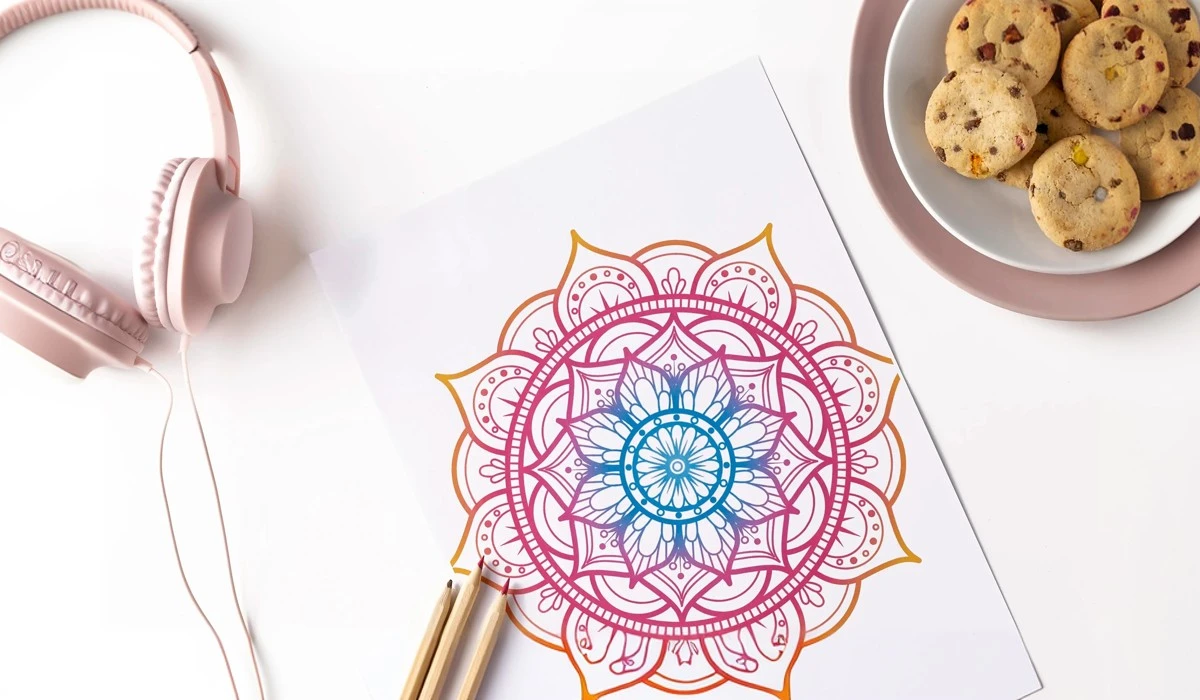
A Peaceful Mind Achieved Through Mandala Art
Staring at a blank wall after an exhausting day rarely calms a racing mind. Sitting still often makes physical anxiety worse. Humans require a physical anchor to pull their thoughts away from daily problems. Putting pen to paper gives your brain a specific, demanding task to focus on. Creating mandala art offers a highly accessible and scientifically backed way to quiet your nervous system.
The word translates as circle in ancient Sanskrit. People have utilized this spiritual map representing cosmic order since the Hindu Rigveda appeared around 1500 BCE. Even 12th-century Christian mystic Hildegard von Bingen created illuminated circular drawings to process her intense emotional states.
According to a 2016 quasi-experimental study published in Art Therapy, creating visual art has a measurable effect on the cortisol levels of healthy adults. Researcher Girija Kaimal observed that 45 minutes of active art-making resulted in lower cortisol levels for 75 percent of participants. The researchers further noted that previous experience with art did not correlate with these physiological benefits, meaning you do not need any prior background to achieve these results.
The Psychology Behind Why Mandala Art Calms the Mind
Rhythmic drawing physically alters your brain activity. When you stress over work or daily obligations, your brain operates on Beta waves. These waves range from 14 to 30 Hz and keep your mind in a state of high alert.
Drawing detailed mandala art shifts your electroencephalogram activity directly into Alpha waves. Alpha waves hum between 8 and 13 Hz. This specific frequency promotes a relaxed and highly lucid focus.
Shifting from Active Worry to Passive Flow
Swiss psychiatrist Carl Jung introduced these circular designs to Western psychology in 1916. As documented by the Jungian Times, he sketched a mandala every morning in a notebook to reflect his inner situation at the time. Jung described the mandala as the psychological expression of the totality of the self, according to various records of his work.
Scientific descriptions of the motor homunculus, such as those published in the Journal of Comparative Neurology, illustrate that the hands occupy a massive portion of the motor cortex. Engaging in highly detailed fine-motor drawing heavily stimulates this area. This intense motor activity may help manage emotional processing in the amygdala, which, as the Cleveland Clinic explains, is the brain region responsible for fear and anxiety.
You might be wondering, Why do mandalas make you feel relaxed? Research published in the Journal of the American Art Therapy Association indicates that the act of making art results in a statistically significant reduction in cortisol levels. This suggests that drawing repetitive circular patterns can help lower stress hormones and slow your breathing, putting your brain into a soothing, trance-like state. You anchor your mind entirely in the present moment, leaving zero bandwidth for anxious rumination.
How Geometric Drawing Provides Comforting Structure
Math and shapes create a significant sense of safety for an overwhelmed mind. As reported in Scientific Reports, adults are able to detect and process symmetrical visual displays more quickly and accurately than asymmetrical ones.
This massive reduction in cognitive load causes an immediate release of dopamine. You feel an instant sense of relief when you look at balanced proportions.
The Brain’s Innate Craving for Symmetry
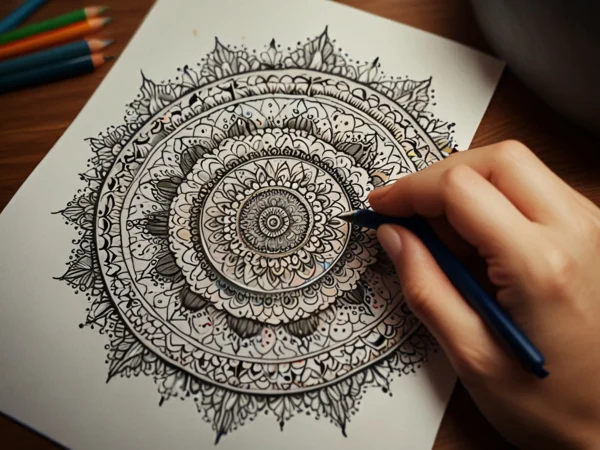
Your brain intuitively understands strict mathematical rules. Engaging in geometric drawing gives your mind a deeply satisfying sense of order. This structural order directly counters the chaos of your daily life.
Nature uses these exact mathematical rules to build comforting environments. Research regarding plant biology in Heliyon notes that leaves are often arranged in patterns of Fibonacci phyllotaxis. Many circular drawings follow these same mathematical sequences, which move in a 1, 1, 2, 3, 5, 8 pattern as layers expand. This expansion perfectly mimics the way leaves arrange themselves on a plant stem.
Predictability as an Anxiety Antidote
Staring at a blank canvas causes heavy decision fatigue. Following a strict grid eliminates these macro-compositional choices entirely. You map out a standard 12-section grid divided by 30-degree angles to guide your hand.
You always know exactly where the next line goes. This predictability bypasses your prefrontal cortex. You achieve a deeply soothing automaticity as you trace the defined paths.
Moving from Idle Doodling to Meditative Art
Scratching random ink on a notepad differs greatly from creating with clear intention. Purposeful mandala art bridges the gap between basic creativity and total mindfulness. Assigning meaning to your movements allows you to take control of your attention span.
Setting a Grounding Intention
True meditative drawing relies heavily on radial balance. All your visual focus anchors to a single central dot called the bindu. This tiny seed prevents your eye and your mind from aimlessly wandering across the page.
Take a deep breath and assign a specific purpose to your work to start your session. You might consciously decide to let go of a stressful workday with every stroke.
Engaging the Physical Senses
Dr. Laury Rappaport developed Mindfulness-Based Art Therapy in 2001. This method utilizes somatosensory processing to ground your racing thoughts. The tactile sensation of your pen gliding across the paper anchors you firmly in the present moment.
This physical feedback transforms your drawing session into a true form of meditative art. Syncing your breath with your drawing hand deepens this physiological effect. Inhale on an upward arc and exhale on a downward arc. This deliberate breathing directly stimulates your vagus nerve and lowers your resting heart rate within three to five minutes.
Essential Supplies for Your First Mandala Art Session
You need reliable tools to create crisp and satisfying lines. A practical setup keeps you focused and prevents beginners from feeling intimidated by the process.
If you are staring at a blank page, you will likely ask, what tools do beginners need for mandalas? You truly only need a piece of printer paper, a standard pencil, a smooth-flowing black pen, and a basic compass to start creating beautiful symmetrical designs.
Choosing the Right Paper and Fineliners
The quality of your materials heavily influences your mandala art experience. Product history from Sakura indicates that Pigma Micron pens were introduced in 1982 as a pioneer of water-based pigment ink. These tools use archival, pigment-based ink rather than dyes, which the manufacturer states provides a chemically stable, fade-resistant line.
This composition prevents the bleeding and feathering that often ruins sharp geometric work. You also need smooth and heavyweight paper for the best results. Drawing guides, such as those from Tudeeo, suggest that the most effective surface for pen and ink work is smooth Bristol board, specifically those with a plate or hot-press finish. Rough papers will snag the delicate 0.20mm nibs of your fine pens during repetitive stroke work.
Navigating Compasses and Protractors
You need specific drafting tools to create flawless foundational circles. A bow compass with a center wheel provides absolute mechanical stability. Standard friction-hinge compasses shift slightly under the pressure of your drawing hand.
That subtle shifting destroys the strict concentricity required for a perfect base grid. You also need a hard 2H or 4H graphite pencil to map this grid. Art instruction resources, such as those from Sophie Ploeg, explain that pencils like the 2H or 4H have a high clay-to-graphite ratio, because a higher clay content results in a lighter and harder lead. They produce very light lines that resist smudging under the heat and friction of your palm.
Establishing a Distraction-Free Creative Environment
Your physical space dictates the mental benefits of your practice. A chaotic room actively distracts your brain from reaching a true flow state. You must optimize your surroundings to support your nervous system.
Lighting and Ergonomics
Proper posture prevents physical pain from interrupting your mandala art session. Angling your drawing surface to 15 or 20 degrees works effectively. This traditional drafting table angle reduces cervical spine flexion by up to 30 percent.
You effectively prevent the muscle spasms associated with hunching flat over a standard desk. You also need the right lighting to prevent ocular fatigue while focusing on millimeter-precise lines. Standards from the Bureau of Energy Efficiency suggest that workspace lighting should reach between 500 and 1000 Lux. Lighting specialists at Flexfire LEDs also suggest using bulbs with a Color Rendering Index of 90 or above to achieve high visual contrast.
Curating a Calming Soundscape
Audio inputs accelerate your brain's move into the parasympathetic nervous system. Acoustic entrainment helps you achieve a deeper state of relaxation much faster.
A study published in the Journal of Personalized Medicine suggests that listening to music at a 432 Hz frequency can serve as a useful resource for managing anxiety and stress. You might also try highly specific binaural beats. Combine 210 Hz in one ear and 200 Hz in the other ear using headphones. This combination creates a resulting 10 Hz Alpha beat inside your head. This auditory trick blocks out distracting background noise and deepens your focus.
Step-by-Step Guide: Working from the Center Outward
Breaking down an intimidating final product into micro-steps guarantees your success. Actionable instructions help you navigate the blank page with absolute confidence. You simply follow the math.
Building Your Base Grid
You construct a balanced 8-point grid using basic protractor math. Place your 360-degree protractor on your center bindu dot and mark tiny dots at strict 45-degree increments.
Many artists start with the Seed of Life base. This basic shape forms the root of many multi-layered geometric drawings. You draft seven interlocking circles of the exact same diameter. They operate exactly like overlapping Venn diagrams to create a perfect central flower.
Layering Shapes and Petals
You build your involved mandala art layer by layer. The secret involves using only four to five repeating micro-shapes. You primarily draw simple teardrops, triangles, semi-circles, and lozenges.
You simply scale these basic shapes up exponentially as you move outward from the center point. Repeating these basic forms over and over creates the appearance of extreme involved detail. Rather than drawing a complicated shape, you draw simple shapes in an involved arrangement.
Embracing Imperfections to Maximize Stress Relief
Perfectionism actively ruins the therapeutic benefits of drawing. You must learn to accept wobbly lines and slight misalignments to truly relax. Your brain needs permission to make mistakes.
Letting Go of the Eraser
Japanese philosophy offers a cognitive framework to defeat artistic perfectionism. The aesthetic of Wabi-Sabi has strong roots in 12th-century Zen Buddhism. This philosophy actively venerates asymmetry and natural imperfection.
Practicing this concept involves drawing directly with a pen. Alternatively, you can commit to never erasing your pencil mistakes. Forcing yourself to keep moving forward breaks the exhausting cycle of anxious self-correction.
Focusing on Process Over the Final Outcome
A 2017 study in The Arts in Psychotherapy proves the high value of letting go. Researchers demonstrated that focusing strictly on the motor process of making art reduced anxiety markers significantly more than analyzing the final aesthetic outcome.
When a line inevitably slips, people often wonder, Do mandalas have to be perfect? Absolutely not, because the therapeutic value comes entirely from the rhythmic process of drawing rather than achieving flawless mathematical symmetry.
Tibetan Buddhist monks model this exact mindset. They spend weeks creating highly detailed Sand Mandalas called Dul-Tson-Kyil-Khor using metal chakpur funnels. Upon completion, they deliberately sweep the colored sand away. The goal of using mandala art involves nervous system regulation rather than preserving a permanent masterpiece.
Finding Your Daily Sanctuary on Paper
You now possess a highly effective coping tool for your most stressful days. The simple physical act of putting pen to paper demands your attention and stops anxious rumination immediately. You shift your brainwaves, lower your cortisol, and find true presence through rhythmic motion.
You do not need hours of free time to feel better. Grab a fineliner pen, map out your geometric grid, and start your very first piece of mandala art today. You will find that genuine peace waits for you right inside those repeating circles.
Recently Added
Categories
- Arts And Humanities
- Blog
- Business And Management
- Criminology
- Education
- Environment And Conservation
- Farming And Animal Care
- Geopolitics
- Lifestyle And Beauty
- Medicine And Science
- Mental Health
- Nutrition And Diet
- Religion And Spirituality
- Social Care And Health
- Sport And Fitness
- Technology
- Uncategorized
- Videos

