
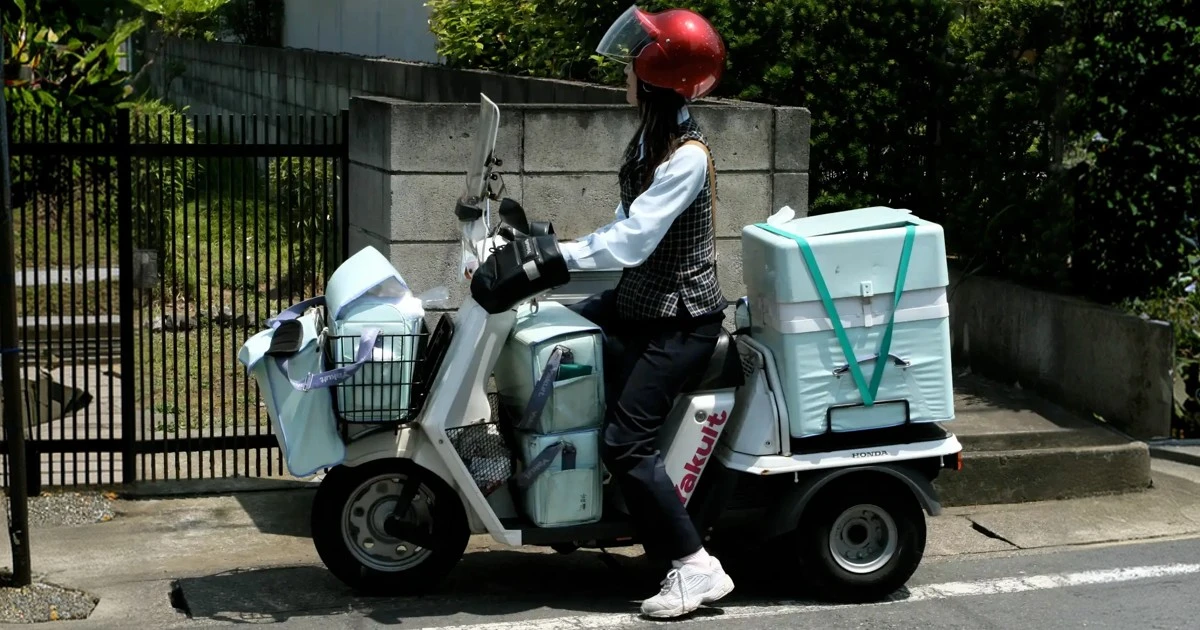
Image Credit - By Jim Epler, Wikimedia Commons
Yakult Ladies Fight Japan’s Loneliness Crisis
When an elderly person dies completely alone in a modern city, officials usually blame failing government safety nets. Yet the most consistent welfare check for millions of isolated Japanese seniors comes directly from a private corporate sales force pushing tiny bottles of fermented milk. This daily doorstep routine prevents countless tragedies.
Every week, Yakult Ladies Japan deliver a popular probiotic drink directly to households across the nation. According to Nutraceuticals World, they operate as a massive, informal neighborhood watch because these workers develop meaningful relationships with their customers and check on the safety and well-being of the elderly. A simple retail transaction forces regular interpersonal contact. This physical interaction directly improves gut health while simultaneously fighting severe social isolation.
Japan faces a crushing demographic shift right now. Examining this specific delivery network reveals a striking collision of public health, private enterprise, and basic human connection. The simple act of handing over a chilled beverage creates a vital lifeline for individuals completely cut off from society. A commercial transaction actively keeps vulnerable people alive.
The Origin of Yakult Ladies Japan and the “Drinking Bacteria” Problem
Launching a radically new medical product often requires bypassing doctors and going directly to neighborhood gossips.
Dr. Minoru Shirota entered Kyoto University's medical school in 1921. He focused heavily on preventive medicine. According to Eater, he eventually formulated his own specific lactic acid bacteria—a strain of Lacticaseibacillus casei known as Shirota—around 1930. Historical records occasionally point to a 1931 invention date, highlighting some fluidity in early corporate record-keeping. Regardless of the exact year, he officially launched his initial beverage in Fukuoka city by 1935.
Early consumers completely rejected the concept. The public lacked modern scientific vocabulary. Selling people on the idea of ingesting living microbes seemed absolutely insane at the time. A company spokesperson notes that the total absence of 'probiotics' terminology during early periods caused extremely sluggish consumer comprehension. Traditional retail shelving failed to educate buyers.
Overcoming Early Scientific Skepticism
The company desperately needed a completely different educational approach. A Hiroshima franchise operator named Kazuhiro Noguchi initiated a grassroots delivery method in the mid-1950s. He hired local women to explain the science directly to individual households.
The corporation later formalized this highly successful strategy into the official women's delivery network in 1963. A report by Eater notes that the company began employing thousands of women to sell bottles in person because they realized direct household explanations worked far better than passive store shelving. Word-of-mouth marketing established deep consumer trust almost instantly.
How Female Deliveries Bypassed Retail Barriers?
Building community trust requires dispatching workers who already hold inherent credibility with local gatekeepers.
The company specifically targeted housewives for a highly strategic reason. Women controlled the grocery budgets and made the daily household health decisions. Sending female workers to knock on doors capitalized on pre-existing neighborhood trust. Customers viewed these specific delivery workers as trusted peers. They completely avoided the aggressive tactics of traditional hawkers.
A local Center Manager points out that fixed product pricing completely eliminated awkward haggling. Customers felt extremely comfortable opening their doors to friendly faces. For decades, Yakult Ladies Japan expanded their daily routes through word-of-mouth and established community relationships.
Adapting the Physical Product
This direct-to-consumer model rapidly accelerated product adoption across the country. Sales volumes hit a staggering 15 million daily bottles by 1971. The physical product eventually evolved alongside the growing workforce.
In 1968, the company switched from heavy glass containers to lightweight plastic. This specific packaging change significantly mitigated the physical weight burdens on the delivery staff walking their daily routes. What exactly do Yakult Ladies do? As detailed on the official Yakult website, they visit customers to deliver probiotic beverages directly to homes and offices while providing health information and checking in on them. This simple routine guarantees a weekly touchpoint for millions of citizens.
The Independent Contractor Reality Behind Yakult Ladies Japan
Corporate branding heavily promotes wholesome community care, while the daily financial reality relies on strict sole-proprietor labor laws.
These workers classify strictly as kojin jigyo usha, or sole proprietors. This franchise-like independence offers extreme schedule flexibility. Worker Satoko Furuhata attributes her optimal personal balance and sustained energy levels directly to her customized four-day workweek structure. Modern corporate materials heavily highlight this flexibility to attract new mothers into the workforce.
However, the financial realities present a sharp economic contrast. Delivery personnel average about $682 USD monthly. Meanwhile, the national female workforce averages a much higher $1,774 USD monthly.

Image Credit - By 玄史生, CC Wikimedia Commons
The Economic Burden of Independent Work
These independent contractors receive zero unpaid sick days and entirely lack formal corporate holidays. They bear significant physical strain walking daily routes in extreme weather conditions. The domestic workforce currently fluctuates between 31,000 and 35,000 women depending on the exact corporate reporting metric.
Sociologist Hilary Holbrow notes a modern decline in the job's overall appeal. Extensive national daycares and paid corporate maternity leaves now offer much better alternatives for young mothers. Decreased marriage rates also completely alter traditional maternal obligations. The midcentury appeal perfectly aligned with traditional housewife constraints, while modern economic realities push women toward formal corporate employment.
Translating Dr. Minoru Shirota’s Vision into Global Dominance
International corporate success often depends heavily on perfectly replicating strict local hiring methodologies over sovereign borders.
The core philosophy, known internally as "Shirota-ism," prioritizes preventive medicine over reactive treatments. Dr. Minoru Shirota linked intestinal health directly to human longevity. This solid biological foundation drove massive international expansion. The corporation currently sells 39 million units daily across 40 countries. You can easily find the probiotic drink in 711,000 retail locations globally.
A 2025 sustainability report by Yakult indicates they employ roughly 50,000—specifically around 49,947—overseas delivery personnel. Some internal company figures suggest a slightly lower 46,600 headcount, highlighting the fluid nature of international contractor tracking.
Global Expansion and Market Failures
PR representative Hideki Maruyama credits these global triumphs directly to rigorous local hiring practices. The company successfully replicated the neighborhood trust model across multiple continents. They also diversified heavily into oncology pharmaceuticals, yogurts, and the Toughman energy drink.
Occasional male workers, like Kazuhisa Ishii, also join the delivery ranks in modern times. Still, some markets completely reject the doorstep model. An Australian trial completely failed and shut down in 1994. The cultural reliance on direct human delivery simply failed to translate in certain Western environments.
A Rapidly Aging Society and the Surge in Solitary Deaths
Demographic collapses force modern nations to create strange new government posts just to manage the sheer volume of forgotten bodies. Japan currently faces a massive demographic crisis. The elderly population share sits around 30 percent. This extreme isolation creates a brutal reality known locally as kodokushi. Solitary deaths surged dramatically, jumping by 3,686 cases between 2024 and 2025. Local municipalities now occasionally coordinate with Yakult Ladies Japan to monitor high-risk neighborhoods.
The government appointed its initial "Minister of Loneliness" in 2021 to combat this rising tragedy. Public officials desperately need reliable methods to check on isolated citizens.
Tracking the Kodokushi Crisis
Between January and June of 2025 alone, authorities recorded an astonishing 40,913 solitary home deaths. Projections show a staggering 11 million solitary elderly residents living completely alone by 2050.
Why are solitary deaths increasing in Japan? A rapidly aging population combined with declining marriage rates leaves millions of seniors living entirely alone without traditional family support. These grim statistical realities outline the sheer scale of the Japanese loneliness epidemic. Government officials struggle to implement viable social solutions at the required speed.
The Biological Link Between Social Isolation and Gut Health
Chronic loneliness physically starves the human digestive tract of the external microbial diversity required for basic bodily survival.
The human microbiome requires constant interpersonal contact to thrive. Microbiome scientist Dr. Emily Leeming identifies a direct correlation between human isolation and reduced gut diversity. Interacting with other human beings facilitates a vital interpersonal microbe exchange. Solitary living breaks this biological chain entirely.
Furthermore, chronic isolation produces severe stress responses in the human body. These negative stress reactions directly degrade gut health over time. A lonely brain actively harms the digestive system.
Interpersonal Microbe Exchange
What is the link between gut health and loneliness? Chronic social isolation initiates stress responses that actively degrade the gut microbiome, while lack of human contact prevents healthy microbial exchange. Drinking Lacticaseibacillus casei Shirota directly combats this physical decline.
The weekly doorstep visits introduce essential physical microbial variety. Friendly conversation directly lowers chemical stress levels. This dual approach tackles both the biological deficit and the psychological trauma simultaneously. The delivery network effectively prescribes human connection alongside medical science.
How Yakult Ladies Japan Became Doorstep Guardians
A simple financial transaction morphs into a vital medical lifeline when the delivery person remains the solitary weekly visitor. These workers evolved far past their initial retail boundaries. They currently function as an informal social safety net. Delivery worker Asuka Mochida views her team directly as community guardians. Their daily duties exceed basic retail tasks.
They actively observe subtle lifestyle shifts during their daily routes. They notice uncollected mail, unusual silence, or subtle changes in a customer's physical appearance. This keen observation frequently leads to the rapid identification of critical health emergencies.
Breaking the Cycle of Isolation
One 83-year-old customer relies heavily on these weekly doorstep interactions. She considers the visits a highly important energy source and a massive relief from crushing isolation. She explicitly values the social health maintenance as much as the physical beverage itself.
The simple act of handing over a plastic bottle consistently breaks the devastating cycle of the Japanese loneliness epidemic. Every delivery interaction reinforces vital community bonds. The neighborhood relies on Yakult Ladies Japan to ensure the most vulnerable citizens remain safe behind closed doors.
The Enduring Value of Human Delivery
A highly advanced modern society ultimately relies on low-tech human interaction to solve its most severe social crises. The simple transfer of a small plastic bottle delivers significant physiological and psychological stability. Dr. Minoru Shirota originally wanted to cure intestinal distress. His aggressive doorstep sales network accidentally built a powerful defense against lethal urban isolation.
Relying on independent contractors to perform critical elder care highlights massive gaps in government welfare systems. Society essentially outsources necessary welfare checks to women earning fractional wages. Regardless of the corporate financial motives or the low contractor compensation, these weekly visits consistently save lives.
The sheer physical presence of Yakult Ladies Japan guarantees that millions of vulnerable seniors remain seen, heard, and physically connected to the outside world. Until governments develop better strategies to manage rapidly aging populations, community survival requires a simple knock on the front door.
Recently Added
Categories
- Arts And Humanities
- Blog
- Business And Management
- Criminology
- Education
- Environment And Conservation
- Farming And Animal Care
- Geopolitics
- Lifestyle And Beauty
- Medicine And Science
- Mental Health
- Nutrition And Diet
- Religion And Spirituality
- Social Care And Health
- Sport And Fitness
- Technology
- Uncategorized
- Videos

