
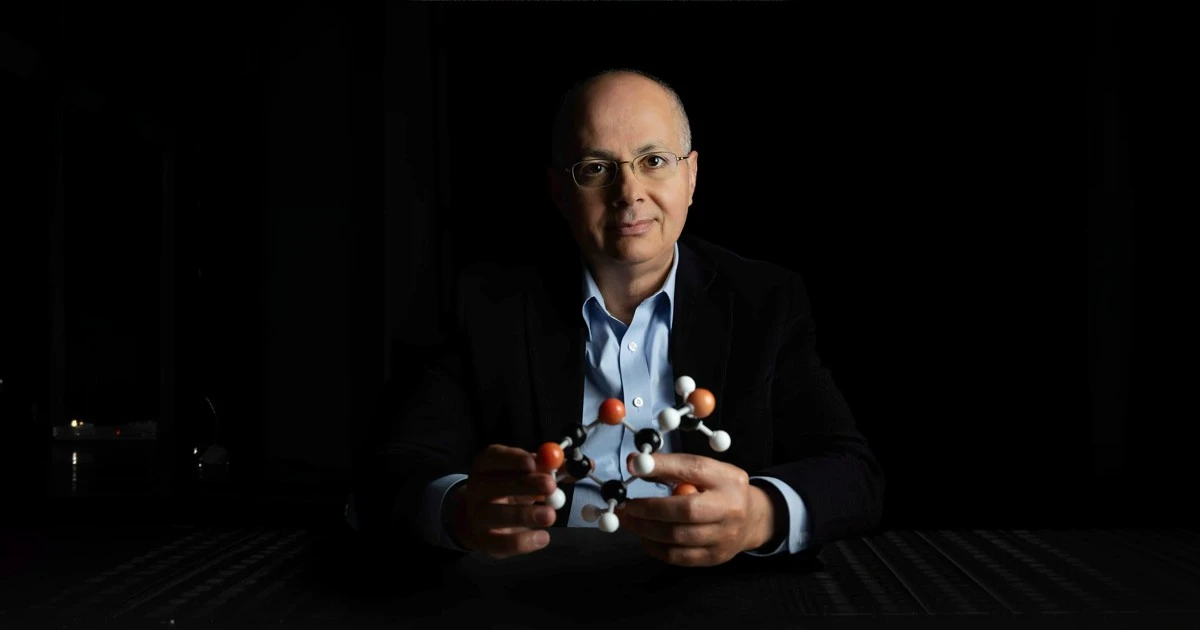
Image Credit - By Christopher Michel, Wikimedia Commons
Omar Yaghi Solves Water Crisis Using Only Air
Most people assume the water supply ends where the river stops flowing. You turn the tap, nothing comes out, and panic sets in. But the air right in front of your face holds more fresh water than all the rivers on Earth combined. We ignore this massive reservoir because catching these floating molecules usually costs a fortune in energy. You normally have to freeze the air or boil it until the moisture surrenders.
One chemist found a different way to pull drinkable liquid straight from the sky without burning through the power grid. According to the Chemistry Nobel announcement, Omar Yaghi designed a material that acts like a specific trap for water molecules, capable of harvesting water from desert air. This structure grabs humidity from the desert air and holds it tight until sunlight releases it as pure water. This breakthrough turns the atmosphere into a limitless, decentralized well for anyone who needs it.
The Man Who Built a Cage for Molecules
Scientific breakthroughs often look like accidents, but this one required stacking atoms like bricks to build a specific cage. Omar Yaghi spent decades pioneering a field called reticular chemistry to control matter on an atomic level. Rather than mixing chemicals in a beaker and hoping for the best, he treated atoms like "Tinker Toys," snapping them together to create highly porous frameworks.
This precision earned him the 2025 Nobel Prize in Chemistry, shared with researchers Kitagawa and Robson. According to UC Berkeley News, the Nobel committee recognized that his work changed how we understand solid materials by creating the field of reticular chemistry. Omar Yaghi proved that we can design solids with specific duties instead of accepting what nature gives us.
As reported by The Business Standard, the Nobel trio developed these Metal-Organic Frameworks (MOFs) with such large spaces that gases can flow through them, creating a structure so open and porous that a single gram has the surface area of a football field. One cubic centimeter of this material contains over 7,000 square meters of internal surface area. This vast internal space acts like a "parking lot" for molecules, waiting to fill up with water.
How to Catch a Ghost in the Desert
Trapping water is easy, but getting it to let go usually takes too much energy to be practical. Standard atmospheric water generators work like air conditioners. They cool the air until water condenses, which fails when the humidity drops below 50 percent. Research from Lawrence Berkeley National Laboratory shows Yaghi took a different route, utilizing 1 kilogram of MOF to generate 2.8 liters from ambient air even at 20–30% humidity. His MOFs use adsorption, where water molecules stick to the surface of the material rather than condensing.
Magnus Bach, the VP of Atoco, explains that the material must "like" the water molecules enough to catch them while avoiding a bond so strong it refuses to let go. This balance is critical. Moving a single atom in the design improved water uptake by 30%.
The process works in a simple cycle. At night, the MOF absorbs moisture from the cool air. During the day, simple ambient heat or sunlight warms the material. Chemistry World explains that this light intensity heats the MOF, expelling almost all collected water into a condenser for collection. Who founded reticular chemistry? Omar Yaghi pioneered this field to create materials with tunable atomic structures. According to Chemistry World, this method works even in arid environments, harvesting water at 7–20 percent relative humidity—conditions typical of midday in the desert—while traditional condensers dry up.
From Lab Beaker to Shipping Container
A scientific discovery remains a curiosity until you scale it up enough to keep a hospital running during a blackout. Omar Yaghi founded Atoco in 2020 to take this chemistry out of the lab and into the actual world. The company aims to prove that atomic precision can solve industrial-sized problems.
They scheduled a prototype demonstration for early 2026 to produce 200 liters of water every-day. This is just the first step. The aim is a commercial unit the size of a standard 20-foot shipping container. When connected to the power grid, this box can churn out up to 4,000 liters of daily drinking water.
Off-grid models offer a lifeline for remote areas. These units run on solar power or waste heat and produce up to 1,000 liters a day. The material potency drives these numbers. A scaled setup using just one ton of nanomaterial can generate 20,000 liters of water every single day. Atoco plans to open commercial orders in the second half of 2026. The shift from academic papers to steel containers marks the beginning of "inland desalination."

Image Credit - By Christopher Michel, Wikimedia Commons
Why Pipes Fail When You Need Them Most
Centralized water systems work perfectly until a storm washes the road away and leaves everyone thirsty. Omar Yaghi emphasizes that reliance on long supply lines makes communities vulnerable. Hurricane Beryl slammed into the Caribbean in 2024, destroying infrastructure and proving this point. Flooding contaminated local supplies, and boats could not reach the islands to deliver bottled water.
Davon Baker, a Grenada official, noted that centralized systems fail exactly when you need them most. Off-grid functionality becomes vital in these moments. Omar Yaghi views his invention as a lifeline for islands facing these threats. The technology allows a community to produce its own water without waiting for a government truck.
This independence matters for survival. Omar Yaghi recalls his own childhood in Amman, Jordan, where water scarcity defined daily life. He remembers the rush to fill containers during weekly government deliveries. That early anxiety fuels his drive to decentralize water production. A device that sits on your roof and pulls water from the air removes the fear of the tap running dry.
Feeding the Internet Without Draining the River
The internet runs on massive servers that drink millions of loads of water just to keep from melting. Data centers generate immense heat and require constant cooling to function. A typical 10-megawatt facility consumes about two million liters of water every day. This creates a conflict between digital progress and local water needs.
Atoco sees a massive opportunity here. Their units can use the waste heat from the data center itself to power the water harvesting process. Can MOFs reduce industrial water waste? Yes, they can capture moisture using waste heat from factories or data centers to create a sustainable cooling cycle. This creates a closed loop where the problem—heat—powers the solution.
The potential extends to green hydrogen production and vertical farming. Agriculture consumes the vast majority of the world's freshwater. Providing a localized water source for farms reduces the strain on aquifers. Omar Yaghi envisions a future where "personalized water" allows off-grid homes to operate with total independence. Even a device the volume of a Coke can could harvest enough water for individual survival in an emergency.
The End of Brine and the Cost of Thirst
Solving a humanitarian crisis only works if the solution costs less than the problem it fixes. Desalination plants turn ocean water into drinking water, but they pump toxic brine back into the sea. This salty sludge damages marine ecosystems and kills local sea life. Omar Yaghi offers a clean alternative.
His method produces zero liquid waste. It extracts pure water and leaves the air exactly as it was, just slightly drier. The economic model relies on selling the units rather than licensing the tech. Adding more nanomaterial allows users to scale their output up or down.
Atoco targets a cost reduction of 50 percent below current direct air capture averages. The industry used to view atmospheric water as expensive and undependable. The Nobel win validates the business case and sparks investor interest. Samer Taha, the CEO of Atoco, notes that the award simplifies explaining the value to the world. It proves the science is solid.
A New Definition of Scarcity
We treat water as a resource that must be moved from where it is to where it is not. We build massive pipelines, dams, and canals to fight geography. Omar Yaghi argues that water is actually everywhere, provided you have the right net to catch it.
The global scarcity numbers are terrifying. Over 2.2 billion people lack safe drinking water. Omar Yaghi believes science allows us to reimagine matter itself to fix this. He pushes leaders to protect academic freedom because you never know which experiment will save millions of lives.
Federal grants and funding from the US Department of Energy and BASF supported the early research. Evelyn Wang at MIT helped establish the passive device potential. Now, the focus shifts to mass production. Is atmospheric water safe to drink? Yes, the water harvested by MOFs is pure and free from groundwater contaminants or piped pollutants. The transition from a scarcity mindset to an abundance mindset begins with realizing the air is an ocean.
The Future is Dry and Wet at the Same Time
Omar Yaghi changed the rules of chemistry to change the rules of survival. We spent thousands of years settling near rivers and digging wells. Now, we can carry the well with us. The ability to harvest water from desert air breaks the link between geography and destiny.
Beyond offering a drink to a thirsty person, this technology offers resilience to a fragile world. It secures data centers, saves island nations after storms, and allows farmers to grow food in the sand. The molecular "parking lot" he built proves that the solution required looking at the air to see what was already there, rather than finding more water.
When Omar Yaghi accepts the accolades, he celebrates a future where no one has to wait for a water truck again, rather than merely a prize. The water crisis requires better cages for the molecules that refuse to fall, rather than a reliance on rain.
Recently Added
Categories
- Arts And Humanities
- Blog
- Business And Management
- Criminology
- Education
- Environment And Conservation
- Farming And Animal Care
- Geopolitics
- Lifestyle And Beauty
- Medicine And Science
- Mental Health
- Nutrition And Diet
- Religion And Spirituality
- Social Care And Health
- Sport And Fitness
- Technology
- Uncategorized
- Videos

