

Pavel Durov: The Billionaire Behind Telegram
Pavel Durov: The Billionaire Behind Telegram
Giving people the power to speak without permission forces governments to treat a software programmer like a rogue state. When a person builds a tool that ignores borders, they lose the protection of those borders themselves. Pavel Durov lives in this friction. He created a platform that currently serves one billion people, yet he operates it with the tight control of a private kingdom. This approach bypasses traditional media and political filters. It allows direct communication between leaders and the masses.
However, this level of influence creates a target. States see his refusal to censor content as a direct challenge to their authority. He has spent over a decade moving between countries to stay ahead of legal demands. From his early days in St. Petersburg to his recent legal battles in Paris, his life follows a pattern of defiance. He prizes individual freedom above national loyalty. This philosophy has made him one of the most powerful and controversial figures in the modern world.
The Birth of Digital Populism in Russia
Refusing to delete a single post creates a friction that eventually forces a founder out of his own country. Pavel Durov began his journey in Leningrad, USSR, on 10th October 1984. He grew up in a family of intellectuals. His father, Valery Durov, worked as a professor of classical philology. Pavel spent part of his childhood in Turin, Italy, while his father worked overseas. He returned to Russia and attended the St. Petersburg Classical Gymnasium.
Teachers recognized him as a science prodigy. Later, he studied English and Translation at Saint Petersburg State University from 2002 to 2006. In 2006, he launched VKontakte, known as VK. He collaborated with Vyacheslav Mirilashvili and Lev Leviev. The platform grew rapidly. By 2008, VK dominated the Russian market. It surpassed its rival, Odnoklassniki. This success gave Pavel Durov immense influence. He did not just build a social network; he built a way for millions of people to organize. The government noticed this power.
Signaling Defiance to the Kremlin
Following the 2011 elections, the Russian government demanded that Durov censor opposition pages. He refused. He posted a photo of a dog in a hoodie to signal his defiance. In 2012, he donated a million dollars to Wikipedia to support free knowledge. This act reinforced his image as a defender of the open web. However, the pressure continued to build. By 2013, he started working on a new project with his brother, Nikolai Durov. They called it Telegram.
The standoff reached a breaking point in April 2014. The FSB requested data on Ukrainian protesters. Durov again refused to comply. Shortly after, the board dismissed him as CEO of VK. He realized he could no longer stay in Russia. He left the country permanently in 2014. He chose to lose his home rather than betray his users. He prioritizes principles over profit. He believes in creating things individually rather than relying on inheritance.
Building the Billion-User Fortress
A platform with a billion users and one owner removes the traditional checks and balances found in corporate boards. Pavel Durov maintains 100% ownership of Telegram. This gives him total control over product decisions, marketing, and public relations. He operates the company as a one-man show. This centralization allows Telegram to move faster than its competitors. Nikolai Durov serves as the technical architect. He is a math and programming prodigy. He built the custom data protocol that Telegram uses. This partnership between the two brothers combines visionary leadership with high-level engineering. How many kids does Pavel Durov have? He recently claimed to have over a hundred biological children through sperm donation to help families struggling with fertility. He sees this as a social duty to improve global genetic quality.
Investigating the Gap Between Image and Reality
Telegram reached a massive milestone in March 2025. It now has over 1 billion active monthly users. The platform generates more than $1 billion in annual revenue. It ended 2024 with half a billion dollars in cash reserves. This financial independence allows Durov to ignore pressure from advertisers or investors. He often compares Telegram to WhatsApp. He claims Telegram is superior because it resists competitor sabotage and state influence. Durov follows spartan habits to maintain creative clarity. He avoids intoxicants like alcohol. He practices six-day water-only fasts. He also pursues freedom from material possessions. He claims he owns no yachts or private jets. However, some critics point to social media posts showing him on superyachts. This creates a gap between his public asceticism and his private reality.
National Borders and the Price of Neutrality
National borders lose their meaning when a person holds four passports and moves a company across the globe. After leaving Russia, Durov became a global nomad. He eventually settled in Dubai, UAE, in 2017. He likes the neutral political stance of the Emirates. In February 2021, he became a naturalized citizen of the United Arab Emirates. Later that year, in August, he received French citizenship through a special "merit foreigner" procedure.
He frames Telegram as a non-player in global geopolitics. He rejects state-driven censorship. This libertarian ideology draws a deep suspicion of government constraint. He believes in absolute freedom of expression. This stance has led to conflicts with various nations. Between 2018 and 2020, Russia attempted to block Telegram. Durov used a technique called domain fronting to evade the ban. The Russian government eventually lifted the ban after two years of failure.
What is Pavel Durov’s net worth?
Forbes ranks him at $17.1 billion in 2025, placing him at number 149 on the global wealth list. This wealth comes entirely from his stake in Telegram. In 2021, the UAE government injected $75 million into the company. This investment helped Telegram expand its infrastructure. Durov also launched the TON cryptocurrency platform. He raised $1.7 billion for the project through an initial coin offering. However, the SEC halted the project. Durov pivoted, and the community now manages the TON blockchain. He also launched Fragment, a site for selling usernames as digital assets. It sold $50 million worth of usernames in just one month.
The Surveillance War and Operation Purple Music
Governments often view total encryption as a direct threat to their ability to maintain public order. Because Telegram allows people to communicate without state oversight, it attracts the attention of intelligence agencies. In 2017, French and UAE authorities launched a joint operation named "Purple Music." They targeted Durov specifically. The operation involved a device intrusion. Investigators hacked Durov’s iPhone. They wanted to surveil activists and track extremist groups using the platform. They also hoped to find dissidents. This operation shows that even a "neutral" platform faces constant attack from state actors. Durov often warns about the risk of state-forced encryption keys. He fears that authorities will eventually compromise private data.
The Liability Crisis
Telegram markets itself as a secure and encrypted app. However, a nuance exists here. Standard chats and groups do not use end-to-end encryption by default. Users must manually start "Secret Chats" to get that level of security. Critics often point this out. Despite this, Telegram spokespeople maintain that their moderation standards meet or exceed industry norms. They remove millions of harmful posts daily. They deny using algorithms to promote toxic content. Durov views himself as a tool-maker. He argues that platform owners should not face liability for the actions of their users. He thinks modern tech suffers from the application of obsolete laws. He finds it baffling when governments blame a developer for how criminals use a service. This tension led to his most significant legal challenge in 2024.
The Legal Battle in France
Legal pressure on a single individual often serves as a test for the future of global communication. On 24 August 2024, French authorities detained Pavel Durov at Le Bourget Airport. They issued a warrant based on the platform's alleged lack of moderation. They claimed Telegram allowed drug trafficking and fraud to flourish.
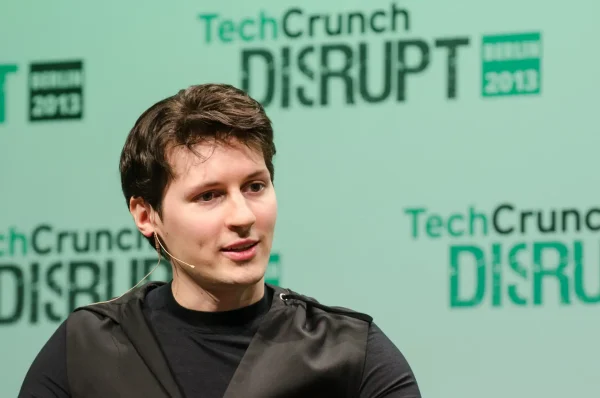
Image by - TechCrunch, CC BY 2.0, via Wikimedia Commons
Is Pavel Durov still in jail?
He was released on August 28, 2024, after paying a €6 million bail, though he initially faced travel restrictions within France. The formal charges include non-cooperation with legal demands. Durov called the arrest "absurd." He noted that he had previously complied with legal requests from French authorities. He faces a potential penalty of 10 years in prison if convicted of the primary charges. The arrest caused a global debate. Supporters saw it as an attack on free speech. Critics saw it as a necessary step to hold big tech accountable.
Irina Bolgar, who claims to have had a decade-long romantic relationship with Durov, also came forward. She filed a lawsuit in Switzerland alleging personal abuse. She criticized his public image of liberty. She claimed his private behavior contradicted his public persona. Durov remained in France under a travel ban for several months. In July 2025, the court eased the ban for limited travel to Dubai. By November 2025, the French government fully removed the travel ban. His legal status remains a major point of interest for the tech world. This case sets a precedent for how countries handle founders of encrypted platforms.
The Contradictions of a Libertarian Leader
Building a brand on radical transparency often requires a leader to live a deeply guarded life. Pavel Durov presents an image of a man who owns nothing and answers to no one. He claims to have no luxury assets. Yet, documentation exists of his travel on private aircraft. This contradiction defines his public life. He promotes bio-hacking and longevity science. He has a strong interest in pronatalism. He believes high-earning professionals like lawyers and doctors will face a brutal transition due to AI. He views progress as a state where humans live royally without performing "slave-like" labor. He uses his platform to distribute this worldview. Nikolai Kononov, a writer who studied Durov, calls him a pioneer of digital populism. Durov uses software features to interact directly with the mass audience.
How Durov Built a Billion-User Fortress
His family history also adds layers to his story. He has Ukrainian heritage through his mother’s maiden name, Ivanenko. He still has relatives living in Kyiv. This background makes the ongoing conflict in Eastern Europe a personal matter. He has stated that he had to choose between his home in Russia and the safety of his users. He chose the latter. This decision defined the last ten years of his life. Telegram continues to grow despite these personal and legal struggles. It remains one of the few platforms that refuses to join the global consensus on content moderation. This makes it a haven for dissidents, but also a challenge for law enforcement. Durov manages this balance with a small team and absolute authority.
The Future of Human Creation and Control
High-quality genetics and artificial intelligence are becoming the new focus for leaders who think in centuries rather than years. Pavel Durov sees the world changing rapidly. He believes sperm donation helps alleviate the global fertility decline. He wants to de-stigmatize the process. He views himself as a contributor to the future of the human race. His work with the TON blockchain suggests a move toward a decentralized internet. He wants to integrate financial services directly into communication. This would allow users to trade assets without traditional banks. The Fragment platform already proves that people will pay high prices for digital identity. This moves Telegram from a simple messaging app to a complete digital economy.
Durov remains a figure of intense intellectual tension. He fights for the right to remain anonymous while being one of the most famous people on earth. He demands freedom from government surveillance while governments hack his personal devices. He preaches asceticism while managing a multi-billion dollar empire. These are not just personal quirks. They are the result of a man trying to live outside the systems that govern everyone else. As of late 2025, his legal troubles in France have stabilized. He continues to lead Telegram from Dubai. The platform’s reach is larger than ever. It has survived ban attempts, spy operations, and the arrest of its founder. Pavel Durov remains committed to his vision of a world where communication is a fundamental right that no government can switch off.
Conclusion: The Persistence of Pavel Durov
A person who provides a tool for total independence eventually becomes the focal point of a global struggle for control. Pavel Durov built Telegram as a fortress for free speech. He designed it to withstand the pressure of powerful states. This mission cost him his home in Russia and his freedom of movement in France. However, it also gave him a following of one billion people who value privacy. He has proven that a single individual can challenge the information monopoly of governments.
His story is one of constant movement and calculated defiance. He uses his wealth and technical skill to stay one step ahead of those who wish to regulate him. Whether through his pursuit of genetic legacy or his push for decentralized finance, he looks toward a future where individuals hold more power than institutions. The legal battles and personal controversies surrounding him only highlight the impact of his work. Pavel Durov has changed how the world communicates, and in doing so, he has made himself a permanent fixture in the debate over digital liberty. He continues to prove that in the age of information, the most valuable asset is the ability to remain independent.
Recently Added
Categories
- Arts And Humanities
- Blog
- Business And Management
- Criminology
- Education
- Environment And Conservation
- Farming And Animal Care
- Geopolitics
- Lifestyle And Beauty
- Medicine And Science
- Mental Health
- Nutrition And Diet
- Religion And Spirituality
- Social Care And Health
- Sport And Fitness
- Technology
- Uncategorized
- Videos

