
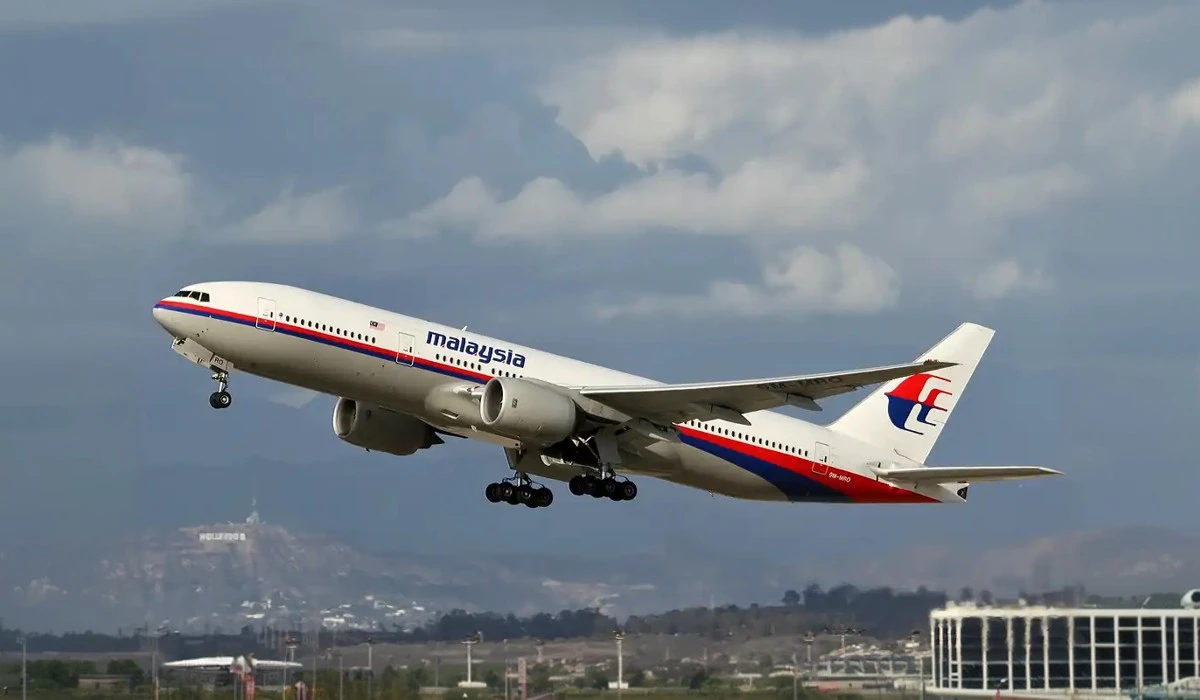
Image Credit - by Ohconfucius, CC BY-SA 2.0, via Wikimedia Commons
MH370 Search: Why 2025 Could Finally Solve It
A pilot switches off the transponder to ensure the world looks in the wrong direction. This simple act creates a gap in the record that lasts for over 10 years. The Guardian reports that Malaysia Airlines Flight 370 left Kuala Lumpur for Beijing on 8th March, 2014, with 239 people aboard. It never arrived. Instead, the aircraft crossed back over the Malay Peninsula before proceeding south into the remote Indian Ocean. For years, the global community looked for answers in the dark.
Today, the search for fight MH370 enters a final, high-stakes phase. New technology and fresh legal mandates provide a path toward the truth. We now understand that the flight did not simply vanish. It followed a direction which suggests deliberate choices. Every minute of that flight left a trace, from satellite pings to fragments of wing washing up on distant shores. As 2025 begins, a specialized fleet of underwater drones prepares to scan the remaining 15,000 square kilometers of high-probability sea floor. This mission represents the last hope for families who have spent eleven years waiting for a single answer.
The New Search in the Deep
Success in the deep sea relies on trusting software to find what humans cannot see. On 30th December 2025, Ocean Infinity restarted its seabed scanning operations. The Guardian reports that the company operates on a "no find, no fee" basis. It only collects a $70 million reward if it locates the wreckage. This arrangement shows its confidence in its tools and its data.
As noted in The Guardian Environment, Ocean Infinity uses a fleet of Hugin 6000 AUVs. These units cost $8 million each and can dive to depths of 6,000 meters. The report indicates that the drones move through the water with minimal oversight from human operators. Simon Maskell explains that the mapping task belongs to these autonomous units. They scan the floor and return only when they finish their programmed path.
Who is searching for the flight in 2025? Ocean Infinity leads the current effort using a fleet of advanced autonomous drones to map the seafloor. This team prioritizes reputation over immediate profit. Richard Godfrey notes that the firm seeks market leadership through finding the wreckage. Finding the plane would cement its status forever.
Why the First Search Failed
Searching for a needle in a haystack works only if you know which haystack the needle fell into. The initial multi-national effort covered 120,000 square kilometers. It cost over $155 million, yet it found nothing. The terrain in the Southern parts of Indian Ocean makes any search difficult. The sea bed contains massive underwater volcanoes, deep canyons, and jagged ridges. Wreckage can easily hide in these rugged structures or under layers of shifting sediment.
How much did the search cost? The total expense of all search efforts has exceeded $155 million, making it the costliest search in aviation history ever recorded. Despite this spending, the first three years of searching ended in January 2017 with no results.
The technical limits of the flight also hindered the investigation. Skybrary notes that the Cockpit Voice Recorder (CVR) in a Boeing 777 operates on a two-hour loop. It constantly overwrites old data with new audio. If the plane flew for seven hours after the pilot made his final transmission, the CVR would only hold the sounds of the last 2 hours of the flight. Investigators would never hear the important moments when the plane first turned off its path. Ironically, the black boxes that could solve the mystery likely contain no record of the initial deviation.
The Deliberate Turn and the Southern Flight Path
A Boeing 777 flies itself for hours after someone makes the first hard turn. The flight began normally at 12:41 AM. At 1:06 AM, the plane sent its final automated ACARS position report. Thirteen minutes later, a voice from the cockpit told ATC, "Good night, Malaysian three seven zero." This was the final verbal transmission. At 1:21 AM, the aircraft’s transponder went offline. The plane suddenly deviated from its usual route.
Captain Steven Green argues that a sudden course alteration points to manual input rather than a medical emergency. If a crew becomes incapacitated, a plane usually maintains its last programmed path. The sharp turn back toward the peninsula requires someone to physically move the controls. Military radar tracked the plane until 2:22 AM as it flew 200 nautical miles northwest of Penang.
After this point, the plane "talked" only to satellites. The Satellite Data Unit requested a log-on at 2:25 AM. This suggests the power briefly failed or someone manually shut it down and then restarted it. Data from these satellite pings helped investigators triangulate the plane's distance and speed. They used metrics called Burst Time Offset and Burst Frequency Offset to trace a path leading deep into the Indian ocean. Reuters reports that this southern flight path matches a route with the pilot's home flight simulator during an FBI analysis.
Recovered Debris and the Final Dive
Small pieces of metal tell the story of a high-speed collision. Britannica reports that while the main body of the plane remains missing, the ocean has returned 27 pieces of debris. The study notes that the most significant find occurred in July 2015 on Réunion Island: a right-wing flaperon that David Soucie later confirmed came from a Boeing 777. Its structural consistency linked it directly to the missing airframe.
Where is MH370 now? Most experts and recovered debris suggest the plane rests on the floor of the Indian Ocean, nowhere near its original destination. An ATSB debris analysis shows the flaps were in a retracted position when the plane hit the water. This evidence supports a "high-speed spiral dive" theory, suggesting the plane hit the water with immense force rather than attempting a controlled ditching.
According to Britannica, the debris traveled miles across the sea and washed up on the shores of Africa and various Indian Ocean islands. These fragments prove the plane ended up in the water, but they do not reveal exactly where it went down. The significant between the crash location and the sites where wreckage appeared makes backward-tracking the drift almost impossible.

The Tech Powering the 2025 Search for Flight MH370
Modern drones treat the seabed as a flat map, ignoring the darkness of the void. The 2025 search uses tools that did not exist during the first mission. Capt. Byron Bailey notes that modern sonar can detect objects the size of a bus with high probability. The Hugin 6000 drones fly close to the seafloor, providing high-resolution images that older towed sensors could not match.
The current priority area covers 15,000 square kilometers. This zone represents the highest probable location based on refined satellite data and new hydroacoustic analysis. However, the work remains dangerous. Simon Maskell warns of severe maritime conditions in this region. The waves reach extreme heights, making the area unsuitable for recreational craft and causing persistent motion sickness for personnel on surface vessels.
The searchers must also account for missing signals. Usama Kadri pointed out a discrepancy in hydrophone data. Underwater microphones did not pick up the expected pressure signatures of a massive plane hitting the sea. The 2025 mission aims to fill these gaps through a search of the places the first search missed.
Cargo and Potential Risks
Investigators also looked into what the plane carried in its hold. The cargo included 221 kg of lithium-ion batteries and 4,566 kg of mangosteens. Some experts wondered if a fire in the batteries caused the crash. However, a fire does not explain the sophisticated turns or the continued flight for seven hours.
Military Radar vs. Civilian Disclosure
A major point of tension involves the timing of information. Military radar saw the plane turn back immediately. Yet, the public did not learn about this for a full week. This delay meant the first search focused on the South China Sea, far away from the actual flight path. This lost time allowed the black box batteries to weaken and the surface debris to scatter.
Legal Rulings and the Cost of Silence
Courts demand payment when evidence remains buried under miles of salt water. As reported by AP News, on December 9, 2025, a Beijing court issued a landmark ruling. It mandated financial support for the victims’ families. This legal liability places the burden on Malaysia Airlines and other entities to provide financial closure. The ruling acknowledges the ongoing tragedy and the government's role in finding a final resolution.
The Transport Ministry maintains its dedication to finality. They state that the families need closure to end this long-standing grief. For people like Sarah Bajc, who lost a loved one, the years have brought a mix of exhaustion and skepticism. Many families doubt the official conduct of the investigation but still hold onto hope that the 2025 mission will find the wreckage.
The court's decision transforms the search into a legal requirement to settle damages, moving beyond simple exploration. Finding the plane would provide the physical proof needed to conclude these legal battles once and for all.
The Problem with Acoustic Pings
In 2014, searchers thought they heard pings from the black boxes. They spent weeks diving in those areas. Later, they realized the sounds came from faulty equipment cables on their own ships. This error wasted critical time and diverted resources away from the true flight path.
Pilot Mental State
Evidence regarding the pilot remains a point of debate. CCTV footage showed no behavioral changes pre flight. He appeared calm and professional. However, the pre-calculated path found on his flight simulator suggests he may have planned a flight to the southern ocean long before he stepped into the cockpit.

Image Credit - by CEphoto, Uwe Aranas, CC BY-SA 3.0, via Wikimedia Commons
Lessons from the Operation
True closure requires finding the physical remains of an aeroplane that left the radar behind. The search for flight MH370 has taught the world about the limits of modern tracking. We assume that every flight is watched, but vast parts of the ocean remain "dark." This event forced the aviation industry to change how planes report their positions. Future flights will likely carry trackers that cannot be easily turned off from the cockpit.
The 2025 mission represents the peak of human capability in deep-sea exploration. If the Hugin 6000 fleet cannot find the 777 in this 15,000-square-kilometer zone, the mystery may remain unsolved for generations. The $70 million reward stays on the table, waiting for the first image of a fuselage on a sonar screen.
The families value the truth of the final moments over money or technology. As the drones move through the canyons of the Indian Ocean, they carry the weight of 239 lives. Finding the plane would finally bring an end to the most baffling mystery in the long history of flight. The world waits to see if the southern ocean will finally give up its secrets.
Recently Added
Categories
- Arts And Humanities
- Blog
- Business And Management
- Criminology
- Education
- Environment And Conservation
- Farming And Animal Care
- Geopolitics
- Lifestyle And Beauty
- Medicine And Science
- Mental Health
- Nutrition And Diet
- Religion And Spirituality
- Social Care And Health
- Sport And Fitness
- Technology
- Uncategorized
- Videos

