
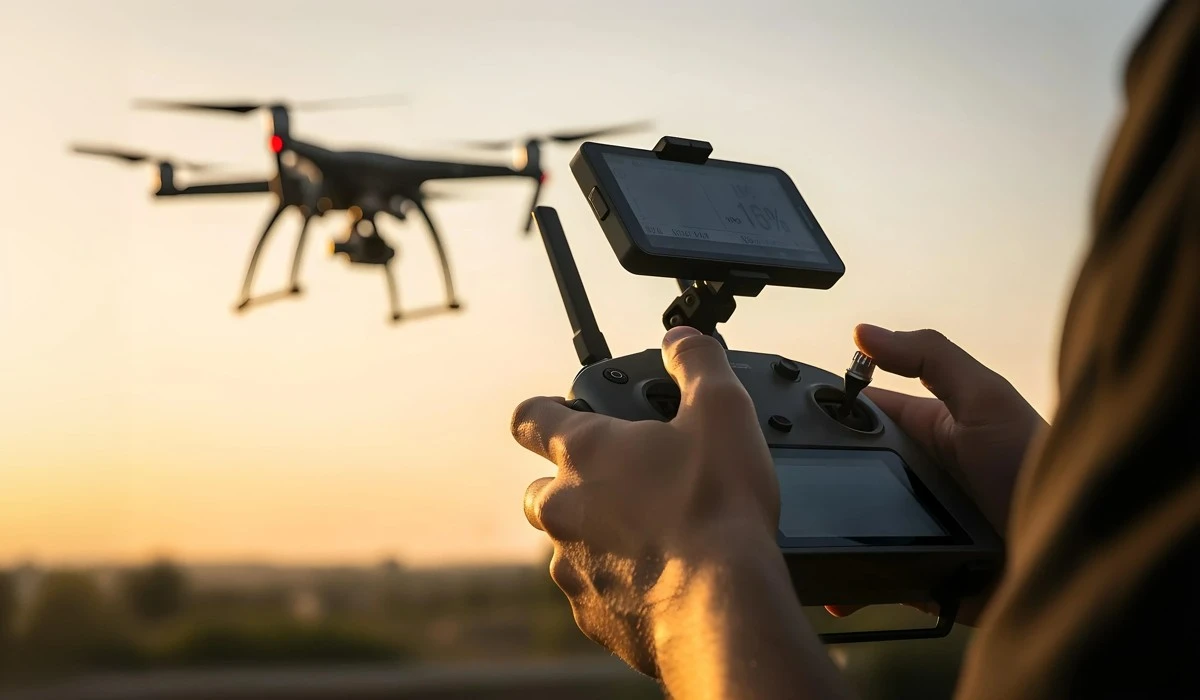
Get Perfect Stability With Drone Technology
You move the control stick a fraction of an inch. The drone hangs in the sky like a fixed star, ignoring a crosswind that should have knocked it sideways. You feel like an expert pilot, but a detailed world of hardware and rapid calculations makes that stability possible. This steady hover happens because of the ongoing conversation between the motors and the brain of the craft. When you fly, you utilize a system that processes thousands of data points every second.
Modern drone technology bridges the gap between your thumb movements and the physics of flight. It turns a chaotic environment into a smooth experience. Achieving drone flight control involves technical precision along with a legacy of engineering that, according to PBS, dates back to 1898 when Nikola Tesla demonstrated a four-foot-long, radio-controlled steel boat at Madison Square Garden. Today, anyone can capture cinematic footage because the craft handles the difficult math of staying upright.
The Anatomy of Modern Drone Technology
The physical build of a drone determines how well it reacts to your commands. Every gram of weight and every millimeter of propeller length affects performance. Drone technology has evolved from bulky frames to high-strength carbon fiber structures that protect sensitive electronics while remaining incredibly light.
IMUs and Gyroscopes: The Inner Ear of the Aircraft
A drone stays level because it knows exactly where the ground is at all times. The Inertial Measurement Unit (IMU) acts as the inner ear for the aircraft. Inside the IMU, the InvenSense MPU-6000 serves as an industry standard because of its precision. This chip uses a 32kHz sampling rate to detect tiny tilts and vibrations. It filters out the high-frequency noise from the spinning motors so the flight controller only reacts to actual movement. Without this constant feedback, the drone would tumble out of the sky the moment you let go of the sticks.
ESCs and Motor Response for Drone Flight Control
The flight controller sends instructions, but the Electronic Speed Controllers (ESCs) do the physical work. These components manage the power flow from the battery to the motors. As detailed in the ExpressLRS documentation, contemporary ESCs employ the DShot1200 protocol, facilitating data transmission speeds of up to 1.2 megabits per second. Research published in Applied Sciences indicates that this technical standard provides 2,048 discrete values for throttle resolution. When the drone detects a slight dip in one corner, the ESC increases the motor speed in that specific spot almost instantly. Outrunner brushless DC motors (BLDC) provide the muscle for this system. They use permanent magnets on an external bell to create high torque, spinning propellers at over 30,000 RPM to maintain drone flight control.
How Software Algorithms Refine Drone Flight Control
The code running on the flight controller acts as the translator between your goals and the drone's actions. It takes the raw data from the sensors and decides how to move the motors to keep the flight smooth.
PID Tuning: The Math Behind the Movement
Every stable flight relies on a mathematical logic called a PID controller. Nicholas Minorsky first developed this concept in 1922 to steer navy ships, but it now powers every quadcopter. The "P" or Proportional term handles the immediate correction. If a gust hits the drone, the P-term pushes back. The "I" or Integral term fixes errors over time, such as a battery that makes one side heavier. Finally, the "D" or Derivative term acts like a brake. It predicts when the drone will reach the right angle and slows down the correction to prevent a shaky overshoot.
Intelligent Flight Modes and Pilot Assistance

Flight modes take the stress out of flying by automating the boring parts of the job. Altitude hold uses a barometer to keep the drone at a set height, while GPS-lock stops the drone from drifting horizontally. These features make the craft feel like it is sitting on a solid shelf in the air. How do I make my drone fly more smoothly? Smooth movement is best handled through the adjustment of "expo" settings in your software to dampen stick sensitivity around the center point. This adjustment gives you fine control for cinematic shots without losing the ability to make big moves when necessary.
Essential Sensors Powering Drone Technology Today
Modern drones perform functions beyond simple flight as they perceive the world around them. This perception allows them to avoid trees, walls, and people without the pilot intervening. Advanced drone technology uses several different types of sensors to build a mental map of the surroundings.
LiDAR and Ultrasonic Sensors for Obstacle Avoidance
As explained in research from MDPI, LiDAR sensors emit light pulses and measure the time it takes for them to return to the source to determine distance. High-end inspection drones use solid-state LiDAR units to detect thin power lines from 200 meters away. This gives the flight controller enough time to stop the craft before a collision occurs. Ultrasonic sensors work similarly but use sound waves. They are perfect for shorter distances, usually under 10 meters, and help the drone maintain a safe distance from solid walls during indoor flights.
Optical Flow Sensors for Low-Altitude Stability
When you fly indoors or under a thick tree canopy, GPS signals often fail. In these situations, the drone uses an optical flow sensor like the PMW3901. This tiny camera tracks the movement of pixels on the ground at 100 frames per second. The drone monitors the movement of patterns on the floor to calculate its ground speed and stay in one spot. This sensor prevents the "toilet bowl" effect, where a drone circles uncontrollably because it has lost its position data.
Overcoming Challenges to Drone Flight Control
The real world is messy. Wind, radio interference, and gravity all work against a stable flight. Engineers design drones to fight these forces so the pilot never feels them.
Managing Wind Resistance and Aerodynamics
A strong gust of wind can easily flip a light aircraft. The flight controller maintains a high-frequency loop to stay ahead of this. Documentation from Betaflight notes that many current systems operate with an "8k/8k" configuration, where the controller checks sensors and updates motors 8,000 times per second to match the optimal gyro frequency. This speed allows the drone to lean into the wind before it actually starts moving off course. What is the best way to fly a drone in the wind? The most effective method is to utilize "Sport Mode" or a high-performance flight profile that allows the motors to use their full torque to counteract resistance. This mode prioritizes power over smooth camera movements to keep the craft safe.
Mitigating Signal Interference and Latency
The connection between your remote and the aircraft must be fast and reliable. A technical paper from USENIX observes that most systems use 2.4GHz because its 12.5cm wavelength allows signals to maneuver around obstacles effectively. However, for maximum performance, pilots use ExpressLRS (ELRS). This uses Semtech LoRa modulation to achieve a packet rate of 1000Hz. This results in a delay of less than 2 milliseconds. When the latency is this low, the drone responds to your touch instantly, making the flight feel natural rather than sluggish.
The Role of AI in Advancing Drone Technology
Artificial Intelligence has moved from laboratories into the flight controllers of consumer drones. This shift allows the aircraft to make complex decisions on its own. Drone technology now includes onboard processors that can recognize shapes and predict future events.
Computer Vision and Subject Tracking
Drones no longer need a pilot to follow a mountain biker through a forest. DJI Enterprise reports that systems like APAS 5.0 utilize six omnidirectional fish-eye vision sensors to create 3D maps of the environment. The AI identifies the subject and plans a path around obstacles in real-time. It doesn't just stop when it sees a tree; it finds a way around it while keeping the camera focused on the target. This level of autonomy turns the drone into a flying camera crew that operates with zero human input.
Predictive Analytics for Battery and Motor Health
AI also monitors the health of the hardware. It looks for patterns in voltage sag or motor vibration that might suggest a looming failure. If a motor starts to draw too much current, the system can warn the pilot or initiate an emergency landing. This predictive power ensures safe drone flight control by preventing crashes before the hardware actually breaks. As reported by The Verge, a 2017 firmware update for the DJI Spark resolved a battery error that had caused sudden power loss during flight, showing how software keeps hardware in the air.
Expert Calibration: The Key to Perfect Drone Flight Control
Even the best hardware fails if it isn't set up correctly. Calibration tells the drone's brain how to interpret the signals from its sensors. Regular maintenance of these settings ensures that the drone always knows its true orientation.
Compass and IMU Calibration Procedures
The Earth's magnetic field helps the drone know its heading, but the metal screws and motors on the drone itself can interfere. VectorNav explains that "Hard Iron" calibration is used to compensate for static magnetic noise generated by the drone's internal components. If you don't calibrate the compass, the drone might think it is facing North when it is actually facing northwest. This confusion causes the flight controller to fight itself, leading to wobbles and crashes.
Firmware Updates and Performance Patches
Manufacturers constantly find ways to make their drones fly better. Can software updates improve drone flight control? Yes, firmware updates often contain refined PID loops and sensor fusion algorithms that directly improve the responsiveness and stability of the aircraft. These updates also include "No-Fly Zone" databases to keep you out of restricted airspace. Keeping your software current ensures that you are flying with the latest safety features and the most productive motor timing available.
Future Trends in Drone Technology and Automation
The future of flight belongs to drones that can think and act together. We are moving away from single drones controlled by single pilots and toward large, coordinated groups of aircraft.
Edge Computing and Real-Time Data Processing
The next generation of drones will carry powerful chips like the NVIDIA Jetson AGX Orin. These modules allow for 275 trillion operations per second. With this much power, a drone can perform Simultaneous Localization and Mapping (SLAM) in "GPS-denied" environments like caves or deep urban canyons. The drone builds its own map as it flies, allowing it to navigate elaborate spaces without any external help or pre-loaded data.
Swarm Intelligence and Multi-Drone Coordination
According to Guinness World Records, drone technology has progressed to managing thousands of units, as demonstrated by the simultaneous control of 15,947 aircraft from one computer. This swarm intelligence uses decentralized networks. Each drone calculates its position relative to the drones next to it. This prevents collisions and allows the group to move as one giant, fluid entity. This tech will eventually change how we handle search and rescue or large-scale agricultural spraying.
The Future of Precision is Here
Modern flight has become a partnership between human intent and machine execution. You provide the vision and the direction, while drone technology manages the thousands of micro-adjustments required to stay in the air. From the early radio-controlled boats of Nikola Tesla to the AI-powered swarms of today, the goal has stayed the same. We want to move through the sky with absolute precision.
Learning drone flight control involves understanding the tools that keep the aircraft stable, rather than focusing solely on years of practice. As sensors get sharper and processors get faster, the barrier to entry continues to fall. You can now focus on the art of the shot or the data of the mission while the software handles the physics. The field of drone technology changes every day, offering new ways to see the world from above with perfect stability.
Recently Added
Categories
- Arts And Humanities
- Blog
- Business And Management
- Criminology
- Education
- Environment And Conservation
- Farming And Animal Care
- Geopolitics
- Lifestyle And Beauty
- Medicine And Science
- Mental Health
- Nutrition And Diet
- Religion And Spirituality
- Social Care And Health
- Sport And Fitness
- Technology
- Uncategorized
- Videos

