
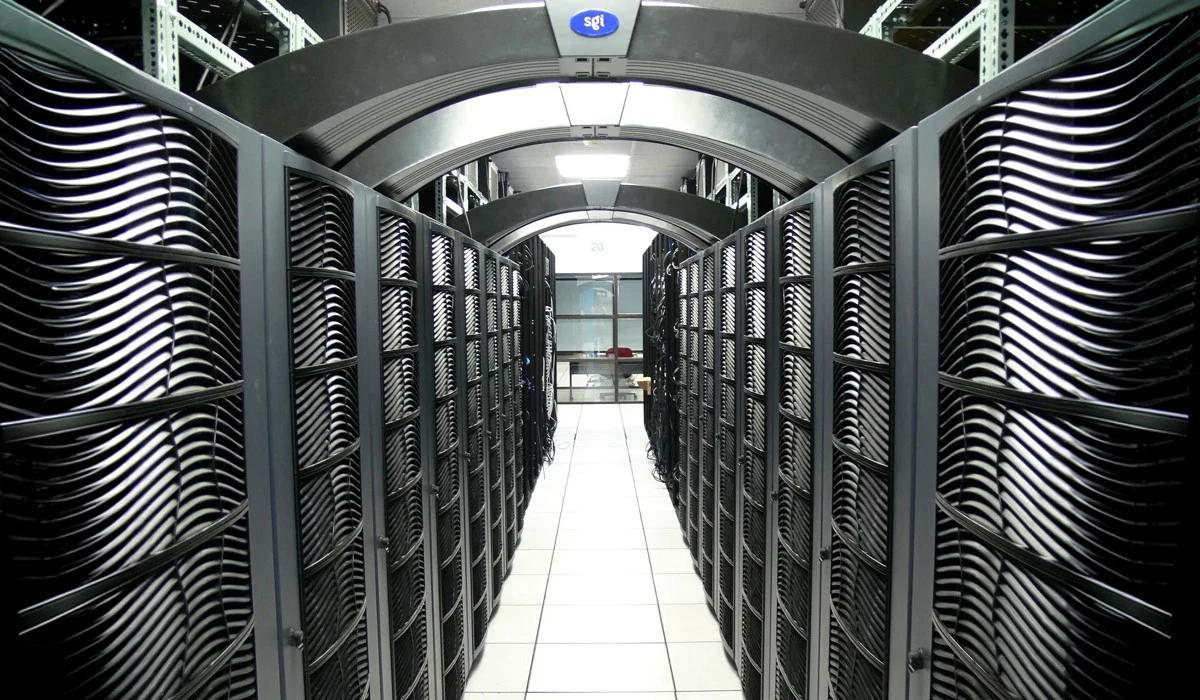
Image by Christopher Bowns, CC BY-SA 2.0 , via Wikimedia Commons
Data Center Cooling Controls Future of AI
Every time you ask an artificial intelligence to write a poem or solve a math problem, a physical chip somewhere reaches temperatures that would melt plastic. A constant, aggressive flow of coolant keeps the internet from melting with it. Reuters reported that in November, a cooling failure at CyrusOne data centers forced CME Group financial trading technology offline. This event showed that money itself stops moving when heat stays trapped. Modern Data Center Cooling sets the physical limit on human thought. If we cannot move the heat away from the silicon, the most advanced software in the world becomes useless junk. We are currently shifting from blowing air over hot metal to dunking computers into baths of liquid. The power required for reasoning AI models creates a thermal load that air cannot carry. This shift changes everything from how we build cities to how much water remains in local wells. Data Center Cooling represents the primary bottleneck for the digital age.
Why AI Demands a New Approach to Data Center Cooling
As chips grow more powerful, they generate heat at a density that exceeds the physical limits of traditional air-based fans. According to IEEE Spectrum, the average power density in a rack is growing from 8 kW to 100 kW for AI, creating an urgent need for better cooling methods. Reasoning AI models require 100 to 1,000 times more energy than a standard chatbot. The chips powering them run hot enough to fail in seconds without constant intervention.
The industry currently relies on fans to push air through racks of servers, but this method is hitting a wall. Air conducts heat poorly. When chips consume massive amounts of power, the air around them heats up so fast that fans cannot move it away quickly enough to prevent a crash. This reality forces engineers to look toward liquid immersion. Liquid carries heat away from a source better than air. Research from datacenters.com indicates that liquid cooling systems can use closed-loop designs to minimize water use and reduce environmental effects.
How does liquid cooling work for computers? Iceotope describes its process as delivering dielectric coolant through a manifold directly to server hotspots. The coolant subsequently circulates into the chassis, drawing heat from each component. Microsoft research suggests that immersion cooling allows operators to run server hardware at elevated clock speeds and run them at peak performance 24/7, though they must balance performance with power draw. This shift removes the need for loud, energy-hungry fans. The room stays quiet while processing billions of calculations.
The Water Cost of Data Center Cooling
Every digital interaction leaves a physical footprint on the local water supply because most facilities evaporate water to keep internal temperatures stable. While people think of the internet as something existing in a cloud, it actually functions like a massive, thirsty industrial plant.
Research shows that GPT-3 consumes about 500ml of water for every 10 to 50 prompts it processes. When you multiply that by millions of users, the total volume becomes staggering. Projections suggest that by 2027, AI-driven demand could push global water consumption to 1.7 trillion gallons. How much water does a data center use daily? A report by the Environmental and Energy Study Institute (EESI) notes that a single large facility can consume up to 5 million gallons daily, a volume matching the needs of a town with 50,000 residents.
Only 51% of operators currently track their water usage, and a mere 10% monitor it across all their sites. This lack of transparency creates friction with local communities. In the US, data centers utilize 90% of all watersheds, with 20% of these facilities located in high-stress regions in the West. As detailed by Amazon, the company aims for "water positive" status by 2030 and utilizes direct adiabatic cooling that uses no water for over 95% of the year in places like Ireland. They aim to limit cooling water usage to only the 10% hottest days of the year and invest in rainwater harvesting, but the immediate strain on infrastructure remains a point of heated debate.
The Subsea Shift and the Reliability of Isolation
Removing humans from the server room allows for cooling environments that would be impossible for a person to survive in. Microsoft researchers found that seafloor data centers in Project Natick operate 8 times more reliably than land-based versions. Without humans around, the facility can be filled with dry nitrogen instead of oxygen, which prevents the corrosion of delicate parts. Cold seawater provides a constant, natural heat sink that requires zero water consumption and achieves a Power Usage Effectiveness (PUE) rating of 1.07. For context, a rating of 1.0 is perfect performance.
What is a good PUE for a data center? Most experts consider PUE below 1.2 to be excellent, meaning very little energy is wasted on anything other than the actual computing. Using liquid cooling channels at a tiny scale within the silicon itself, engineers can move heat through paths that mimic the way blood moves through a body. This level of precision allows the server to stay cool even when it sits in a pressurized container at the bottom of the ocean.
Passive Cooling and the Mimicry of Nature
The most effective way to move fluid through a cooling system involves stopping the use of pumps and letting physics do the work. Engineers at the University of California San Diego developed a fiber membrane that removes heat through evaporation without mechanical pumps.
This system mimics tree transpiration, where water moves from the roots to the leaves without a mechanical heart. In a data center, the heat from the chips creates the pressure needed to pump the coolant. This removes the need for external power to run the cooling system itself. If the chips get hotter, the "pumping" action happens faster. This self-regulating cycle could lead to massive energy savings.
Current liquid cooling methods can already save up to 80% of energy compared to traditional air fans. Adopting passive fluid movement allows the industry to reduce the "energy overhead" of the internet. This is vital because the US energy demand is on track to exceed generation capacity by 2028. Every watt saved is a watt that can be used to run the actual AI models. Without these developments, the power grid may collapse under the weight of our digital habits.
Turning Server Heat into Community Power
Operators move heat from the chip to the water rather than destroying it, and that hot water can heat buildings. In the UK, a crisis is unfolding where 400 swimming pools have closed over the last 12 years due to skyrocketing energy costs.
Data Center Dynamics reports that Deep Green installs "digital boilers" in sites like the Exmouth leisure center, where servers heat swimming pool water. This allows the pool to stay warm for free while the data center gets the cooling it needs. Can data centers heat homes? Small-scale immersion tubs already serve as Edge platforms to provide heat for homes and apartments, turning a waste product into a valuable resource.
This approach changes the economic math of a local community. An average leisure center pool might see its annual heating cost jump from £18,000 to £80,000. Leisure centers swap expensive gas boilers for electric servers that generate revenue. This turns the data center into a neighbor rather than a drain on resources. Instead of building massive, isolated campuses, we may soon see computing power distributed throughout our cities in the basements of schools and gyms.

Image by Florian Hirzinger - CC BY-SA 3.0, via Wikimedia Commons
The Chemical Conflict in the Cooling Pipes
The move toward more waste-free cooling introduces a new risk involving "forever chemicals" that stay in the environment for centuries. Wired highlights that two-phase systems often use PFAS, which face potential restriction under new regulations due to environmental risks.
While these chemicals carry heat effectively, they pose significant environmental and health risks if they leak. If a leak occurs, these greenhouse gases contribute to climate change at a much higher rate than carbon dioxide. Some companies, like Iceotope, push for PFAS-free cooling to avoid this hazard. They use single-phase liquids that do not turn into gas, which eliminates the risk of high-pressure leaks and chemical exposure.
The industry is currently split between using the most effective chemical conductors and protecting long-term environmental health. As 200+ environmental groups in the US demand moratoriums on new data center construction, the choice of coolant becomes a political issue. Regulators are beginning to ask for mandatory resource reporting, forcing companies to disclose exactly what chemicals are circulating in their pipes and what happens if a pipe bursts.
The Regulatory War Over Land and Water
The rapid expansion of data centers has created a direct conflict between the digital economy and the people living near the physical infrastructure. Between 2010 and 2025, data usage increased 146-fold, leading to the construction of over 5,300 data centers in the US alone.
While these facilities bring in tax revenue and jobs, they also strain local resources. In Mansfield, residents like Beverly Morris have reported that their home life has become impossible because their well water is filled with sediment. They suspect that the massive water draw from nearby data centers is depleting the aquifer and causing plumbing failures. Meanwhile, Meta has funded groundwater studies that claim no effect, creating a stalemate between corporate data and personal experience.
The tension comes down to a simple reality: a person cannot live without water, but an AI cannot "live" without Data Center Cooling. This creates a choice for local governments. Do they protect the drinking water of their citizens or the infrastructure of the global economy? Groups like Foxglove are now demanding total transparency from governments regarding how much water is being promised to new data center zones. Without strict rules on resource consumption, the growth of the internet may eventually outpace the planet's ability to keep it cool.
Balancing Progress and Preservation
The path forward for Data Center Cooling requires a move away from the "take and waste" model of the past. We can no longer afford to pump billions of liters of water into the air just to keep a server from crashing. The future involves closed-loop liquid systems, subsea isolation, and the reuse of waste heat for the benefit of the community.
We are seeing a shift where "efficiency" is no longer just about saving money for a corporation; it is about the survival of the local environment. As the UK Environment Agency forecasts a daily demand for an extra 5 billion liters of water by 2050, the tech industry must find ways to compute using less. Whether it is through tree-like passive pumping or submerged silicon, the way we handle heat will determine the ceiling of our technological potential. If we overcome the challenge of Data Center Cooling, we open the next age of intelligence. If we fail, we risk a future where the internet is too hot to handle.
Recently Added
Categories
- Arts And Humanities
- Blog
- Business And Management
- Criminology
- Education
- Environment And Conservation
- Farming And Animal Care
- Geopolitics
- Lifestyle And Beauty
- Medicine And Science
- Mental Health
- Nutrition And Diet
- Religion And Spirituality
- Social Care And Health
- Sport And Fitness
- Technology
- Uncategorized
- Videos

