
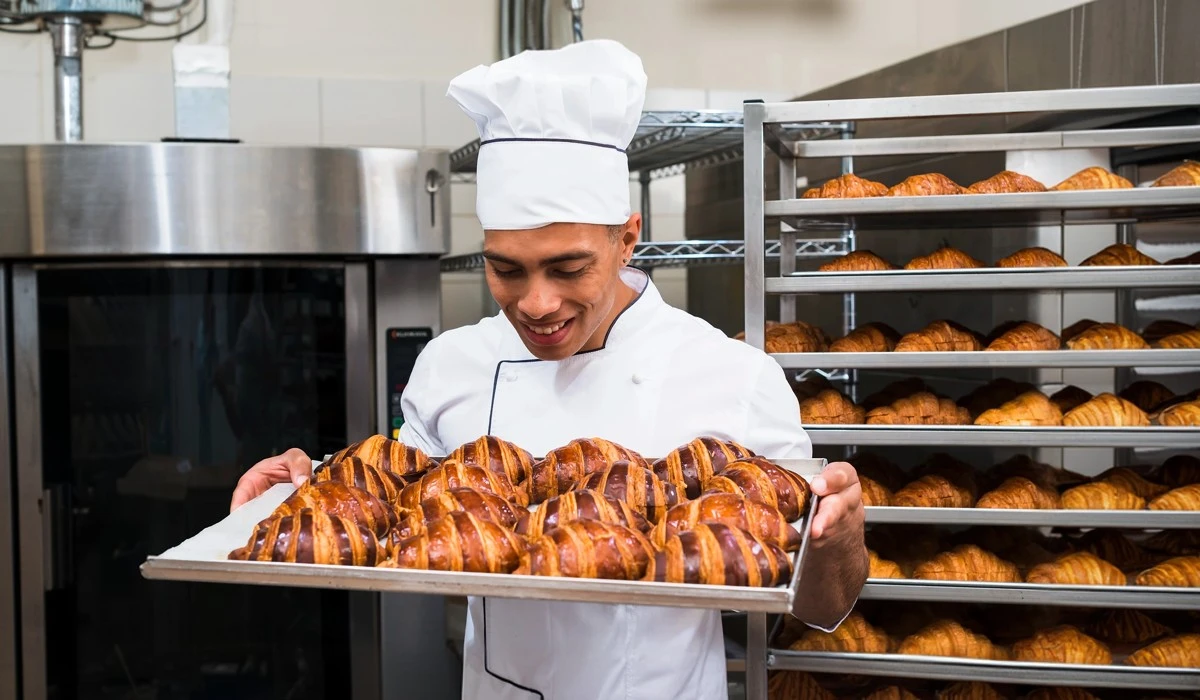
Bakery and Patisserie Technology For The Crunch
You bite into a fresh croissant, expecting a sharp crunch that showers your plate with golden flakes. Instead, you find a soft, bready interior that feels heavy on the tongue. This failure usually stems from a breakdown in the physical layers long before the tray enters the oven. While many bakers rely on feel, the most successful kitchens treat dough like a structural engineering project.
Precision makes the difference between a soggy roll and a world-class pastry. Modern Bakery and Patisserie Technology removes the guesswork from this process by controlling exactly how fat and flour interact. These tools help bakers successfully execute advanced pastry lamination methods that once took years to learn by hand.
Today, we see a shift in how professionals approach the bake. In 1838, an Austrian officer named August Zang brought the Kipferl to Paris. This move changed the industry forever, shifting dough from a simple brioche style to the multi-layered laminated structures we love today. Now, we use high-tech sensors and automated rollers to perfect that legacy.
The Science of Modern Bakery and Patisserie Technology
Crispness starts with a physical event called the Leidenfrost Effect. Research published in ScienceDirect explains that the rising of pastry occurs when steam is generated and then trapped by the layers of fat. When you place laminated dough in a hot oven, the water trapped within the fat layers reaches 100°C (212°F) almost instantly and flash-vaporizes into steam. The study indicates that this vapor pushes upward, physically lifting the dough layers apart before the structure sets.
Modern Bakery and Patisserie Technology manages this expansion by ensuring the fat stays in distinct sheets. If the fat melts too early, the steam escapes. This results in a flat, greasy product. To prevent this, technology monitors the starch gelatinization threshold. As documented in a ScienceDirect study, starch typically undergoes gelatinization in water across a temperature range between 60°C and 75°C. The fat must remain separate until the dough reaches this temperature to ensure the "lift" becomes permanent.
Molecular Precision in Dough Handling
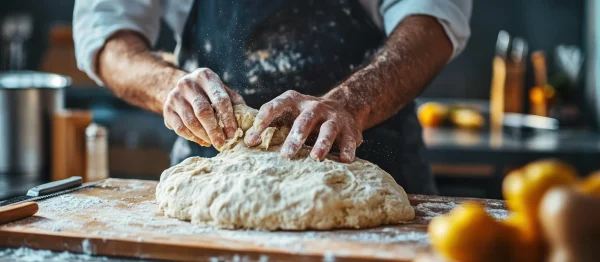
Successful pastry lamination methods require a strong protein network. According to findings in Food Chemistry via ScienceDirect, many industrial producers incorporate glucose oxidase to reinforce the wheat dough. This enzyme establishes a network that supports heavy fillings without the pastry collapsing. Meanwhile, adding just 0.01% L-cysteine helps break specific bonds in the gluten. This allows the dough to stretch during mechanical sheeting without tearing. These small chemical adjustments ensure the dough remains thin enough to shatter upon the first bite.
Refining Precision Pastry Lamination Methods
Lamination involves a strict mathematical process. Bakers encase a fat block, known as the beurrage, inside a flour-and-water dough called the détrempe. This combined package is the pâton. As explained by Brod & Taylor, the term "turn" denotes a full cycle of rolling and folding. The study further notes that in the formula L=(F+1)^n, F indicates the fold type and n signifies the number of completed turns.
Bakery and Patisserie Technology ensures that these layers remain uniform from the first fold to the last. While a human might press harder on one side of a rolling pin, a machine applies the same pressure across every square inch. This uniformity prevents the fat from breaking through the dough, which would ruin the lamination.
Achieving the Perfect "Lift" Through Uniformity
What makes pastry layers stay crispy? The answer lies in achieving paper-thin dough layers separated by intact fat barriers that flash-boil in the oven. This creates the internal pressure required for maximum expansion. If the layers vary in thickness, the steam escapes through the weak spots.
Modern sheeters use programmable logic controllers (PLC) to prevent this. These computers store up to 100 different reduction programs. They adjust the rollers for different dough types, ensuring the fat-dough boundaries stay sharp. This level of accuracy is why professional pastries look so much taller and more defined than home-baked versions.
Temperature Control as a Base for Success
Temperature dictates the behavior of fat. Specifications from President Professionnel indicate that professional lamination requires "Dry Butter," also called beurre de tournage. This product contains 82% to 84% fat and has a melting point between 34°C and 38°C. If the room gets too warm, the butter loses its structure.
Advanced Bakery and Patisserie Technology uses climate-controlled rooms to keep the fat in its Beta-prime (β') crystal form. A study archived in PubMed Central notes that fats exist in three polymorphic states: alpha, beta, and beta-prime. This specific crystal structure makes the butter smooth and plastic. Plasticity allows the butter to spread thin without snapping. Bakers must keep the dough between 15°C and 20°C (59°F-68°F) during the folding process to maintain this state.
Preventing Fat Melt-In During the Lamination Cycle
If the dough temperature climbs above 26°C, a problem called "oil-out" occurs. The fat melts, and the dough absorbs it. This turns your laminated pastry into standard bread. Digital retarder-proofers prevent this by maintaining a strict 75-85% humidity. This moisture level keeps the dough from forming a "skin." Dry skin blocks the steam from expanding the layers, resulting in a tough, chewy crust instead of a crispy one.
Why Bakery and Patisserie Technology Prevents Fat Leakage
Fat leakage often happens when the dough undergoes too much stress. When a baker rolls dough by hand, the gluten often snaps back. This tension can squeeze the fat out of the sides of the dough. Modern Bakery and Patisserie Technology solves this with "stress-free" sheeting lines. These machines use satellite rollers and multi-stage reduction to thin the dough gently.
A thickness reduction of only 10-15% per pass allows the machine to preserve the tiny gas cells inside the dough. This keeps the fat trapped exactly where it belongs. Advanced sensors also monitor the elasticity of the dough in real-time. If the dough becomes too tense, the machine slows down to allow the protein network to relax.
Stress-Free Sheeting and Dough Relaxation
The use of a dough sheeter improves pastry because it applies even, calibrated pressure that prevents the "tearing" of fat layers common with manual rolling pins. This consistency ensures the fat stays encased. For even better results, some bakers use "inverted" lamination. In this method, the butter-flour block wraps around the dough. This method leads to less shrinkage in the oven and creates a more friable, shattering texture.
Digital Monitoring and High-Volume Consistency
Scaling a bakery from ten croissants a day to ten thousand requires massive precision. Automated Bakery and Patisserie Technology allows large operations to maintain boutique quality. According to research published in the Journal of Dairy Science, some industrial lines utilize Anhydrous Milk Fat (AMF). This fat has a melting point of up to 40°C, which allows for production in tropical climates where standard butter would fail instantly.
Once the pastries finish baking, the cooling process becomes the next hurdle. Traditional cooling takes 90 minutes, which can make the crust soft as moisture migrates from the center. Vacuum cooling technology fixes this. A reduction in atmospheric pressure decreases the cooling time to just 3 minutes. This flash-evaporates the leftover moisture and sets the crispy crust immediately.
Real-Time Humidity and Airflow Adjustments
Is automated lamination better than manual? While manual craft is vital for learning, automation provides a level of thermal stability and repetitive accuracy that is nearly impossible to maintain over a 10-hour shift. Patented technology for oven control describes the use of infrared (IR) sensors to monitor the heating process. They observe the pastry surface and initiate the Maillard reaction, the browning process, only after the internal moisture drops below 5%. This ensures the pastry is truly dry and crispy, not just brown on the outside.
Integrating Advanced Tools into the Artisan Kitchen
Small bakeries can also benefit from Bakery and Patisserie Technology. Entry-level reversible sheeters allow artisans to produce consistent layers without the physical strain of a rolling pin. These machines ensure that the "French lock-in" (starting with 3 layers) or "English lock-in" (starting with 5 layers) remains perfect every time.
Bakers also use tools like Acoustic Envelope Detectors (AED). Research from Newcastle University details how these devices record sound pressure levels and the number of sound peaks to measure the sound of a pastry breaking. Measurement of the decibel level and frequency of the "crunch" allows bakers to objectively prove which methods produce the crispiest results. This data helps them refine their recipes for maximum effect.
Selecting Equipment for Maximum Texture Results
Choosing the right equipment depends on your goals. A US Patent describes the use of ultrasonic blades that vibrate between 20,000 and 40,000 Hz to cut unbaked dough without pressing the layers shut. These devices help preserve the "lift" at the edges of the pastry. To extend shelf life, technology-driven emulsifiers like DATEM slow down the staling process. This keeps the internal crumb moist while the outside stays sharp and crunchy.
Advancing Your Craft with Bakery and Patisserie Technology
Modern tools act as an extension of the baker’s skill. Through proficiency in Bakery and Patisserie Technology, you gain more control over the final product. The prevention of moisture ruining your crust is possible through the monitoring of water activity (aw) in your fillings. You can also use digital sensors to ensure your dough never hits the "oil-out" temperature.
The industry is growing rapidly because of these innovations. By 2013, the automated baking market in emerging regions reached over US$25.4 billion. This growth shows that people everywhere value the consistent quality that technology provides. Embracing these tools allows you to focus on creativity while the machines handle the mathematical precision.
The Future of Bakery and Patisserie Technology
The heart of a great pastry always remains with the baker, but the character of its texture resides in the Bakery and Patisserie Technology used to build it. Every crispy layer represents a victory over heat, moisture, and tension. The application of advanced pastry lamination methods ensures that every customer experiences that perfect brittle crunch.
Precision tools do more than just save time. They protect the integrity of the ingredients and the history of the craft. Whether you use vacuum cooling to set a crust or PLC programs to manage your folds, Bakery and Patisserie Technology provides the basis for excellence. As the industry evolves, those who combine traditional passion with modern Bakery and Patisserie Technology will continue to lead the way in creating the world’s most irresistible pastries.
Recently Added
Categories
- Arts And Humanities
- Blog
- Business And Management
- Criminology
- Education
- Environment And Conservation
- Farming And Animal Care
- Geopolitics
- Lifestyle And Beauty
- Medicine And Science
- Mental Health
- Nutrition And Diet
- Religion And Spirituality
- Social Care And Health
- Sport And Fitness
- Technology
- Uncategorized
- Videos

