
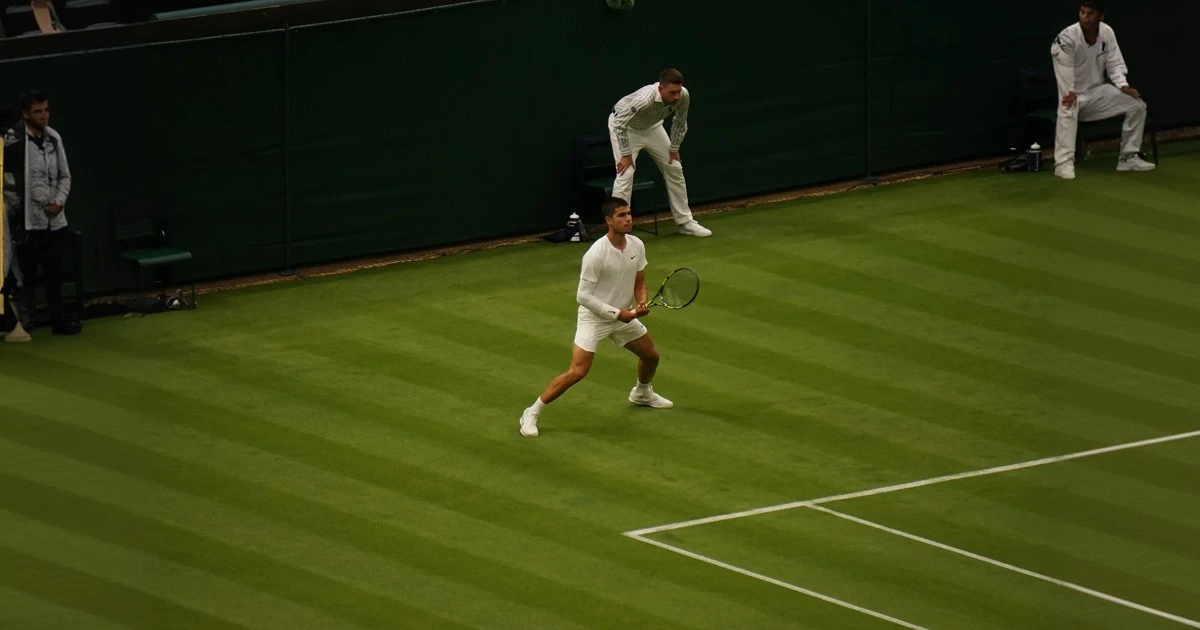
Image Credit - By Wikimedia Commons
Why Carlos Alcaraz Rejects “Carlos” On Court
Most professional athletes tighten their muscles when the pressure spikes, believing that intensity reduces errors. Carlos Alcaraz operates on the exact opposite principle. He discovered early on that seriousness restricts his physical genius, while a relaxed state releases it. This internal switch creates a strange reality where he performs better when he ignores the gravity of the situation. When the stakes are highest, he forces himself to smile, not to show off, but to physically release his range of motion.
The tennis world views this joy as simple charisma, yet his lighthearted demeanor serves a strict tactical requirement. If he stops enjoying the rally, his feet slow down and his shots lose their sting. This connection between mood and movement explains his specific preference for how people address him. He rejects the name "Carlos" because it sounds too stern, like a parent scolding a child. He plays his best tennis when he feels like "Carlitos" or "Charlie," keeping the weight of history off his shoulders.
The Identity Switch That Releases Power
Names often carry instructions on how to behave, and this psychological cue dictates his performance on the court. Using his full legal name accidentally primes his brain for trouble. As told to Tennis365, he does not mind if people call him Carlitos or Charlie, noting that close family has used Carlitos since he was very young, though he often introduces himself as Charlie. That seriousness is the enemy of his natural flow. He prefers "Charlie" or "Carlitos" because these names strip away the professional pressure and return him to the mindset of a kid in El Palmar.
He told Sportskeeda that he always remembers his grandfather’s motto of "three Cs"—head, heart, and balls—which stays with him constantly. He balances tactical intelligence with passion and bravery. The "Charlie" persona allows him to access the "heart" portion of that formula without getting bogged down by the "head." When he embraces the playful identity, the difficult shots land. When he reverts to the serious "Carlos," the unforced errors pile up.
A New Creature Made of Old Parts
His game resembles a collage of the sport's greatest nightmares rather than a new invention. Andre Agassi observed that Alcaraz combines the best traits of the "Big Three" simultaneously. He possesses the defensive elasticity of Novak Djokovic, the heavy spin of Rafael Nadal, and the delicate touch of Roger Federer. This combination creates a problem for opponents because there is no safe place to hit the ball. Andy Roddick pointed out that his drop shot might be the single best shot in the history of the sport. This is not hyperbole. He disguises the move so well that opponents cannot react until the ball is already dead on the clay. He mixes these soft touches with explosive power, creating a high-risk, high-reward system. Sometimes this leads to baffling choices, like attempting a volley from no-man's-land, but more often it produces winners that look physically impossible.
Racing Against History
The standard learning curve for tennis professionals collapsed completely under his feet. Most players spend years grinding on the lower circuits, but Alcaraz treated the rankings like a speedrun. He debuted on the Challenger Circuit in 2019 and immediately claimed his first title, beating Jannik Sinner in Alicante. A report from the ATP Tour notes that at just 16, he stayed up past his bedtime to win his debut match at the Rio Open in 2020. The tennis world barely had time to learn his name before he started taking down legends.
His breakthrough at the 2021 US Open, where he reached the quarterfinals by beating Stefanos Tsitsipas, signaled that he was ready for the main stage. The very next year, he won the US Open. Reuters reported that he also became the first teenager to beat Nadal and Djokovic in the same tournament on consecutive days at the 2022 Madrid Open. People often wonder about his rapid rise. How old was Alcaraz when he first became World Number One? The same Reuters report highlights that at 19 years and four months, he became the youngest world number one in ATP rankings history. This timeline defied all conventional wisdom about the maturity required to lead the sport.
Happiness as a Tactical Requirement
Smiling during a brutal fifth set usually signals resignation. Here, however, it targets the opponent. For Carlos Alcaraz, "Happy Tennis" serves as the fuel for his motor rather than functioning as a mere marketing slogan. He believes that enjoyment is essential for victory. If the joy disappears, the wins disappear. This philosophy contradicts the old school approach where suffering and stoicism were the only paths to a trophy. He prioritizes instinct over rigidity.
While other players stick to a strict game plan, he allows himself to improvise. This freedom keeps his muscles loose and his mind clear. When the pressure mounts, he looks for a reason to smile at his box. This resets his mental state. What is Alcaraz's motto? He relies on the phrase "cabeza, corazon, cojones," reminding himself to use his head, heart, and courage in equal measure. This mental approach turns stressful tie-breaks into opportunities for creativity rather than moments of fear.
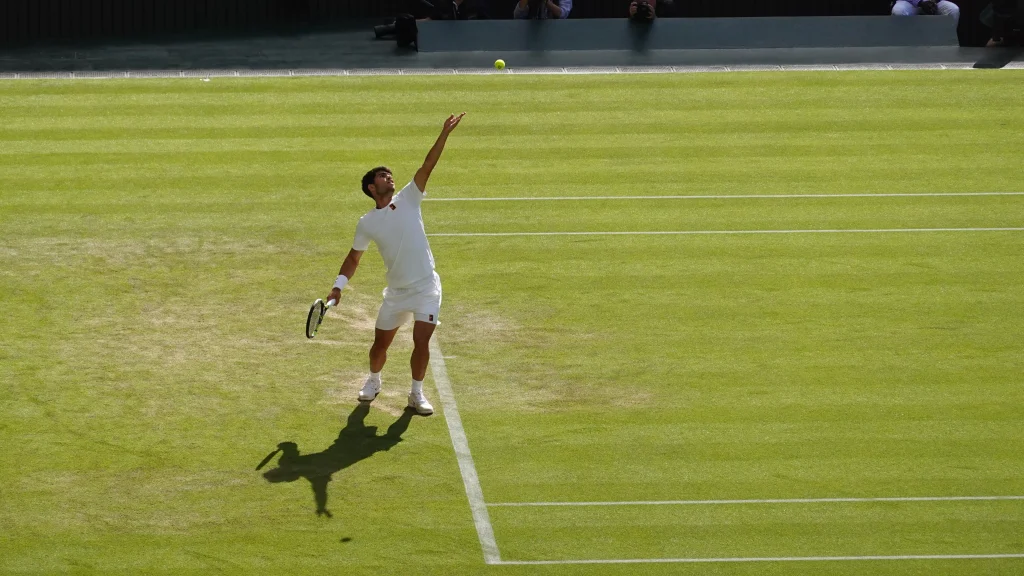
Image Credit - By Wikimedia Commons
The Physical Cost of High Speed
Playing at maximum intensity creates a debt the body eventually forces you to pay. The explosive movement that defines his game also puts tremendous strain on his joints and muscles. His career path twists rather than moving in a straight line, punctuated by significant physical breakdowns. An abdominal tear in 2022, a hamstring issue in 2023, and a forearm injury in 2024 all forced him to the sidelines. These injuries reveal the double-edged sword of his athleticism. He moves faster than anyone else, but that speed requires extreme torque. Sometimes the frustration boils over. While he usually maintains his composure, he is not immune to outbursts. A rare racket smash in Cincinnati in 2024 showed that even he struggles to contain the fire. He has matured from a temperamental prodigy into a champion, yet the physical toll remains a constant threat to his dominance.
The End of the Ferrero Chapter
Even the most successful partnerships eventually become cages that limit further growth. Juan Carlos Ferrero was the architect of the early Carlos Alcaraz years. Ferrero spotted the unorthodox potential early and instilled the professional habits regarding sleep and diet that turned a raw talent into a machine. He guided him to World Number One and multiple Grand Slam titles. However, every student eventually outgrows the teacher. According to Reuters, Alcaraz and Ferrero announced their split in December 2025, ending a successful seven-year partnership. This marked the end of a defining chapter. As noted by AP News, Samuel López had previously joined the team to work alongside Ferrero for the 2025 season, adding new perspectives. The decision suggested that to stay at the top, he needed a new voice. This coaching change was a gamble, removing the safety net that had supported him since his teenage years.
Completing the Puzzle Down Under
Greatness requires conquering every surface, even the ones that fight your natural instincts. At the end of 2025, Alcaraz had engraved his name on the US Open, Wimbledon, and French Open trophies. The Australian Open remained the final hurdle. The hard courts in Melbourne require a specific type of endurance and precision. In January 2026, he arrived with a new coaching setup and a clear mission. He tore through the draw and claimed the title, completing the Career Grand Slam at just 22 years old. This victory cemented his status as a historic figure, not just a passing phenomenon. He became the youngest man to win all four majors, breaking records held by the legends he grew up watching. How many Grand Slams has Alcaraz won? As of early 2026, he holds seven total major titles, securing at least one victory at each of the four Grand Slam tournaments.
Measuring the New Kings
Iron sharpens iron only when the metal is strong enough to survive the strike. The rivalry with Novak Djokovic served as the ultimate test for Carlos Alcaraz. He beat Djokovic in a five-set thriller to win Wimbledon in 2023, proving he could handle the mental game of the greatest player ever. However, Djokovic struck back. Reuters reported that he secured the Golden Slam in a magnificent battle, while AP News noted he won his first Olympic gold by defeating the Spaniard in straight sets.
These battles forced him to evolve. Now, his primary competition comes from his peer, Jannik Sinner. Their head-to-head record sits at 10-6 in favor of the Spaniard. The Guardian acclaimed their 2025 French Open final as one of the sport's greatest matches. Steve Flink called his 2024 Olympic display against Djokovic the "best two-set match ever seen." These rivalries define the new age. He fights giants and wins rather than dominating a weak field.
Conclusion: The Smile That Conquered the World
The rise of Carlos Alcaraz proves that technical perfection is useless without the right mental approach. He disrupted the tennis hierarchy by refusing to let pressure crush his spirit, rather than relying solely on hitting the ball harder. Rejection of the serious label of "Carlos" in favor of the joyful "Charlie" allows him to maintain peak performance when others crumble. With seven Grand Slams and a completed set of majors by age 22, the strategy clearly works. He plays a game that looks impossible because he refuses to take it too seriously.
Recently Added
Categories
- Arts And Humanities
- Blog
- Business And Management
- Criminology
- Education
- Environment And Conservation
- Farming And Animal Care
- Geopolitics
- Lifestyle And Beauty
- Medicine And Science
- Mental Health
- Nutrition And Diet
- Religion And Spirituality
- Social Care And Health
- Sport And Fitness
- Technology
- Uncategorized
- Videos

