
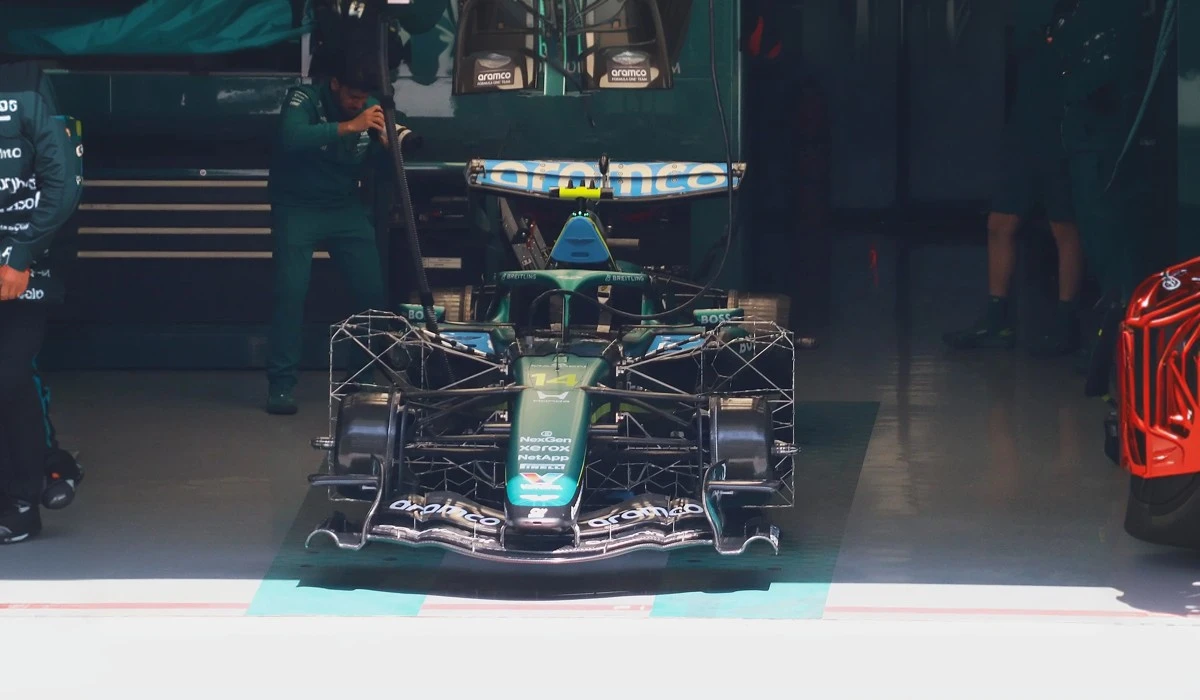
Image Credit - by Liauzh, CC BY 4.0, via Wikimedia Commons
The Aston Martin F1 Struggles Nobody Saw Coming
Aston Martin came into 2025 with one of the most hyped driver lineups on the grid and Adrian Newey in the building. So why is the AMR26 slower than a midfield car at a track where it should be fighting for points?
The answer is not what most fans think. GPS telemetry data from four-time trial sessions puts the team 3.6 seconds off the baseline pace. That is not a power unit problem. That is a car that was never fully developed before it hit the tarmac. A missed wind tunnel window, a chassis that shakes itself apart, and a supply chain stripped of experienced engineers all stacked up at once. The Aston Martin F1 struggles are not one failure. They are several failures running simultaneously.
According to an official Formula 1 announcement, administrators paused the motorsport season in April, canceling the Bahrain and Saudi Arabian Grands Prix. That break gave journalists time to ask questions. What the telemetry answered was brutal.
The Timeline Crunch Behind the Aston Martin F1 Struggles
Adrian Newey joined the team last March to lead a complete vehicle redesign. What happened next set the tone for the entire season.
The engineering team missed their April wind tunnel entry window. That single scheduling failure compressed the development schedule for the whole year. Engineers had to finalize the aerodynamic shape of the car without adequate testing time. The resulting chassis came out overweight and structurally clumsy.
As reported by ESPN, starting wind tunnel development 4 months adrift of rivals left almost no room to correct errors before the season opener. In Formula One, a delay of even a few weeks guarantees an overweight, unresponsive car for the entire year. There isn’t any shortcut through that process.
The AMR26 suffers in high-speed corners as a direct result. The rushed design phase severely limited aerodynamic evaluations. Newey currently rates the chassis as roughly the 5th best on the F1 grid. He is certain that the team has the ability to become Q3 contenders eventually. Right now, the car demands near-perfect laps just to stay out of last place.
Why the Aston Martin F1 Struggles Point Directly to the Chassis
GPS telemetry removes all opinions. It isolates exact time losses across specific track sections, and the numbers are not kind. Aston Martin sits 3.6 seconds off the baseline pace across those four-time trial sessions. Alpine, fifth fastest, sits 1.268 seconds off the pace. Haas, sixth, posts a 1.567-second deficit. Aston Martin is not battling for sixth. The gap to the top ten is enormous.
Why is Aston Martin so slow in F1 right now? The team loses roughly 2.3 seconds purely due to a flawed, overweight chassis that struggles through high-speed corners. Senior sources at Suzuka confirmed this chassis gap using GPS tracking data. The issue does not stem from the power unit. The team runs Mercedes-equivalent engine performance. Formula One rules dictate that customer engines follow identical specifications to works teams. McLaren proved this by achieving full parity with Mercedes using the same power unit.
Pit wall location and garage positioning follow historic convention and give every partner team access to the same data. The real difference between partner squads comes down to integration timelines. Aston Martin lost time there. A lot of it.
The Tremor Threat Tearing the Cars Apart
Carbon fiber is stiff by design. It is also a perfect conductor of vibration. That combination is now a serious health risk for both Aston Martin drivers. As highlighted by Crash.net, Honda's power unit produces extreme vibrations that travel directly from the internal combustion engine into the steering wheel. Formula One carbon structures offer zero shock absorption. Every tremor transfers straight into the driver's hands.
Fernando Alonso maxes out his physical endurance after 25 laps. Lance Stroll hits his limit after 15. Both drivers face a real risk of permanent nerve damage to their hands. The violent shaking also destroys the car itself. Mirrors detach from sidepods at speed. Taillights fall off the rear wing mid-race.
The battery damage is even worse. Formula One rules allow each team two battery units per season. A report from Reuters reveals the violent shaking forced Aston Martin to consume four units by the Australian Grand Prix, having already lost several in testing. The factory holds zero spare batteries in reserve. That is not a performance problem. That is a survival problem.
The Blame Game Between Honda and Newey
Two engineering departments are pointing at each other while the car falls apart between them. Newey holds the power unit responsible. He cites the internal combustion engine and the motor generator unit as the primary sources of the vibrations. Honda boss Koji Watanabe sees it differently. Watanabe states the engine tremors remain tolerable during standard dyno evaluations. The massive intensity spike only appears during chassis integration. He claims the AMR26 chassis actively makes the shaking worse.
Does Honda still make F1 engines for Aston Martin? Yes. Honda partnered with Aston Martin to supply spec power units for the current regulatory era. But the integration process between the two parties broke down. Newey reportedly submitted late integration requests to Honda, which severely complicated the assembly timeline. Engineer Ikuo Takeishi notes that multiple components interacting improperly create the abnormal tremors. Takeishi eventually halted track operations entirely for safety reasons as battery destruction reached critical levels.
Neither side is walking away. But both sides acknowledge the fix requires full collaboration, and right now that collaboration is behind schedule.
The Corporate Brain Drain That Crippled Honda
The Aston Martin F1 struggles did not start on the track. Part of the story began in Honda's engineering department at the end of 2021.
Honda suffered a massive personnel drain as engineers migrated to the growing solar panel industry. The manufacturer lost essential technical expertise and then re-entered Formula One late in 2022. They managed to retain only about 30 percent of their original F1 technical team. That sudden loss of experienced talent caused a direct failure to meet original power output targets.
Development restrictions made things worse. Honda entered a strict budget cap phase for the 2023 season. Meanwhile, competitor manufacturers faced zero financial restrictions throughout 2021 and 2022. Newey claims he had no knowledge of this massive staff exodus until a Tokyo meeting in November. Honda insists they made their exit and return announcement timelines clear to the entire grid. That communication gap delayed major engineering solutions and continues to cost the team time.

Image Credit - by Liauzh, CC BY 4.0, via Wikimedia Commons
Missing Mileage and Crumbled Batteries
A Formula One car needs thousands of kilometers to expose its buried flaws. Aston Martin did not get close. According to F1i, Aston Martin logged just 2,115 kilometers during pre-season testing, barely a third of the distance covered by front-running competitors. That was the lowest mileage total on the entire grid. Low track time masked the vibration problems until the season officially started. By then, the damage was already happening.
Will Aston Martin improve their F1 car this year? The team plans to introduce consistent upgrades throughout the season, prioritizing basic reliability fixes over raw performance gains. The Australian Grand Prix exposed the severity of the battery crisis. Extreme vibrations shattered internal battery cells on track. Takeishi halted the cars entirely to prevent electrical fires. The team exhausted their component limits immediately. Solving this requires both the chassis builders and engine suppliers working together, not in parallel and not after the fact.
A Mountain of Deficits on Race Day
The Japanese Grand Prix gave Aston Martin a team finish. Alonso crossed in 18th place, a massive 70 seconds out of the points. The team debuted new chassis upgrades at Suzuka, including major revisions to the front wing and floor. Those aero adjustments aimed to stabilize the car through high-speed sectors.
The lap time data tells a complicated story. Pole position times worsened year-over-year across multiple rounds. The car lost 3.422 seconds in Australia, 1.423 seconds in China, and 1.793 seconds in Japan compared to the previous year. Race day fastest laps showed small gains in Australia and China, dropping 0.076 and 0.179 seconds respectively. Japan recorded a race lap deficit of 1.467 seconds.
Safety car timings add a luck factor to all of these numbers. Mercedes data shows Andrea Kimi Antonelli would secure a victory regardless of safety car positioning in similar conditions. Team principal Mike Krack acknowledges the performance gap and sees no need for a truce with Honda. He insists the partnership remains solid.
Escaping the Aston Martin F1 Struggles
Formula One punishes small mistakes with large deficits. The Aston Martin F1 struggles come from a chain of development delays, corporate talent losses, and violent physical forces working against the team simultaneously.
The missed April wind tunnel window guaranteed an overweight car. The rigid chassis turned normal engine vibrations into shockwaves that destroyed batteries and put drivers at medical risk. Both Honda and the chassis division must solve the integration failure together. A repaired power unit does nothing if the frame tears the electronics apart on the first lap. A complete chassis rebuild requires track time the team does not currently have.
Every upgrade this season must focus on vehicle survival before chasing podium speeds. The telemetry data shows exactly where the time is going. The Aston Martin F1 struggles are fixable, but only if both sides of this partnership stop pointing fingers and start solving the same problem.
Recently Added
Categories
- Arts And Humanities
- Blog
- Business And Management
- Criminology
- Education
- Environment And Conservation
- Farming And Animal Care
- Geopolitics
- Lifestyle And Beauty
- Medicine And Science
- Mental Health
- Nutrition And Diet
- Religion And Spirituality
- Social Care And Health
- Sport And Fitness
- Technology
- Uncategorized
- Videos

