
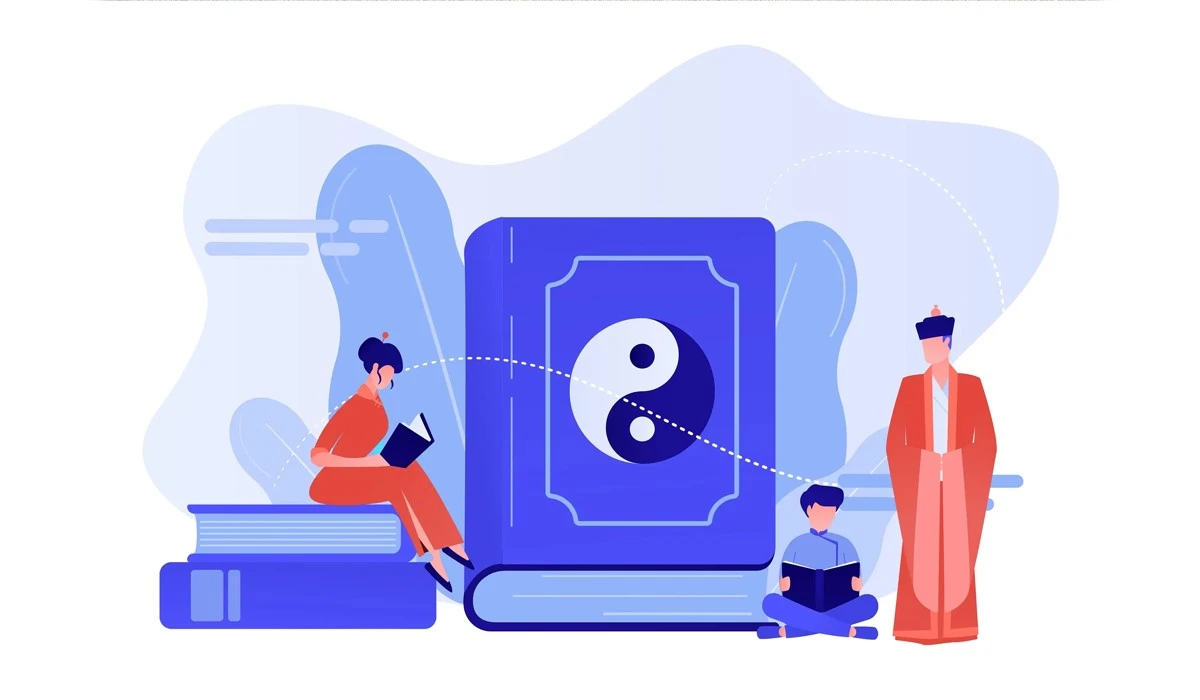
Taoism and Wu Wei for Effortless Living
When you push a swinging door with all your strength, it often slams shut or breaks. When you wait for the natural swing, it opens wide with almost no effort. Most people treat their lives like that heavy door. They wake up and immediately start fighting the world. They believe that more sweat and more force always bring more success. In reality, this constant friction burns people out before they even reach the finish line. Taoism offers a different path. It teaches us that the hardest way forward usually creates the most resistance. Learning the wu wei philosophy helps you stop fighting the grain of life. You start using the natural momentum of your environment to move faster. Thriving happens when you align your internal energy with the external world.
The Core Framework of Taoism for Modern Success
Everything in the world follows a natural rhythm. Trees grow without straining their limbs. The tides turn without a motor. Taoism calls this the "Dao," or the Way. It represents the basic order of the entire universe. When you work against this flow, you feel tired and stuck. High achievers often think they must manufacture every outcome. However, aligning with the Way means you spot opportunities instead of trying to force them. This shift turns an exhausting career into a sustainable path.
The ancient sage Laozi wrote about these principles during the Warring States Period. He saw leaders failing because they tried to control too much. He proposed a simpler way to live. Letting go of the need to dominate every situation gives you power. This approach directs your efforts toward the right methods rather than stopping them entirely. This framework turns your daily grind into a series of smooth movements. You achieve your goals when you move with the world rather than against it.
Effortless Action vs. Passive Inaction
Many people mistake wu wei philosophy for doing nothing. According to Britannica, this concept focuses on taking no action that is not in accord with the universe's natural course. Imagine a professional surfer. They don't control the ocean. They read the wave and move with it. You might wonder, what is the main principle of wu wei? The encyclopedia also states that it is the practice of "action through inaction," where a person aligns so perfectly with a situation that their efforts seem effortless and produce the best possible outcome. This represents high-level effectiveness.
You apply this when you look for the "secret openings" in your work. In the Zhuangzi, a famous story describes Cook Ding. He was a butcher whose knife never went dull. He didn't hack at the bones. He found the spaces between the joints. He moved his blade through the natural gaps. You can do the same with your projects. Instead of hitting a problem head-on with brute force, you look for the path of least resistance. This saves your energy and preserves your tools.
Identifying the "Flow State" in Everyday Tasks
Modern psychology calls this the "Flow State." When you are in flow, you lose track of time. The work feels like it is doing itself. Living the wu wei philosophy helps you enter this state more often. You stop second-guessing every move and let your skills take over. Scientists call this "transient hypofrontality." This is just a fancy way of saying your brain shuts off the part that worries and judges.
When you practice this, your productivity skyrockets. You don't feel the mental strain of forced concentration. You become like water flowing down a hill. The water doesn't think about how to get around a rock. It just flows where the gravity takes it. Trusting your training and the natural timing of events allows you to finish tasks faster. You end your day feeling energized rather than drained.
Balancing Ambition with Rest
Yin-yang harmony explains why your body eventually shuts down after a massive deadline. You cannot have the "push" of ambition without the "pull" of rest. Yin represents stillness and receptivity. Yang represents activity and fire. If you only use Yang, the fire burns the house down. Business leaders often hit a wall because they ignore the Yin side of their lives. They treat rest as a luxury rather than a requirement.
According to Britannica, Yin and Yang represent complementary, interdependent phases alternating in space and time that evoke the harmonious balance of opposites. Think of a heartbeat. The heart must contract to pump blood, but it must also expand to fill back up. If it only did one, you would die. Your career works the same way. You need periods of intense focus balanced by periods of total silence. This balance keeps your creative "Qi" or life force moving. It prevents the stagnation that leads to professional boredom.
The Interdependence of High Performance and Recovery
Many people ask, what is the concept of yin-yang harmony in a practical sense? The same encyclopedia notes that this understanding involves viewing opposing forces, like activity and rest, as alternating and interdependent phases necessary for a healthy, functioning whole. Think of a muscle. It grows during the rest phase, not during the lift itself. High performance requires high-quality recovery. If you skip the recovery, you eventually lose the performance.
A translation of the Tao Te Ching provided by Columbia University notes that Taoism teaches the Law of Reversion, meaning extreme forces eventually expand and turn into their opposites. If you work 20 hours a day (Extreme Yang), your body will force you into a long sickness (Extreme Yin). Maintaining a steady middle ground prevents this. You weave rest into your day before you feel tired. This keeps your energy levels stable for years instead of weeks.
Eliminating Decision Fatigue Through Natural Rhythm

Taoism simplifies your choices. Instead of over-analyzing every detail, you wait for the "clear water." Think of a muddy pond. If you stir it up to clean it, it stays muddy. If you wait, the dirt settles on its own. Most people make bad decisions because they act while they are still confused or emotional. They stir the pond and wonder why they can't see the bottom.
Aligning with natural rhythm means you act only when the path is clear. This reduces decision fatigue. You don't waste mental energy debating fifty different options. You watch the situation develop. When the timing is right, the correct choice becomes obvious. This patience is a form of power. It allows you to move with certainty while others are still guessing.
Intuition Over Calculation
A common search query is, how do you practice wu wei in daily life? You practice it when you let go of the need to control every outcome and instead respond to life’s challenges with flexibility and an open mind. This allows your intuition to lead the way. You stop calculating every risk and start feeling which path has the least resistance. Taoist masters call this the "Empty Vessel."
A bowl is only useful because of the empty space inside it. If the bowl is full of rocks, you can't put soup in it. Your mind works the same way. If it is full of ego and "should-be" thoughts, you can't see what is actually happening. Emptying your mind of preconceived results makes you receptive. You notice small details that others miss. This intuitive edge often leads to better results than a hundred spreadsheets.
Leading Without Control: The Taoist Management Style
The Columbia University text also highlights water as the most potent element in wu wei philosophy, noting that while it is soft and yielding, nothing surpasses its ability to dissolve hard and rigid obstacles. Great leaders use this "Water Method." They don't micromanage or use heavy-handed control. They create an environment where people feel empowered to act on their own. They lead through humility and staying "low," just as all rivers flow to the ocean because the ocean is the lowest point.
The best leader is the one people barely notice. When the job is finished and the goal is met, the team feels they did it themselves. This approach builds massive trust. It removes the friction of ego-driven management. When you stop trying to control every move your team makes, they find their own yin-yang harmony. They become more creative and more loyal because they have the space to breathe.
Collaboration Through Mutual Resonance
Teams thrive when they reach a state of mutual resonance. In a balanced team, one person brings the creative spark (Yang). Another provides the structure and grounding (Yin). They don't compete for the same space. They complement each other. Taoism views a team as an ecosystem where every part has a natural role.
When you stop striving to be the best and start striving to be the most helpful, the whole group wins. You move from competition to "Ganying," or resonance. This is the idea that when one part of a system moves in harmony, the rest of the system responds. You don't have to force people to work harder. You simply set the right tone, and the group naturally follows the flow.
Overcoming Stress by Embracing Change
As noted in the Columbia University text, Taoism views change as a constant, suggesting that recognizing this impermanence helps people stop holding on to rigid expectations. A tree that stands stiff and rigid in a storm often snaps. The willow tree bends with the wind and survives. Stress comes from resisting what is happening. When you fight reality, you lose 100% of the time. Being "like water" means you adjust to obstacles instead of hitting them head-on.
If a project fails or a market shifts, you don't break. You simply flow into the next shape. You treat every setback as a change in the terrain. This mindset makes you nearly impossible to defeat. You are not attached to one specific way of doing things. This flexibility allows you to find new paths to success while your competitors are still crying over the old ones.
Developing Emotional Stability Through Detachment

When you detach your self-worth from your results, you actually perform better. You remove the fear of failure. This lack of ego allows you to see facts clearly. Most people are too "full" of themselves to notice the truth. They want the world to fit their vision. Taoism suggests you should fit the world's vision instead.
This detachment creates a sense of calm rather than coldness. You do the work because the work is worth doing, independent of external trophies or validation. This reduces anxiety. Research by Chris Fraser published on cjfraser.net describes this as acting with a "fasted heart," where you empty your mind of preconceived content so your internal state does not depend on external praise. This stability gives you a massive advantage in high-pressure environments.
Morning Alignment: Setting the Natural Tone
Start your day with yin-yang harmony through movement. You don't need a grueling workout to be successful. According to research published by World Scientific, traditional East Asian physical and mental training methods like Tai Chi or Qi Gong focus on slow, controlled breaths and fluid motion. This centers your mind. It prepares you to face the day's Yang energy with a solid Yin foundation.
Research published in PMC indicates that practicing these slow movements in the morning improves psychological well-being by reducing anxiety and teaching your nervous system that you are safe. A separate PMC study notes that effective breathing interventions support greater parasympathetic tone, which counterbalances the high sympathetic activity intrinsic to stress and keeps you out of a "fight or flight" state. This allows you to carry the wu wei philosophy into your first meetings. You respond to emails and requests with a clear head. You set the pace for the day rather than letting the day set the pace for you.
Evening Reflection: Returning to the Source
At night, you must "empty the cup." You release the stresses and stories of the day. Many people take their work problems to bed. This creates a "Yang" sleep that isn't restful. To thrive, you must return to the source of stillness. You can do this through simple meditation or by putting away all screens an hour before bed.
This ritual ensures you stay rooted in Taoism principles even while you sleep. It allows your body to perform the deep "Yin" work of repair. When you empty your mind at night, you wake up the next morning as an "uncarved block." You are fresh and ready for whatever changes the new day brings.
Thriving Long-Term Through Taoism
True success feels light. If your career feels like a constant war, you are likely fighting the natural flow of the world. Taoism shows us that the most effective way to live is to stop striving and start aligning. You don't need to be the loudest or the hardest worker to win. You just need to be the one who best understands the rhythm of the situation. Mixing wu wei philosophy with yin yang harmony helps you reach your goals without destroying your health. You stop being a person who survives the world and start being a person who thrives within it. Align your actions with the Way, and you will find that the world begins to work for you.
Recently Added
Categories
- Arts And Humanities
- Blog
- Business And Management
- Criminology
- Education
- Environment And Conservation
- Farming And Animal Care
- Geopolitics
- Lifestyle And Beauty
- Medicine And Science
- Mental Health
- Nutrition And Diet
- Religion And Spirituality
- Social Care And Health
- Sport And Fitness
- Technology
- Uncategorized
- Videos

