
Sacred Grace Found Via Catholicism Sacraments
We often think of faith as something stuck inside our heads. We imagine prayer as a quiet thought or a feeling in the heart. But most people eventually get tired of just thinking. They want to reach out and actually touch something holy. They want the divine to have weight, texture, and a scent.
This is where Catholicism steps in. It claims that God waits for us in water, oil, bread, and wine instead of remaining only in the clouds. Instead of simply watching a play, you are watching a collision between two worlds when you walk into a church and see someone splashed with water or smell incense. This intersection is the heart of catholic sacramental theology, which studies how God uses ordinary objects as "visible signs of grace that is not seen." As noted in the Encyclopedia Britannica, St. Augustine defined these as visible forms representing grace that is otherwise unseen. For believers, these are not just symbols; they are actual encounters with a living God.
The Incarnational Basis of Catholicism
The Stanford Encyclopedia of Philosophy explains that the doctrine of the Incarnation describes how the second person of the Trinity took on a distinct and fully human nature roughly two thousand years ago. The physical world acts as a bridge instead of a distraction from the spiritual because God became a man, breaking down the barrier between the spiritual and the physical forever.
Catholicism teaches that since we have bodies, God talks to us through our bodies. Instead of sending only a mental message, He sends a physical person. This idea of the "Incarnation" is the basis of all Church rituals. It suggests that matter is good and can be used to transmit the very life of God.
The Human Need for Sensory Worship
Research published by the National Library of Medicine suggests that word learning is better supported when people have access to rich multisensory experiences. We know love through a hug, and we know comfort through a warm meal. Catholicism respects our biology by providing tangible touchpoints for faith. We see the candle, feel the water, and taste the bread.
The use of the material world ensures that catholic sacramental theology keeps religion grounded in reality. It prevents faith from becoming a vague philosophy that only exists in books. Instead, it makes grace something you can feel on your skin.
Defining the Seven Channels of Grace in Catholicism
According to the Catechism of the Catholic Church, there are seven specific rituals: Baptism, Confirmation, the Eucharist, Penance, Anointing of the Sick, Holy Orders, and Matrimony. The text also notes that Christ established these seven sacraments to reach every stage and significant moment of a believer's life. They act as a roadmap for the soul's path from birth to the afterlife.
As the Church organizes its spiritual life, it groups these rituals based on how they help the person. People often ask, what are the seven sacraments of the Catholic Church? The Vatican website further groups these rituals into the categories of initiation, healing, and those at the service of communion. Each of these seven channels provides a unique type of "sacramental grace" tailored to a specific need or challenge in life.
The Operational Beauty of Catholic Sacramental Theology
The way these rituals work is both simple and deep. According to the Catechism of the Catholic Church, a sacrament is an efficacious sign of grace that Christ established for the Church to provide divine life. A sacrament differs from a sign, like a "Stop" sign, because it carries the power to make a change happen rather than requiring a decision to stop.
For example, the water of Baptism does not just symbolize washing. The Church teaches that the water actually washes the soul instead of only representing a symbolic cleaning; specifically, the Catechism explains that Baptism is the sacrament through which justification is granted to the soul. According to the Encyclopedia Britannica, St. Augustine viewed these rituals as visible signs of grace that cannot be seen. They are the instruments God uses to perform spiritual surgery on the human heart.
The Necessity of Matter and Form
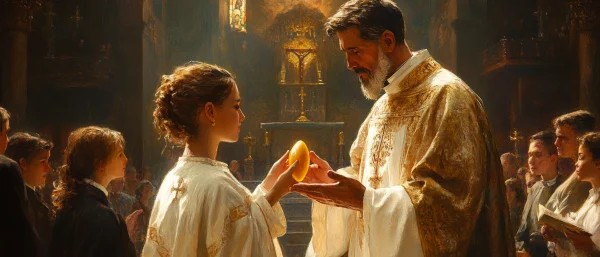
Every sacrament requires two things to be real: "matter" and "form." In a 2009 audience, Pope Benedict XVI stated that every sacrament requires both matter—the physical reality—and the word that provides spiritual meaning. The "matter" is the physical stuff, like the water in Baptism or the olive oil in Confirmation. Without the right matter, the ritual fails.
The "form" consists of the specific words spoken by the minister. Documents from the Congregation for the Doctrine of the Faith specify that the necessary words for the ritual are "I baptize you in the name of the Father, and of the Son, and of the Holy Spirit." The Church further maintains that using unauthorized formulas or skipping the water renders the baptism invalid. This precision ensures that the believer is receiving exactly what Christ intended.
Understanding Ex Opere Operato
One of the most comforting parts of catholic sacramental theology is the concept of ex opere operato. This Latin phrase means "from the work worked." The power of the sacrament depends on Christ's power rather than the holiness of the priest.
If a priest is a secret sinner, the sacrament he performs is still 100% valid. This protects the people. You don't have to worry if your priest is "good enough" for your Baptism to count. Ironically, while the grace is always offered, the person receiving it must be open to it.
Naturally, this raises questions about why we do this at all. Why do Catholics believe sacraments are necessary? They are viewed as the primary, God-ordained instruments through which Christ communicates His life to the faithful to ensure salvation and spiritual growth. Without these tools, staying connected to God’s life would be much harder for a physical human being.
How Catholicism Views Spiritual Transformation
When a person receives a sacrament, something happens inside them that changes who they are. Catholicism views this as a biological-style change for the soul instead of just joining a club or following rules. It moves the person from a state of natural life to a state of "supernatural" life.
This is the difference between "sanctifying grace" and "sacramental grace." The Catechism of the Catholic Church describes sanctifying grace as a gift from God that the Holy Spirit places in the soul to heal it from sin. Sacramental grace is like a specific vitamin that helps a specific part of the soul grow strong.
The Sacramental Seal
Some sacraments are so powerful that they can only be done once. As noted in the Catechism, Baptism, Confirmation, and Holy Orders each imprint an eternal spiritual mark or character on the soul. This is a permanent identity shift that lasts forever, even after death.
The text further explains that because Baptism is granted once for all time, it can never be repeated. Once you are baptized, you are always baptized. Even if you walk away from the faith, that mark remains. It is like a spiritual brand that shows you belong to God. This is why catholic sacramental theology insists that these three rituals can never be repeated.
The Eucharist as the Source and Summit of Catholicism
The most important part of catholic sacramental theology is the Eucharist. While the other sacraments give us God’s grace, the Eucharist gives us God Himself. According to the Catechism of the Catholic Church, the Eucharist represents the very heart and highest point of the Church’s life.
In the 13th century, thinkers like St. Thomas Aquinas explained this through "Transubstantiation." In the Compendium of the Catechism, it is explained that the "substance" of the bread changes while the outward physical traits remain the same. Substance refers to what a thing actually is, while accidents refer to its appearance, taste, and smell.
Beyond Symbolism to Substance
During the Mass, the bread and wine become Jesus instead of remaining mere symbols. The physical properties—the wheat taste and the red color—remain. However, the internal reality is now the Body and Blood of Christ.
This is a difficult concept for many to grasp, leading to frequent searches for clarity. What is the most important sacrament in Catholicism? The Catechism of the Catholic Church asserts that the Eucharist is the most significant sacrament because it truly contains the whole Christ—Body, Blood, Soul, and Divinity—instead of being a mere channel of grace. It is the moment where the physical world and the Creator become one.
Sacramental Life Within the Modern World
The goal of Catholicism is to change how people see the whole world rather than simply getting them into a church building. Through the sacraments, you start to develop a "sacramental worldview." You begin to see that everything in creation can point back to God.
A tree represents God’s creativity rather than being merely wood. A meal acts as a sign of God’s providence instead of being only calories. This perspective turns the entire world into a place where God is constantly "leaking" through the cracks of the mundane.
From Ritual to Daily Action
Receiving the sacraments should change how you treat your neighbor. If you believe that you have received the actual life of God, you cannot walk out of the church and ignore someone in need. Catholicism links the altar to the street.
When someone receives the Eucharist, they are supposed to become "bread" for others. The grace they receive gives them the strength to practice charity, seek justice, and forgive their enemies. In this way, the ritual becomes a fuel for real-world action.
Why Catholicism Prioritizes the Sacramental Encounter
At the end of the day, Catholicism is a relationship instead of being merely a list of ideas. You can study the Bible or memorize the Catechism, but those are mental activities. Catholic sacramental theology argues that a relationship needs physical presence.
Just as you cannot have a marriage purely through text messages, you cannot have a full relationship with God purely through thoughts. You need to show up. You need to eat the meal. You need to feel the water. The sacraments provide the "place" where that meeting happens reliably.
Following this roadmap supports a person from birth until death. They are washed at birth, strengthened as teenagers, fed throughout their lives, healed in their sickness, and prepared for the path into the next world.
The Enduring Beauty of Catholicism
The world can often feel cold, empty, and purely material. We are told that what we see is all there is. But Catholicism offers a different story. It tells us that the physical things we touch every day are actually windows into a much larger reality.
The lens of catholic sacramental theology reveals that God is not obscured. He waits in plain sight, waiting for us in the most basic elements of earth. This system provides a sense of peace because it makes the divine reachable. Finding God requires showing up where He promised to be, rather than being a genius or a mystic. Amidst a chaotic world, these ancient rituals offer a steady hand and a tangible reminder that we are never truly alone. Catholicism ensures that the path to the divine is always paved with things we can see, touch, and taste.
Recently Added
Categories
- Arts And Humanities
- Blog
- Business And Management
- Criminology
- Education
- Environment And Conservation
- Farming And Animal Care
- Geopolitics
- Lifestyle And Beauty
- Medicine And Science
- Mental Health
- Nutrition And Diet
- Religion And Spirituality
- Social Care And Health
- Sport And Fitness
- Technology
- Uncategorized
- Videos

