
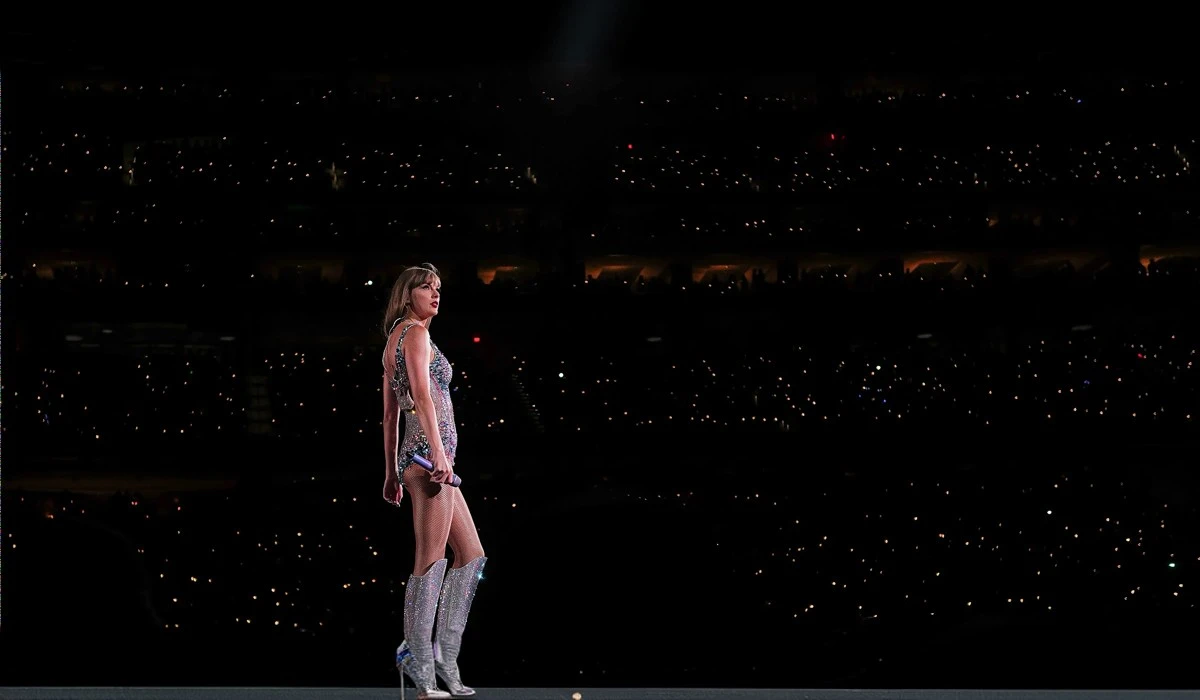
Image by- Paolo V, CC BY 2.0, via Wikimedia
Taylor Swift Tour Hid Southport Trauma
When a pilot hits severe turbulence, they grip the controls and steady their voice to keep hundreds of passengers from spiraling into mass hysteria. Taylor Swift lived this exact split reality during the final leg of her European tour. While millions saw a smiling pop star in sequins, a terrifying reality churned backstage. She had to fracture her mind into two separate pieces just to walk onto the stage. One part carried the crushing weight of the attack on a Taylor Swift dance class in Southport, while the other projected pure, untouchable joy for 3 and a half hours.
She could not show the cracks in the armor. A single slip in composure could shatter the illusion of safety for tens of thousands of people standing in a stadium. This wasn't just about performing hits; it became a desperate exercise in emotional regulation. As reported by AP News, the "The End of an Era" docuseries, which premiered on Disney+ on December 12, 2024, finally pulled back the curtain on this darkness. It revealed that while the world debated the headlines, the woman at the center of the storm fought a private war to keep her plane in the sky.
The Pilot Metaphor and Professional Dissonance
Great performers do not just act; they build a concrete mental wall that separates their personal terror from the audience’s experience. Taylor Swift explicitly compared her role during the tour to that of an airline pilot. A pilot cannot weep or tremble when the engines fail. They must remain the anchor of calm to prevent a catastrophe in the cabin. Swift applied this exact logic to her stadium shows. She understood that her emotional state directly dictated the energy of the crowd.
She faced a brutal professional dissonance. Internally, she grappled with grief and trauma following the tragedy. Externally, her job required her to manufacture a massive, joyful escapism for her followers. She described this existence as surreal. The obligation to suppress sadness wasn't a choice; it was a mandate for the show to survive. She had to lock away her grief minutes before stepping into the lights.
For 3 and a half hours every night, she smiled. She danced. She engaged with the crowd. But this wasn't simple acting. It was a high-stakes containment strategy. She prioritized the audience's need for a safe space over her own need to process the horror. She fabricated a mental refuge for her followers, even as her own sense of security crumbled.
The Reality of the Southport Tragedy
Violence often targets the most innocent spaces because the contrast between joy and horror creates the maximum psychological impact. On July 29, 2024, that horror struck a Taylor Swift-themed dance workshop in Southport. The attacker, 17-year-old Axel Rudakubana, entered the space with a specific intent. He did not bring a manifesto or a terrorist ideology. His motive was the commission of mass murder as an end in itself.
According to court documents published by the Judiciary, the weapon used was a 20cm kitchen knife purchased online. In moments, the joy of a summer dance class turned into a crime scene. A report by The Guardian confirmed that 3 teenage girls lost their lives: Bebe King, age six; Elsie Dot Stancombe, age seven; and Alice Da Silva Aguiar, age nine. The violence did not stop there. Ten other people suffered injuries. This count included eight children and two adults, Leanne Lucas and Jonathan Hayes, who tried to interfere.
Public perception often blurs the specific details of such events. People might wonder about the scale of the physical damage. How many people were injured in the Southport attack? Sentencing remarks released by the Judiciary confirm the attack injured ten people, including eight children and two adults protecting them.
The prosecutor, Sarah Hammond, later described the savagery as unrelenting. The attacker targeted the youngest and most vulnerable people in the room. He aimed to maximize terror and outrage. This wasn't a random scuffle; it was a calculated assault on innocence.
Backstage at Wembley Stadium
Healing often happens in the quiet, unscripted moments that cameras miss rather than in public statements or press releases. The narrative initially suggested a single meeting between the star and the families. The reality was far more extensive. Euronews reported that following the attack in Southport, Taylor Swift held private backstage meetings before every single one of her five Wembley shows in August 2024.
These were not photo opportunities. They were sessions of shared grief. She met with the families of the survivors and the victims. Her mother, Andrea Swift, offered comfort during the inevitable emotional breakdowns that occurred behind the scenes. Andrea believed in the positive impact these moments had on the grieving families, even while witnessing her daughter's despair.
The toll on Swift was visible to those close to her. She described the comfort offered as a necessary bridge. Despite the heaviness, she felt a responsibility to provide that physical presence. It was a stark contrast to the glitter of the stage waiting just yards away. She absorbed their pain, dried her tears, and then went to work.
The Vienna Plot and Escalating Fear
Fear evolves from worrying about your own performance to terrifying realizations about the physical vulnerability of thousands of strangers. The Southport attack was not the only threat looming over the tour. Reuters reported that in Vienna, authorities foiled a separate, distinct plot, leading to the cancellation of three concerts. This was a bomb plot, grounded in ideology, targeting the concerts directly. Swift described this cancellation as "dodging a massacre."
The two events created a compound fracture in her sense of safety. Southport was a non-ideological mass stabbing at a tribute event. Vienna was a terror plot at a live venue. The distinction mattered legally, but emotionally, they merged into a singular, overwhelming threat. For the 1st time in her 20-year touring history, Swift feared for the physical safety of her fans.
Her anxiety shifted. It was no longer about hitting the high notes or remembering choreography. It became a primal fear of a mass casualty event. She viewed the safety of the audience as a fragile thing that she had to protect. This novel fear changed the texture of the trip. Every show felt like a victory against disaster.

Image by- By The Emperor of Byzantium - Own work, CC BY-SA 4.0
Insights from "The End of an Era"
Edited footage often tells a cleaner story than the messy, chaotic emotional breakdown that happens the second the curtain drops. The release of the docuseries "The End of an Era" on Disney+ provided the visual evidence of this struggle. It didn't just show the costume changes or the set design. It showed the emotional cost of maintaining the "Pilot" persona.
Viewers saw the logistical precision required to keep the tour moving. But they also heard the exhaustion in Swift's voice. She spoke candidly about the urgent need to fabricate that mental refuge. She revealed the intensity of the stress she carried. In a call to her fiancé, Travis Kelce, she expressed relief after a show ended safely.
Coverage by AP News of the docuseries highlights that the stress was so extreme she feared amnesia. She worried she would forget her musical skills or lyrics under the weight of the pressure. The brain shuts down non-essential functions when it stays in fight-or-flight mode. Swift lived in that mode for months. The documentary captured the collision between the massive scale of her celebrity and the human fragility underneath it.
Legal Consequences and the Attacker
The legal system creates a finality on paper that rarely matches the ongoing psychological sentence served by the victims and witnesses. Axel Rudakubana, the perpetrator of the attack on the Taylor Swift workshop in Southport, faced the consequences of his actions in court. However, he denied to appear his own judgement. The judge, Mr Justice Goose, proceeded without him.
The crime was described as extreme and shocking. The sentence was life imprisonment with a least term of 52 years. Originally, the judge had to amend the sentence wording to "detained at His Majesty's pleasure" due to an age error, but the severity remained absolute. Release is unlikely. The legal system identified no terrorist ideology, despite Rudakubana’s obsession with violent historical figures and genocide.
He had a past of knife possession and school expulsion. He had been diagnosed with Autism-Spectrum-Disorder, but the court focused on the calculated nature of the attack. People often search for the final fate of such criminals. What happened to the Southport attacker? Axel Rudakubana received a life sentence with a minimum term of 52 years.
The Fan Response and Legacy
Collective grief can transform a helpless audience into a massive, organized force for tangible support. The Swifties did not just watch the tragedy unfold; they mobilized. Fans raised over £300,000 for the Alder Hey Charity, the hospital treating the victims. They viewed themselves as a "global force" capable of counteracting the darkness of the event.
The concerts became more than just entertainment. They functioned as therapeutic spaces. Fans attended to release their own emotions, finding safety in the crowd. Swift recognized this value. She knew that providing this space was the most important thing she could do, even when she felt broken.
The tour history spans 20 years, but this chapter redefined the relationship between the artist and the fan base. It wasn't just about music anymore. It was about mutual survival. The legacy of this period is not just the record-breaking numbers, but the resilience required to finish the run.
The Cost of the Show
The show creates the refuge, but the builder of that refuge often remains outside in the cold. Taylor Swift's experience during the Eras Tour highlights the brutal trade-off of global stardom. To provide escape for millions, she had to imprison her own trauma. The attack in Southport forced Taylor Swift to become a pilot flying through a storm that never truly cleared.
She projected calm. She smiled for the cameras. She met the grieving families in the shadows and then stepped into the light to sing. The "End of an Era" documentary serves as a testament to that discipline. It proves that the greatest performance wasn't the singing or the dancing. It was the act of keeping the plane steady when the world felt like it was falling apart.
Recently Added
Categories
- Arts And Humanities
- Blog
- Business And Management
- Criminology
- Education
- Environment And Conservation
- Farming And Animal Care
- Geopolitics
- Lifestyle And Beauty
- Medicine And Science
- Mental Health
- Nutrition And Diet
- Religion And Spirituality
- Social Care And Health
- Sport And Fitness
- Technology
- Uncategorized
- Videos

