
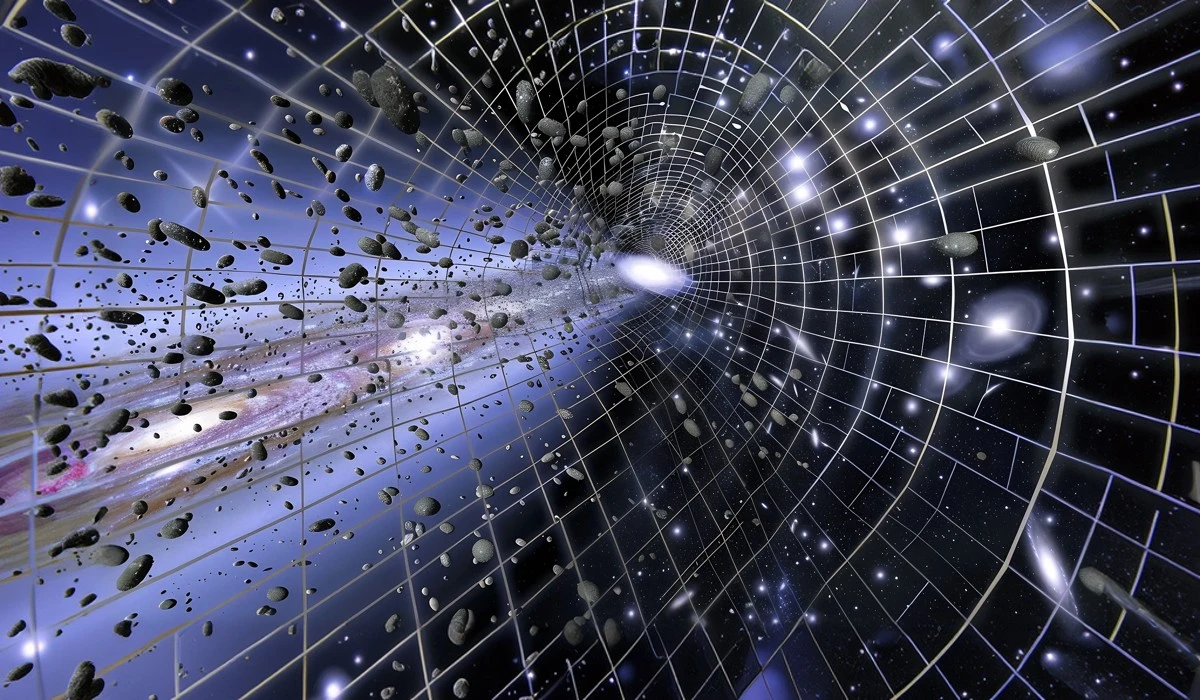
How Astrophysics Tracks Dark Matter Filaments
While galaxies are often perceived as isolated islands in the dark, the University of Oxford highlights that they actually sit at the busy intersections of long, thin highways made of gas and dark matter, which serve as paths for matter to flow into galaxies. This giant network dictates where every star and planet ends up.
Understanding how these cosmic highways grew from nothing is the ultimate goal of modern researchers. NASA records that some 13.8 billion years ago, the universe began with a rapid expansion known as the Big Bang, leading to the process we call cosmological structure formation. Astrophysics provides the tools to see this massive framework, which explains how a smooth, hot soup of particles eventually turned into the involved world we inhabit today.
The Foundation of Astrophysics in Mapping Cosmic Voids
The early universe looked very different from the one we see today. According to the European Space Agency's Planck mission, observations of the Cosmic Microwave Background (CMB) reveal a nearly uniform heat cloud, featuring only minute temperature variations of approximately one part in 100,000 across the sky. These small differences in density acted as seeds for everything that followed. Gravity went to work on these seeds immediately.
Regarding the composition of the cosmic web, the Max Planck Institute notes it is primarily composed of dark matter filaments and diffuse hydrogen gas, with galaxies concentrated at the intersections of these strands. Gravity pulled matter away from low-density areas and shoved it into high-density zones. This created the giant holes and thick walls we see in the sky today.
Defining the Voids and Nodes
As suggested by research found on arXiv, cosmic voids occupy the majority of the volume in our universe but contain only a small portion of the galaxy population. These regions contain very little matter and few galaxies, similar to giant bubbles in a sponge. Meanwhile, the nodes sit where multiple filaments meet, housing massive galaxy clusters.
Astrophysics identifies the gravitational balance that maintains these structures. Dense regions grow denser as they pull in surrounding gas. This movement empties the voids further. The contrast between these regions defines the large-scale look of our universe.
Dark Matter as the Scaffolding
Research from the Planck mission indicates that dark matter provides the backbone for the entire universe, making up about 26.8% of the total mass-energy budget. As noted by the Max Planck Institute, it also accounts for roughly 85% of all matter. Without it, stars and galaxies would never have clustered together quickly enough.
Because it does not interact with the electromagnetic force, CERN explains that dark matter does not absorb, reflect, or emit light, meaning we cannot see it directly. However, its gravity creates "potential wells." These wells act like giant funnels that capture regular gas. This gas eventually cools and collapses to form stars, which remains a central part of cosmological structure formation.
The Cold Dark Matter (CDM) Model
Scientists use the Cold Dark Matter model to describe this complicated process. In this model, dark matter moves slowly compared to the speed of light. This slowness allows it to clump together into small "halos" early in history.
ScienceDirect explains that this bottom-up assembly means small structures form first, with these pieces later joining together to build giant clusters. This hierarchical growth is a central pillar of modern Astrophysics.
How Astrophysics Decodes Large-Scale Filaments

Filaments are the longest structures in the known universe. They stretch for hundreds of millions of light-years. They consist mostly of dark matter and hot, ionized gas. Detecting these strands requires looking at how they influence their surroundings.
Addressing how astronomers see dark matter, National Geographic explains that while this substance doesn't emit light, researchers detect it by observing how its gravity bends light from distant galaxies, a process known as gravitational lensing. The measurement of these tiny distortions allows researchers to map out the weight and shape of the filaments.
The Role of Baryon Acoustic Oscillations
As published in ResearchGate, Baryon Acoustic Oscillations (BAO) act like a cosmic measuring tape. Before the universe cooled down, gravity and radiation fought a tug-of-war. This created sound waves in the hot plasma. When the universe reached a certain age, these waves froze in place.
Symmetry Magazine reports that the scale of these oscillations is roughly 490 million light-years. Astrophysics uses this "standard ruler" to measure how much the universe has expanded. It helps us track the speed of cosmological structure formation across different eras.
The Computational Power Behind Simulating the Web
We cannot wait billions of years to watch the universe grow. Instead, researchers build digital universes. They use supercomputers to run N-body simulations. These simulations calculate the gravity of billions of individual points to see how they interact.
The IllustrisTNG project adds even more detail by solving the coupled evolution of dark matter, gas, stars, and black holes. These models show that supermassive black holes actually push gas back out into the web. This prevents galaxies from growing too large, too fast.
N-Body Simulations and Supercomputing
The Monthly Notices of the Royal Astronomical Society notes that the AREPO code is one tool that makes these simulations possible, using a moving-mesh system to solve fluid dynamics. This allows for high resolution in crowded areas like galaxy centers.
These simulations must match what we see in real sky surveys. If the digital universe looks like the real one, we know our theories are correct. This validation is essential for understanding cosmological structure formation. It confirms that our understanding of gravity and dark matter is on the right track.
Observing the Growth Through Time-Slice Spectroscopy
NASA’s Hubble mission documentation notes that light takes time to travel, meaning when we look at a distant galaxy, we see it as it appeared billions of years ago. This allows us to take "time-slices" of the universe's history. We can see the cosmic web in its infancy and compare it to its current state.
Why does the universe look like a web? The universe takes on a web-like appearance because gravity pulls matter into dense clusters and long strings while dark energy pushes the gaps apart into massive empty voids. This constant stretching and pulling creates the distinctive filament pattern.
Looking Back in Time with Redshift
Astrophysics uses redshift to determine how far away a galaxy is. As the universe expands, it stretches the light waves coming toward us. Stretched light looks redder. Measuring this shift allows us to place galaxies on a 3D map of the cosmic web.
Techniques like Lyman-alpha forest tomography help map the gas between galaxies. This method looks at light from distant quasars as it passes through clouds of hydrogen. Each cloud leaves a fingerprint on the light. This lets us "see" the filaments even when they don't contain bright stars.
The Consequences of Dark Energy on Cosmological Structure Formation
Dark energy acts as the opposite of gravity. According to the University of Chicago, dark energy began to dominate the universe about five billion years ago, pushing everything apart at an accelerating rate. This acceleration changes how structures grow.
Ironically, dark energy actually slows down the building process. It pulls matter away from the filaments faster than gravity can collect it. Eventually, dark energy will stretch the voids so much that the filaments will snap. This battle is a primary focus of Astrophysics today.
The Tug-of-War Between Gravity and Expansion
The Lambda-CDM model captures this struggle. The "Lambda" represents dark energy, while "CDM" represents cold dark matter. This model predicts that the universe will become increasingly lonely.
As expansion speeds up, the distance between galaxy clusters will grow too large to cross. The cosmic web will eventually fade away. Understanding this helps us predict the ultimate fate of all cosmological structure formation. We are currently living in the peak period of the web’s involved nature.
Future Frontiers in Astrophysics and Web Mapping
New missions will soon give us the clearest view of the universe yet. The Euclid space telescope will map billions of galaxies. Its goal is to measure the shape of the cosmic web out to 10 billion light-years. This will show us exactly how dark energy has fought gravity over time.
NASA states that the Nancy Grace Roman Space Telescope will provide a field of view at least 100 times larger than Hubble. This will allow researchers to capture massive sections of the web in a single image. These tools represent the next great leap for Astrophysics.
The Next Generation of Space Telescopes
These missions focus on a period called "cosmic noon." This was the period when star formation peaked. During this time, the cosmic web was at its most active. Gas flowed heavily along filaments into the first giant galaxies.
Studying this period allows us to learn how the web feeds its inhabitants. We can see how the large-scale environment dictates the life of a single star. This connection between the massive and the minute is the heart of cosmological structure formation.
Decoding the Grand Design through Astrophysics
The cosmic web represents more than a visual pattern in the sky; it serves as a detailed record of the universe's 13.8 billion-year history. From the tiny ripples in the Big Bang to the massive clusters of today, every strand tells a story. We are just now beginning to read the chapters.
Astrophysics provides the language we need to understand this history. It turns points of light into a coherent map of reality. Tracking the growth of these filaments allows us to learn where we came from and where the universe is headed.
Stay curious about these deep-space discoveries. Each new map and simulation brings us closer to understanding the giant network that holds our world together. The growth of the cosmic web is the greatest construction project in existence.
Recently Added
Categories
- Arts And Humanities
- Blog
- Business And Management
- Criminology
- Education
- Environment And Conservation
- Farming And Animal Care
- Geopolitics
- Lifestyle And Beauty
- Medicine And Science
- Mental Health
- Nutrition And Diet
- Religion And Spirituality
- Social Care And Health
- Sport And Fitness
- Technology
- Uncategorized
- Videos

