
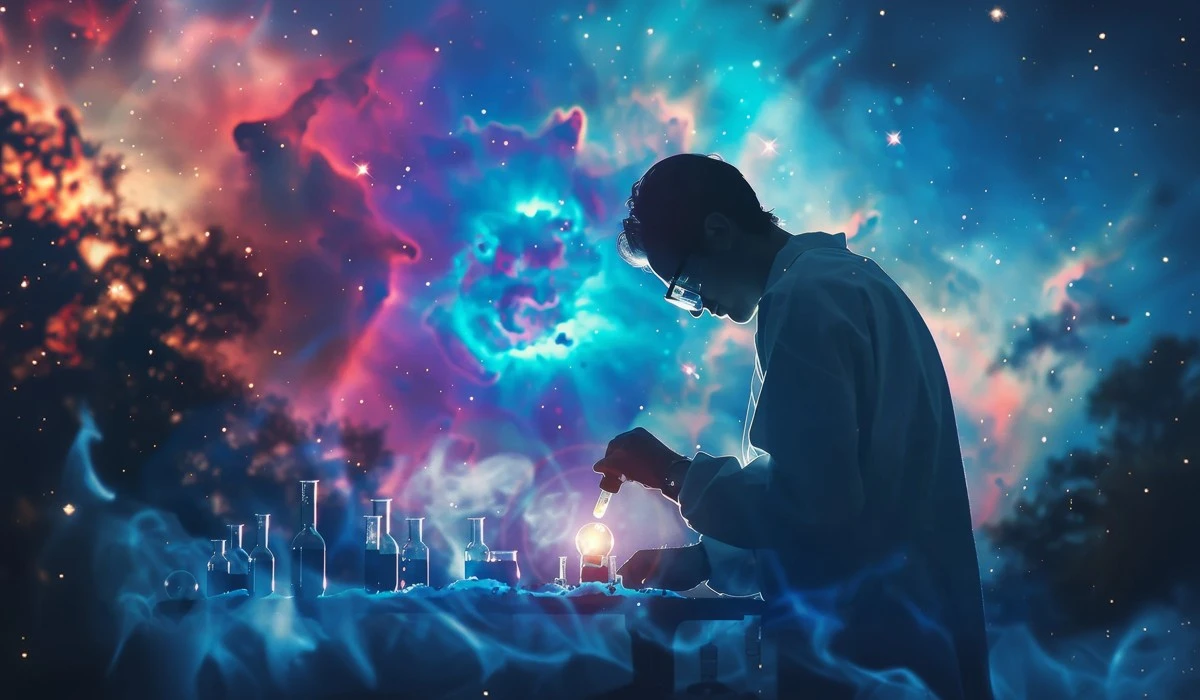
Chemistry of the Universe: Map Your Life
Every time you take a breath, you inhale atoms that floated through the void for billions of years before the Earth existed. Your body acts as a temporary home for ancient debris. You carry the history of the stars inside your cells instead of simply living in the world. When you touch your skin or blink your eyes, you use materials forged in extreme heat and pressure millions of light-years away. This reality connects your daily life to the deep past.
Understanding the Chemistry of the Universe provides a map of where you came from. Most people think of space as a cold, empty place. In reality, the cosmos functions as a massive factory that constantly builds, breaks down, and recycles matter. This process ensures that the iron in your blood and the calcium in your teeth survived a pathway across the galaxy. The identification of these elements shows that your life story began shortly after the start of time.
The Primordial Blueprint of the Cosmos
The start of the universe began nearly 13.8 billion years ago. NASA’s Goddard Space Flight Center notes that when the universe was slightly more than a few minutes old, it consisted of only three elements: hydrogen, helium, and lithium. The James Webb Space Telescope team further details that observations, experiments, and calculations confirm that only these specific elements were formed directly following the Big Bang. This period, known as Big Bang Nucleosynthesis, lasted only from three to twenty minutes. In this short window, the temperature dropped from trillions of degrees to about one billion degrees Kelvin. This cooling allowed the very first particles to stick together.
During this time, the universe produced only the simplest building blocks. It created vast amounts of hydrogen and helium, along with tiny traces of lithium. These elements served as the base for everything we see today. What are the most common elements in the universe? Hydrogen and helium make up roughly 98% of the visible matter in the cosmos, having been created in the intense heat of the Big Bang. These two gases filled the early universe like a thick fog, waiting for gravity to pull them together into the first structures.
How the Chemistry of the Universe Began in the First Stars
The early universe remained dark and filled with gas for millions of years. Eventually, gravity pulled huge clouds of hydrogen and helium together until they became dense and hot. This pressure sparked the stellar nucleosynthesis process, which turned on the lights in the cosmos. According to the James Webb Space Telescope mission overview, astronomers have determined that the earliest stars, officially known as Population III stars, were composed almost entirely of hydrogen and helium. These stars lacked the heavier elements found in modern stars, such as carbon, nitrogen, oxygen, and iron. They grew hundreds of times larger than our sun and burned through their fuel with incredible speed.
The Hydrogen-to-Helium Shift
Inside the core of a star, gravity creates a crushing force that overcomes the natural repulsion between atoms. Encyclopedia Britannica describes the proton-proton chain as a reaction where four hydrogen nuclei fuse into a single helium nucleus. This reaction releases a massive amount of energy, which we see as starlight. Without this constant pressure, the star would collapse under its own weight. How does stellar nucleosynthesis create elements? This process occurs when extreme pressure and heat in a star's core fuse lighter atomic nuclei into heavier ones, effectively acting as a celestial furnace. This specific Chemistry of the Universe changed a simple gas-filled void into a detailed chemical laboratory.
Forging the Heavier Elements
As a star runs out of hydrogen, it begins to burn helium to stay alive. Research published in Encyclopedia Britannica states that once temperatures reach between 100 million and 200 million Kelvin, stars enter the "triple-alpha" stage. This process involves the fusion of three helium nuclei to create carbon. Carbon is the essential building block for all life on Earth. In more massive stars, this process continues, creating oxygen, neon, and magnesium. Each step requires more heat and happens faster than the last. These stars act as massive pressure cookers, building the heavy materials that eventually make up planets and people.
Supernovas and the Enrichment of Space

The stellar nucleosynthesis process eventually hits a wall. Once a star creates iron in its core, it can no longer produce energy through fusion. Fusing iron actually consumes energy rather than releasing it. This creates a sudden crisis inside the star. Without the outward pressure from fusion, gravity wins the battle, and the star collapses in seconds. This collapse causes a massive explosion known as a supernova.
The Dispersal of Life-Giving Matter
A supernova explosion acts as a galactic delivery service. It blasts the elements forged deep inside the star out into space at thousands of miles per second. These explosions scatter oxygen, carbon, and nitrogen across light-years of distance. One single massive star can eject enough oxygen to support millions of planets. This material eventually mixes with gas clouds, providing the ingredients for new stars and solar systems. Without these violent ends, the heavy elements would remain trapped forever inside dead stellar cores.
Creating the Rare and the Heavy
A study in the journal Nature indicates that events like neutron star collisions allow matter to assemble into heavy elements such as gold and platinum through rapid neutron capture, also known as the r-process. During these collisions, atoms are pelted with neutrons so quickly they cannot decay, creating rare metals in the blink of an eye. In 2017, scientists observed a merger that produced several Earth-masses worth of gold. This means the jewelry you wear likely came from a cataclysmic collision between two dead stars.
Understanding Cosmic Chemical Evolution
The universe gets "dirtier" over time, and for life, that is a good thing. Each generation of stars enriches the space around it with more heavy elements. Astronomers call this cosmic chemical evolution. When the first stars died, they left behind a cloud of gas that was richer in carbon and oxygen than the gas from which they were born. The next stars formed from this enriched gas, and they, in turn, produced even heavier elements.
The California Institute of Technology’s IPAC documentation defines metallicity as the mass fraction of all elements heavier than helium. A paper hosted on arXiv notes that our sun is a Population I star, which indicates it has a high metallicity of about 1.34%. This high metal content allowed the Earth to form as a rocky planet rather than just a ball of gas. Cosmic chemical evolution essentially gardens the galaxy, preparing the soil for life to take root. Without billions of years of this celestial recycling, the universe would remain a simple mix of hydrogen and helium.
Finding Your Personal Atomic Signature in the Chemistry of the Universe
You can trace the history of the cosmos by looking at your own body. Your physical form is a mosaic of different stellar events. The water in your cells contains hydrogen from the Big Bang. The oxygen you breathe came from the outer layers of massive stars that exploded long ago. Every piece of you has a specific origin point in the history of the Chemistry of the Universe.
The Calcium in Your Bones and the Iron in Your Blood
The calcium in your bones requires a specific path. It formed during the "oxygen-burning" stage of a massive star just before it died. Meanwhile, the iron in your blood has an even more explosive history. While some iron comes from massive stars, most of the iron in the universe comes from Type Ia supernovas. These happen when a small, dense white dwarf star steals matter from a neighbor until it explodes. Are humans really made of stardust? As noted by the NASA Webb mission, nearly every atom in the human body, except for primordial hydrogen, was created inside a star or during a supernova event. This makes the Chemistry of the Universe a literal family tree for our species.
Carbon: The Backbone of Your DNA
Carbon provides the structural framework for your DNA and proteins. This element is unique because it can form four bonds with other atoms, allowing for elaborate molecules. Every carbon atom in your body was created by the triple-alpha process inside a Red Giant star. These stars lived and died before our solar system even existed. By the time the Sun formed, the local neighborhood already contained enough carbon to eventually build every human who has ever lived.
Analytical Tools for Navigating the Chemistry of the Universe
We know about these ancient processes because light carries a code. When we look at a distant star through a telescope, we see a chemical signature rather than just light. NASA’s Webb mission explains that scientists use spectroscopy to separate starlight into its constituent colors. The agency describes an element’s spectrum as its unique fingerprint or barcode, appearing as dark lines that identify its presence.
Reading the Fingerprints of Light
Spectroscopy allows us to map the chemical makeup of galaxies billions of light-years away. In 1925, Cecilia Payne-Gaposchkin used this method to prove that stars are mostly hydrogen and helium. Before her findings, most scientists thought stars had the same composition as the Earth. Today, we use these "fingerprints" to track how the ratio of elements changes across different parts of the Milky Way. This data helps us confirm that cosmic chemical evolution happens at different speeds depending on how crowded a galaxy is.
Modern Telescopes and the Chemical Map
New tools like the James Webb Space Telescope (JWST) allow us to see the very first chapters of this story. The JWST can look back in time to observe the first galaxies forming. Analysis of infrared light from these distant objects allows us to see the first signs of oxygen and neon in the early universe. This helps scientists visualize the exact moment when cosmic chemical evolution began to change the universe from a simple gas cloud into a layered, element-rich environment.
The Ongoing Change of Our Molecular Reality
The story of the Chemistry of the Universe did not end when the Earth formed. It continues today in every corner of our galaxy. In places like the Orion Nebula, massive clouds of gas and dust are currently collapsing to form new stars. These "stellar nurseries" contain the remains of previous generations, mixed with fresh hydrogen. As these new stars turn on, they begin the fusion process all over again, adding more heavy elements to the mix.
In the distant future, the universe will become even more metal-rich. However, the supply of fresh hydrogen is slowly running out. Eventually, stars will stop forming, and the galaxy will be filled with the cold remains of dead stars. But for now, we live in a golden age of chemical variety. The legacy of cosmic chemical evolution ensures that the universe remains an active system, constantly trading simple atoms for the elaborate structures required for life.
Your Place in the Chemistry of the Universe
You are a living part of the ongoing growth of the cosmos rather than a mere observer. Your body is a collection of atoms that have passed through the hearts of stars and survived the shockwaves of supernovas. Understanding the Chemistry of the Universe changes how you view a simple glass of water or the pulse in your wrist. These are the results of a 13.8-billion-year process rather than mere biological functions.
When you look at the night sky, you are looking at the laboratories that built you. The iron in your blood connects you to the death of white dwarfs, and the oxygen in your lungs connects you to the final moments of massive giants. You are a 13.8-billion-year-old masterpiece of cosmic chemical evolution. To map the stars is to simply learn the history of yourself.
Recently Added
Categories
- Arts And Humanities
- Blog
- Business And Management
- Criminology
- Education
- Environment And Conservation
- Farming And Animal Care
- Geopolitics
- Lifestyle And Beauty
- Medicine And Science
- Mental Health
- Nutrition And Diet
- Religion And Spirituality
- Social Care And Health
- Sport And Fitness
- Technology
- Uncategorized
- Videos

