

Adventure Therapy: Rewire Your Trauma Response
When you survive a terrifying event, your body keeps the record long after your mind tries to move on. Your muscles stay tight. Your breath stays shallow. You might spend years talking about your past in a comfortable office, yet your heart still races at the slightest noise.
The survival parts of your brain speak the language of action and sensation instead of English. To change how you feel, you must change how you move. Adventure Therapy offers a way to reach these deep survival circuits. Physical challenges allow you to teach your body that the danger has passed. You move out of a frozen state and back into a life you control.
The Physiological Stagnation of Trauma
Trauma physically changes the brain. According to research published in Nature, the prefrontal cortex is vital for threat inhibition and emotion regulation, though in trauma, the amygdala often becomes hyperactive and constantly scans for threats. As noted in a report by PMC4657446, the acquisition of fear responses is linked to increased amygdala activation and a failure of the medial prefrontal cortex to manage the fading of these fears. Research in PLOS ONE highlights that the medial prefrontal cortex usually regulates emotional processing, but this part that handles logic loses its connection to your emotions in trauma survivors.
Chronic stress even shrinks the hippocampus by up to 10%. This area handles your memories, which explains the "trauma fog" many survivors feel. You might wonder, how does adventure therapy work for trauma? This method puts the individual in perceived (but physically safe) stress environments where they must use new coping mechanisms to regulate their nervous system in real-time. This exposure helps recalibrate the nervous system's alarm. Instead of staying stuck in a "freeze" response, your body learns to navigate stress safely.
Ironically, staying in a safe, quiet room sometimes reinforces the feeling that the world is too dangerous to handle.
Core Pillars of Adventure Therapy
Based on history from Outward Bound, this field started with Kurt Hahn in 1941 when he established the first Outward Bound school in Wales to assist sailors. Hahn observed that younger sailors often died in survival situations while older, more experienced sailors lived. He realized that the difference was not physical strength, but rather the mental fortitude and self-belief gained through life experience. Later, as documented by Project Adventure, the organization began in 1971 to provide clinical programs that challenge people to solve problems and experience success. These early programs focused on character development, but clinicians soon saw the potential for deep psychological repair.
Today, this therapy relies on several core pillars. A concept explained in ScienceDirect is the "Zone of Proximal Development," which Vygotsky defined as the gap between what a person can do alone and what they can achieve with guidance or peer collaboration. Healing happens here because the brain stays alert but does not become overwhelmed. This zone is the space where growth occurs. If an activity is too easy, the person becomes bored, and no new learning takes place. If it is too hard, the person enters a state of panic, which can re-traumatize them. The therapist’s role is to keep the participant in that middle space where they feel challenged enough to focus, but supported enough to succeed.
Experiential Learning Cycles
Learning involves more than listening; it requires performing a task, reflecting on the result, and applying that lesson to the next challenge. This cycle builds lasting neural pathways. Rather than simply hearing that you are brave, you prove it to yourself through action. This process of reflection is vital. Without the opportunity to sit down and discuss what happened during a climb or a hike, the experience might remain just a physical event. Through the debriefing process, the participant connects their physical success to their internal emotional state. They begin to see that the strength they used to reach a summit is the same strength they can use to manage a difficult day at work or a conflict in a relationship.
Real-Time Risk Assessment
Karl Rohnke developed the "Challenge by Choice" principle. This gives you the power to decide how far you go in any activity. For someone who lost control during a trauma, making these small choices restores a sense of agency. You learn to tell the difference between a real threat and a manageable challenge. Choice is the antidote to the helplessness felt during a traumatic event. When a participant realizes they have the right to say "no" or to set their own limit, they regain a piece of their autonomy. This practice in setting boundaries in the woods directly translates to setting boundaries in their personal lives. It teaches them that their voice has power and that they are the primary decision-makers for their own body.
Healing Through Specific Therapeutic Outdoor Activities
Specific therapeutic outdoor activities target different parts of the trauma response. Every movement serves a psychological purpose and helps you regain your footing. These activities are selected based on the specific needs of the individual. For those who struggle with trust, activities involving partners are used. For those who struggle with focus, activities that require attention to detail are chosen.
Trust Building via Rock Climbing and Belaying
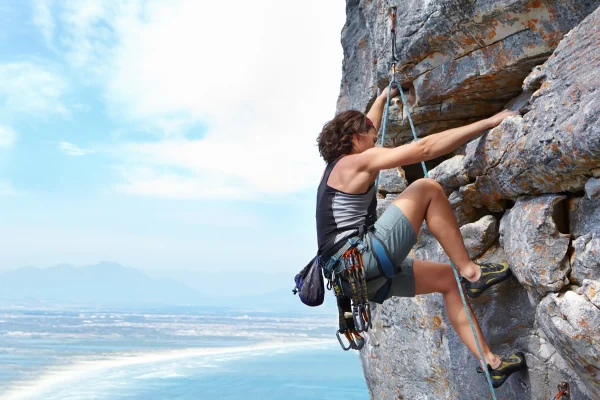
When you climb, a partner holds your safety line. This is called belaying. It forces you to rely on another person for your physical safety. This creates a high-stakes experience of interdependence. It breaks down the urge to isolate yourself, which is a common trauma response. You learn that others can be reliable and that you can be safe while being vulnerable. The climber must communicate clearly with the belayer, and the belayer must show constant attention to the climber. This reciprocal relationship builds a sense of community. It counters the isolation that often follows trauma, showing the survivor that they do not have to carry their burdens alone.
Cognitive Flexibility in Navigation
Using a map and compass requires intense focus. It pulls you out of "trauma fog" and into the present moment. You have to solve problems under pressure while moving through the woods. These therapeutic outdoor activities teach your brain to stay flexible when things go wrong. If you take a wrong turn, you recalibrate instead of panicking. This skill is known as executive functioning. Trauma often impairs the ability to plan, organize, and execute tasks because the brain is too busy looking for danger. Navigation forces the prefrontal cortex back into the lead role. It requires the person to look at the big picture, analyze data, and make a decision based on logic rather than fear.
Immersive Healing in Wilderness Therapy Programs
While a single afternoon of climbing helps, wilderness therapy programs offer a deeper immersion. Research published in Springer shows that these programs typically span several weeks, with a study of participants in Outdoor Behavioral Healthcare (OBH) programs showing an average duration of 45 days.
People often ask, what is the difference between adventure therapy and wilderness therapy? While adventure therapy usually involves specific physical tasks like ropes courses, wilderness therapy programs are long-term, nature-immersion experiences that use the environment itself as the primary therapeutic agent. You live in the woods and learn primitive skills, like making fire with a bow drill.
This requires massive frustration tolerance. Statistics from the Outdoor Behavioral Healthcare Council show these programs are incredibly safe. They actually have fewer injuries than high school football. The constant connection to nature calms the nervous system over time.
Somatic Regulation: Why the Body Leads the Mind
Traditional therapy uses "top-down" processing. You talk, and you hope your body listens. A paper on Academia.edu notes that adventure therapy utilizes "bottom-up" processing, where stimulation of physical and sensory receptors influences the brain's central processing and mental state through ascending neural pathways.
Rhythmic movements like paddling a boat or hiking engage both sides of your brain. This mimics the effects of EMDR therapy. It stimulates the corpus callosum, which is the bridge between your brain's two halves. This helps your brain process stuck memories that words cannot reach.
Physical exertion also boosts Brain-Derived Neurotrophic Factor (BDNF). Think of BDNF as high-quality fertilizer for your neurons. It helps repair the damage caused by years of chronic stress. Your brain literally becomes more plastic and open to change.
Changing the Inner Narrative through Adventure Therapy
Trauma often leaves people feeling helpless. Success in the outdoors changes that story immediately. When you reach the top of a peak or navigate a river, you prove to yourself that you are capable. This shift in perspective is the core of the therapeutic process. The participant moves from a "can't do" mindset to a "can do" mindset. This change is not based on positive thinking, but on lived experience.
This creates a sense of skill and competence. Is adventure therapy effective for PTSD? Research indicates it is highly effective because it helps desensitize the trauma response as it proves to the survivor that they can navigate intense physical and emotional sensations safely. Each success acts as a counter-argument to the negative beliefs that trauma creates. If a person believes they are weak, but then carries a forty-pound pack for ten miles, the belief in weakness begins to fade.
Successes in wilderness therapy programs act as evidence against the "victim" narrative. You stop seeing yourself as broken. Instead, you see a person who can build a fire, climb a wall, and survive a storm. This new identity is built on a foundation of tangible achievements. It provides a sense of pride and self-worth that is often stripped away by traumatic experiences. The survivor begins to view themselves as a resilient individual who has the tools to handle whatever life throws their way.
Integrating the Outdoor Experience into Daily Life
The true aim involves more than becoming a skilled hiker, as it focuses on taking those skills home to your family and your job. Michael Gass developed the idea of "isomorphic framing." This means setting up an activity to mirror a real-life problem.
If you struggle with a "no-exit" maze in the woods, you might be practicing how to handle a toxic relationship at home. You learn to apply the resilience you found on the trail to your daily life. This is called metaphoric transfer.
According to a study in ResearchGate, participants in these programs showed notable gains in their Youth Outcome Questionnaire (YOQ) scores. The report further indicates that parents saw these individuals functioning significantly better a year after the program compared to those who received traditional treatment.
Ending the Trauma Cycle with Adventure Therapy
You cannot change what happened in your past. However, you can change how your body carries that weight today. Adventure Therapy offers a scientifically proven way to reset your alarm system. It moves you from a state of survival into a state of growth.
Through the choice of therapeutic outdoor activities, you reclaim your body and your future. You prove to your nervous system that you are no longer in danger. It is time to step off the couch and onto the trail to finish the healing process. Reaching your potential requires more than talking; it necessitates the courage to move.
Recently Added
Categories
- Arts And Humanities
- Blog
- Business And Management
- Criminology
- Education
- Environment And Conservation
- Farming And Animal Care
- Geopolitics
- Lifestyle And Beauty
- Medicine And Science
- Mental Health
- Nutrition And Diet
- Religion And Spirituality
- Social Care And Health
- Sport And Fitness
- Technology
- Uncategorized
- Videos

