
Naan Bread Secret History Exposed
Empires inevitably fall, but their recipes manage to survive by hiding on the plates of the conquered. You think you are simply ordering a side dish for your butter chicken, but you are actually participating in a centuries-old ritual of adaptation. Food maps human movement better than any border dispute or treaty. When sultans and travelers crossed the Hindu Kush, they brought more than weapons or laws; they carried the starter cultures for what we now know as naan.
This leavened flatbread did not start as the ubiquitous menu item you see today. It began as a rare luxury, restricted by cost and complexity. Over hundreds of years, it transformed from a royal indulgence to a global staple. The story of naan reveals how culture spreads. It tracks innovation, shifting from the clay ovens of Central Asia to the fine dining tables of the West. Every bite contains the tension between preserving tradition and surrendering to modern tastes.
The Persian Blueprint and the Border Crossing
Imports often change entirely the moment they cross a new geopolitical line. As highlighted by Google Arts & Culture, the concept of this bread likely originated in ancient Persia, with the name itself derived from the Persian word for bread, "nân." However, the path did not stop there. Between the 13th and 16th centuries, sultans introduced these culinary roots to the Indian subcontinent. They brought Western and Central Asian techniques that would soon blend with local flavors.
This arrival marked a permanent shift in the region's diet. Historians point to the 1300s for the first solid documentation. The poet Amir Khusrau recorded specific varieties at the royal court. He noted naan-e-tanuk, a light and thin version, and naan-i-tanuri, a thicker variety baked in a clay oven. These distinct types prove that experimentation started early. The chefs, or naan bais, were already refining textures to suit specific needs.
Where did naan bread originally come from?
Most historians trace its origins to ancient Persia, though it was refined and popularized in the Indian subcontinent. Some sources suggest an even deeper contradiction. While the Persian narrative is dominant, there are potential ties to the Indus Valley civilization. This suggests that leavened bread might have existed in the region long before the sultans arrived. History often favors the victors who write the records, but the ovens tell a more complex story.
Royal Exclusivity and the Yeast Divide
Scarcity turns simple ingredients into powerful status symbols. According to Britannica, due to the lengthy process required for leavening, naan during the Mughal Era (1526–1800s) was not a food for the common person; it served as a marker of high status primarily available to royalty. The production required refined flour, known as maida, and expensive ingredients like yeast. This leavening agent set it apart from the daily unleavened breads of the working class.
Kneading these doughs required skilled labor. The nobility employed specialized chefs to master the ratio of flour to yeast. These chefs experimented constantly. They created naan-e-warqi, which featured delicate, flaky layers. In contrast, they baked naan-e-tangi specifically to absorb rich gravies. The naming conventions followed the innovation. You could tell the quality of a host by the texture of the bread they served.
Why was naan historically considered a luxury?
It required expensive refined flour and yeast, along with skilled chefs to prepare it, making it too costly for common people. Class mobility eventually came for the recipe. As the Mughal influence waned, the secrets of the royal kitchens leaked into the streets. What was once restricted to the emperor’s table slowly became accessible to the public. The shift from complex royal techniques to simpler methods helped democratize the dish.
The Tandoor’s High-Heat Alchemy
Texture is merely a hostage situation between dough and extreme heat. The defining characteristic of naan is the method of cooking. Britannica notes that it requires a tandoor, a cylindrical clay oven where the inside walls can reach temperatures as high as 480°C (900°F). As chef Guntaka told the Press Herald, you cannot replicate this environment in a standard home oven, insisting that without a proper oven, "that’s not a real naan."
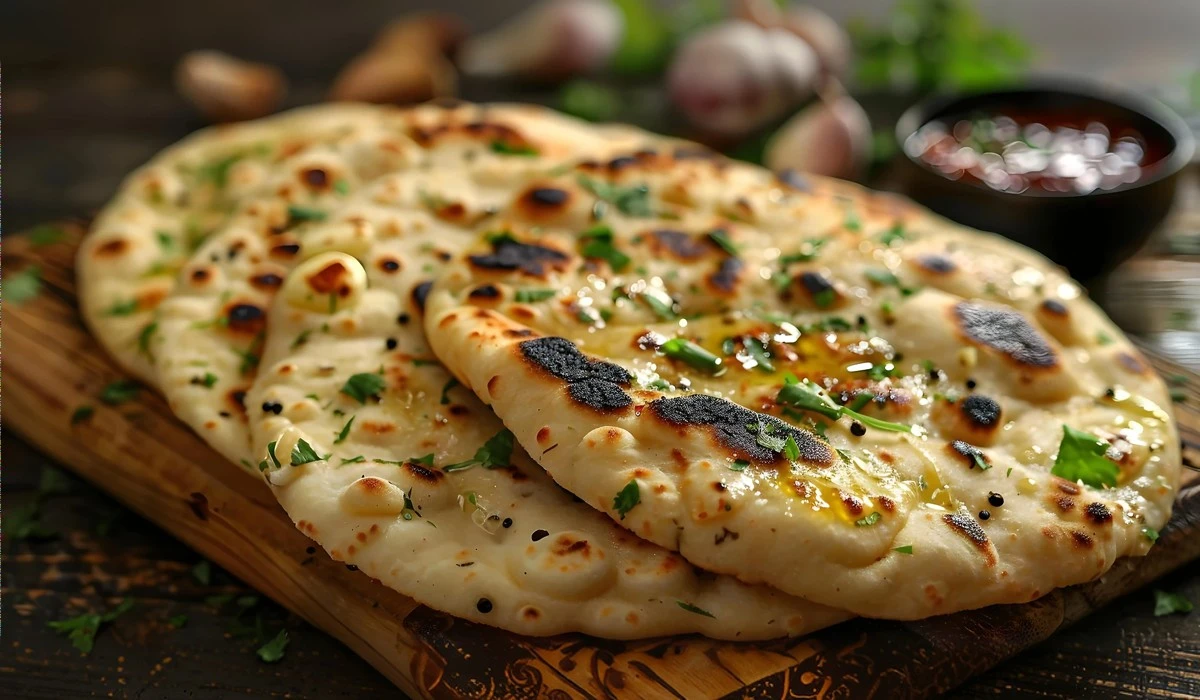
The process creates a specific physical reaction. Bakers slap the dough directly onto the interior walls of the tandoor. The dough defies gravity, sticking instantly to the superheated clay. Serious Eats explains that the shape is also a result of this process, where the heat causes air and water inside the dough to expand rapidly, stretching the dough before it sets. This violence creates the golden-brown spots and air pockets that diners prize.
Why is naan cooked in a tandoor?
The clay walls reach extremely high temperatures that bake the bread rapidly, creating its signature puffy texture and charred spots.
The classic tear-drop shape forms as the dough stretches under its own weight before setting. This is a cooking technique born of necessity and physics. Interestingly, this reliance on the tandoor historically limited consumption to restaurants or community ovens. Indian homes rarely possessed such equipment, preferring chapatti for daily meals.
British Travelers and the Export of Taste
Observers change the observed simply by writing it down. The British arrival in India accelerated the bread's export to the West. English travelers began documenting their culinary experiences, acting as the first bridge between the tandoor and the European palate. The first recorded use of the word in English appeared in a travelogue by William Tooke in 1799 or 1803, originally spelled "nan."
Colonial influence integrated the bread into a new kind of cuisine. It evolved beyond a vessel for Indian stews to appear alongside cured meats and other Western items. The British treated it as a novelty, an exotic addition to their colonial repertoire. This exposure set the stage for the international fame the dish enjoys today.
This period marked a shift in how the world viewed Indian bread. It moved from a local staple to a global export. The spelling standardized to "naan" around the 1970s, cementing its identity in the English lexicon. While the British did not invent the dish, their travelogues ensured that the rest of the world would eventually crave it.
From Side Dish to Global Star
Support acts eventually steal the show if the lead character becomes too predictable. In the modern culinary scene, specifically from the 1990s and 2000s, naan grew beyond a side dish to become a canvas for innovation. Fine dining establishments began experimenting with non-traditional ingredients. You now find versions stuffed with spinach, truffle, or gouda cheese.
The numbers back up this dominance. Data from TasteAtlas confirms this standing, as they recently ranked butter garlic naan in the top spot on their list of the world's best breads. This is a massive shift from its origins as a textural complement to gravy. It is now a standalone star. Chef Suvir Saran notes that these modifications often attract non-Indian palates. They remove the "guilt" some might feel about eating unfamiliar traditional food.
This explosion of popularity represents a shift toward global fusion. The bread has transcended its status as a Persian or Indian item to become a global commodity. The modern reinvention proves that food must adapt to survive. Purists may argue against truffle oil, but the market demands evolution.
The Science of the "Tear" and "Scoop"
Tools disappear when the object itself performs the function. Historically, this bread served as an edible utensil. It replaced cutlery entirely. The texture is engineered to scoop stews and curries without falling apart. A personal essayist notes that stale bread hardens and fails to absorb the gravy, rendering it useless. Freshness is a functional requirement rather than a simple preference.
How is naan traditionally eaten?
It is used as a scoop for curries and stews, functioning as an edible utensil to replace forks and spoons. This creates a specific logic of consumption. Traditionally, people purchased it daily from vendors rather than storing it. It does not keep well. The "tear and scoop" method dictates the structure of the dough. It must be elastic enough to hold heavy meat but soft enough to tear with one hand.
However, modern Western fusion often ignores this logic. We now see the bread used as a pizza crust, a taco shell, or even a burger bun. One personal essay recounts a grandmother’s shock at seeing a "Naan Burger" with beef. She found the unorthodox consumption method amusing but baffling. The utility of the bread has shifted from a scoop to a base ingredient.
Global Variants and Future Fusion
Tradition survives only by betraying its origins. The spread of this bread has spawned variants across Asia, each adapting to local needs. In Myanmar, naan bya is a breakfast item served with tea or coffee, often topped with boiled chickpeas. This breaks the rule of it being a dinner accompaniment for heavy curries.
In China, specifically within Uyghur cuisine, the guokui or náng is integral to the culture. These are baked in cylindrical charcoal ovens, mirroring the tandoor method. Meanwhile, Japan has embraced it as a curry accompaniment in restaurants. They offer free-flow options and have pioneered innovations like cheese and pizza naan.
Indonesia has its own version, Roti Naan, which is spiced with garlic. It serves as a rice alternative for diverse ethnic groups. These regional twists show that the recipe is not static. It is a living document of cross-cultural harmony. Chef Suvir Saran describes it as a symbol of coexistence. Diverse identities live in harmony on the plate, celebrating differences without erasing them.
Conclusion
We eat the past to understand the present. Naan represents more than flour and water; it stands as a record of Persian influence, Mughal refinement, and British expansion. It has traveled from the exclusive ovens of royalty to the frozen aisle of your local grocery store. The shift from yeast to baking powder, and from tandoor to pizza oven, shows the bread's staying power. It remains a powerful marker of identity and pluralism. Whether you eat it as a traditional scoop for gravy or as a fusion burger bun, you are participating in a history that refuses to stay still.
Recently Added
Categories
- Arts And Humanities
- Blog
- Business And Management
- Criminology
- Education
- Environment And Conservation
- Farming And Animal Care
- Geopolitics
- Lifestyle And Beauty
- Medicine And Science
- Mental Health
- Nutrition And Diet
- Religion And Spirituality
- Social Care And Health
- Sport And Fitness
- Technology
- Uncategorized
- Videos

