
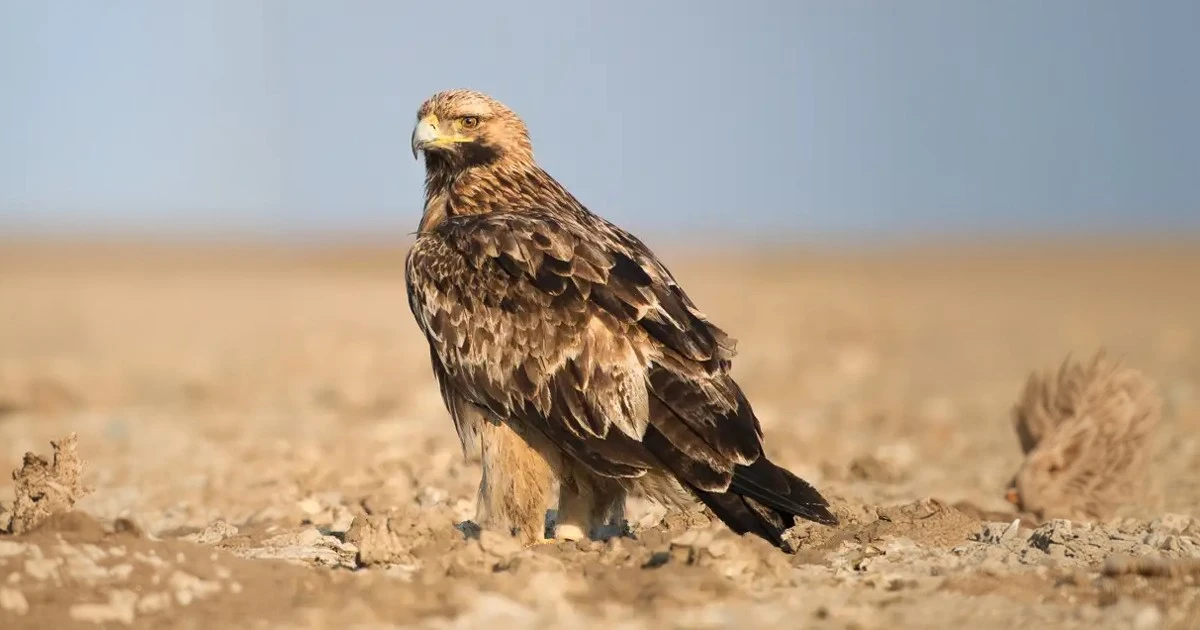
Image Credit - By Sumeet Moghe, Wikimedia Commons
Imperial Eagle Population Surges In Serbia
When you accidentally wipe out your country’s national symbol, bringing it back requires cultural shifts alongside nest protection. You have to completely change how an entire culture treats what they consider "pests."
For decades, the Imperial Eagle sat on the Serbian Coat of Arms while vanishing from the actual sky. Post-WWII industrialization and a culture of rural poisoning pushed this massive raptor to the absolute edge. By 2017, the situation hit a critical low point. As reported by The Guardian, only one breeding pair remained in the entire country. The bird was functionally extinct, surviving only on flags and government stamps. But a sudden shift in strategy, combined with help from neighboring Hungary, turned the tide. Today, the population has surged to 19 breeding pairs, proving that even the most damaged populations can recover through cooperation with nature rather than control.
The Unintended Consequences of Pest Control
Good intentions often cause the worst ecological disasters. After World War II, The Guardian notes that state-run agencies launched aggressive poisoning campaigns to protect livestock. The goal was simple: eliminate wolves and bears. The method was blunt: toxic bait. But poison does not choose its victims. The Imperial Eagle, a scavenger and predator, consumed the tainted meat intended for other animals.
This chemically driven decline continued for decades. By the late 1980s, only two populations remained in the Deliblato Sands and Fruška Gora. The Deliblato population vanished quietly in the 1990s due to general decline and neglect. The Fruška Gora group held on longer but finally disappeared in 2015. The cause wasn't a mystery. As orchards expanded and power lines cut through the hills, the birds simply ran out of room to live.
The Lethal Habit
Laws change on paper, but rural habits usually survive for generations. Even after state-sponsored poisoning ended, local farmers continued the practice. Poisoning remains a "cheap solution" for nuisance animals like foxes and feral dogs. Since 2000, experts have recorded over 300 poisoning incidents. The mindset is deeply embedded. Farmers view raptors as enemies or simply ignore them while targeting other predators.
This "vigilante justice" creates a minefield for the birds. A single piece of laced meat can kill a bird with a two-meter wingspan instantly. Milan Ružić of the Bird Protection and Study Society of Serbia (BPSSS) notes that toxic meat is cheap and accessible, making the habit incredibly hard to break.
A Territory Stripped Bare
A bird needs a home, but economic demands can strip a region bare faster than any storm. Vojvodina, the northern province of Serbia, is an agricultural powerhouse, but it is an ecological desert for trees. The region has less than 1% tree cover in some municipalities, making it the least forested region in Europe. You can drive for hours across these vast plains without seeing significant vegetation.
Farmers removed oaks and poplars to squeeze every ounce of yield from the soil. This agricultural intensification destroyed the grazing lands needed for sousliks (ground squirrels), the Imperial Eagle's primary food source. Without old trees for nesting and sousliks for hunting, the birds faced a double threat. They had nowhere to sleep and nothing to eat.
The Bar Patron Analogy
To understand the scarcity, look at the numbers. Milan Ružić compares the population at its lowest point to a social gathering. At one point, the patrons in a single bar outnumbered the entire Imperial Eagle population in Serbia. This stark reality helped shift public apathy into concern. The scarcity was no longer an abstract statistic; it was a visible crisis.
The Geopolitical Ripple Effect
Global politics can flatten a bird’s habitat thousands of miles away from the conflict. In 2014, Russia annexed Crimea, prompting the European Union to impose strict sanctions. This diplomatic standoff created a surprising economic boom for Serbian farmers. Since Serbia did not join the sanctions, it became a key exporter of fruit to Russia.
Farmers rushed to cash in. They cleared scrubland and grazing pastures to plant vast apple orchards. This economic opportunity destroyed the specific habitat the eagles needed. As exports boomed, the birds lost the few remaining pockets of land where they could hunt. This connection between a border dispute in Ukraine and habitat loss in Serbia highlights how fragile conservation really is.
The Hungarian Reinforcement
Sometimes the only way to save a local population is to borrow one from your neighbor. While Serbia struggled, Hungary pulled off a conservation miracle. In the 1980s, Hungary had only 20 pairs of eagles. Through aggressive protection, that number skyrocketed to 550 pairs today. This booming population needed space, so they began moving south.
Starting in 2011, research by Horvath on Palearctic eagles indicates that the first Hungarian eagles crossed the border into Serbia, expanding their distribution area southwards. This influx provided the genetic stock Serbia desperately needed. Slobodan Knežević emphasizes that biodiversity transcends borders. Without the overflow from Hungary’s success, Serbia’s local population might have vanished entirely.

Image Credit - By Imran Shah from Islamabad, Pakistan, Wikimedia Commons
Technology Meets Bureaucracy
Tracking a wild animal shouldn't require military clearance, but modern tech blurs the line between science and spying. Conservationists use satellite tags to monitor the birds. These devices are essential. They reveal where the birds go and, more importantly, when they stop moving. A stationary signal often means a bird is dead or in trouble, allowing rangers to intervene immediately.
How do conservationists track eagles?
They use satellite transmitters to monitor movement and detect threats like poaching in real time. However, getting this gear into Serbia involves a headache of paperwork. The military gets nervous about high-tech tracking equipment moving through the air. Teams must sign mandatory anti-conflict declarations and prove the tags are strictly for ornithology, not military guidance. Despite these hurdles, the data has been a game-changer. It allows teams to spot poisoning hotspots and direct their protection efforts where they matter most.
Changing the National Story
You can punish poachers, but you get better results if you make them proud of the animal they used to kill. The BPSSS launched a massive rebranding campaign. They reminded the public that the Imperial Eagle is the bird on the Serbian Coat of Arms. It serves as a symbol of national heritage rather than a pest.
This psychological shift worked. Villages that once ignored the birds now take pride in "their" eagles. The bird went from being a target to a celebrated neighbor. According to the Albanian Ornithological Society (AOS), volunteers began guarding nests around the clock, camping nearby to prevent disturbance during the breeding season, a strategy that helped the population grow. This human shield strategy allowed the birds to raise their young in peace.
Ancient Lore
History helped the cause. In folklore, the Imperial Eagle was known as the "cross-bearing eagle." People believed these birds could divert hailstorms and protect crops. Restoring this "sacred" status helped protect the birds in ways that modern laws could not.
Biology and Stubbornness
You can build a perfect home, but you cannot force a wild creature to live in it. Conservationists tried to help by building artificial nesting platforms. The White-tailed eagle loves these structures, but the Imperial Eagle is much more cautious. They rejected the artificial platforms, preferring natural sites even when those sites were scarce.
How long do imperial eagles live?
These birds have a lifespan similar to humans, often living for several decades in the wild. This caution makes recovery slow. Data from Thai National Parks indicates that new pairs take five to six years to attain full adult plumage and begin breeding. Unlike Golden Eagles, they rarely kill their siblings in the nest, which helps population growth, but their pickiness about nesting sites remains a challenge. In Russia, the species adapted to nest on electric poles, but the Pannonian population still insists on tall trees. This biological stubbornness means humans have to protect existing trees instead of relying on metal substitutes.
The Flight Ahead
The recovery of the Imperial Eagle in Serbia is a rare win. The population jumped from a single pair in 2017 to 19 pairs last year, with 10 successful broods. This success proves that rapid recovery is possible when you mix strict protection with cultural changes.
The fight is not over. Poisoning remains a threat, and the terrain is still dangerously bare. But the approach has shifted. Conservation now centers on managing human behavior and geopolitical ripples, rather than biology alone. The eagle has returned to the sky, matching its place on the shield, and for the first time in decades, its future looks clear.
Recently Added
Categories
- Arts And Humanities
- Blog
- Business And Management
- Criminology
- Education
- Environment And Conservation
- Farming And Animal Care
- Geopolitics
- Lifestyle And Beauty
- Medicine And Science
- Mental Health
- Nutrition And Diet
- Religion And Spirituality
- Social Care And Health
- Sport And Fitness
- Technology
- Uncategorized
- Videos

