
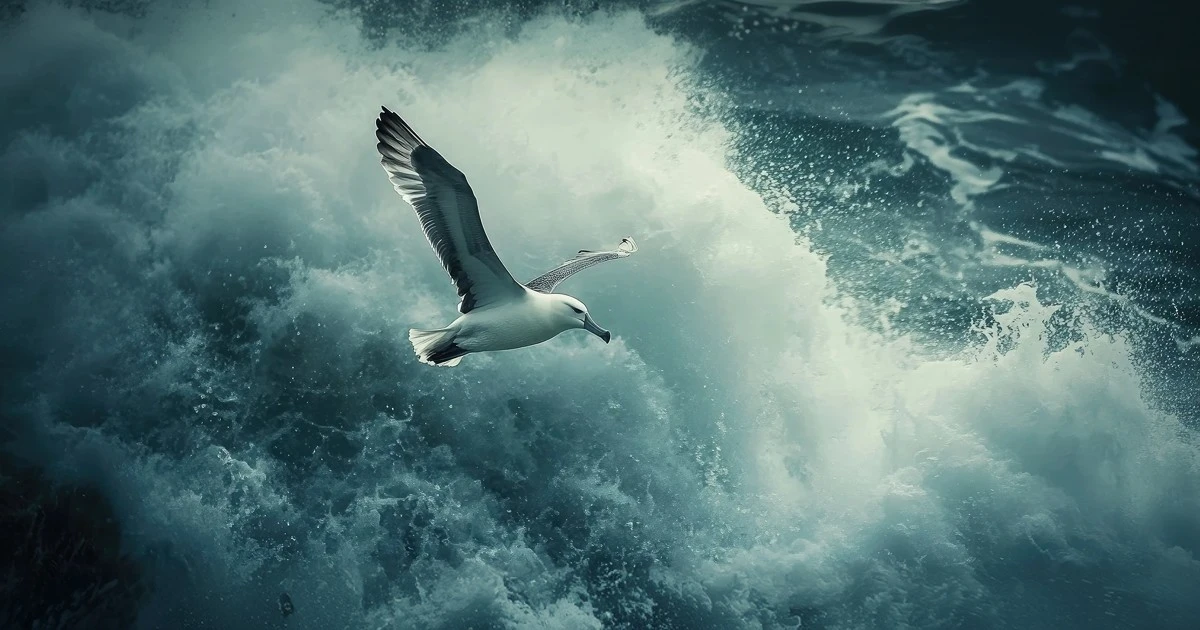
Albatross Task Force Stops 100km Death Traps
Dropping 4,000 hooks into the ocean means hunting tuna while simultaneously setting a dinner table for the wrong guest. The RSPB notes that for decades, commercial long-line fisheries accidentally slaughtered seabirds by the thousands, creating a primary driver of extinction risk. The solution did not come from a courtroom, a protest sign, or a government mandate. It appeared when conservationists realized that fishing captains hate losing expensive bait just as much as bird lovers hate losing albatrosses.
You might assume that saving endangered species requires empathy or strict laws. In reality, the most effective protection comes from aligning the predator's profit with the prey's survival. The Albatross Task Force proved that you do not need to change a fisherman’s heart if you can simply stop birds from stealing his inventory.
The Economics of Survival
Profit margins protect nature better than moral arguments ever could. A single Bluefin Tuna can fetch around $10,000 (£7,400) on the market. Every hook that comes up empty represents a massive financial loss for the vessel. When an albatross dives on a long-line, the bird risks its life while stealing a potential paycheck.
NOAA Fisheries explains that birds spot the bait before it sinks, dive to swallow the hook, and get dragged underwater to drown by the heavy line. For the fisherman, it means retrieving a dead bird instead of a high-value fish. Andrea Angel, a leader at BirdLife South Africa, points out that the motivation here is purely financial. Fishermen prefer tuna over bycatch.
Preserving bait equals preserving profit. BirdLife South Africa notes that this financial reality allowed conservation teams to board vessels not as police, but as consultants showing crews techniques to minimize bycatch.
Why do fishermen save albatrosses?
Fishermen protect these birds primarily because scavenging seabirds steal bait, which reduces the total fish catch and lowers the crew's income.
The Physics of the Slaughter
A seabird's mastery of the wind makes it helpless against a sinking stone.To understand the scale of the threat, you have to look at the gear. According to the Marine Stewardship Council, commercial long-lines can stretch between 50 and 100 km (62 miles). These are not fishing rods; they function as industrial curtains of death. Tim Appleton, a prominent conservationist, explains that captains deploy thousands of baited hooks across these vast distances.
The danger zone lies just off the coast. About 27 nautical miles (50km) off Cape Point, the ocean teems with life. Here, the specific design of the albatross works against it. These birds possess massive wingspans perfect for gliding over oceans, but they are clumsy divers. They can only reach shallow depths.
As noted in WCPFC meetings, the problem arises in the few seconds before the bait sinks below 5 meters, the depth required to clear the bird scaring lines. If the bird grabs the bait at the surface, the line’s tension drags it down.
The Trawl Warp Danger
Long-lines are not the only threat. Trawl warps—heavy steel cables used to tow nets—create a different kind of hazard. In heavy seas, the boat rocks violently. Birds attracted to the fish waste follow the ship and collide with these moving cables. The collision snaps their wings or drags them under the churn. This specific threat has plagued the Hake fishery in South Africa and the Falklands, proving that different fishing methods require different safety protocols.
The Japanese Invention That Changed Everything
The most effective technology often looks like garbage hung from a rope. In the late 90s, Japanese fishermen faced the same bait-loss problem. They invented "tori lines." In Japanese, "tori" simply means "bird." The name is literal, while the function is genius.
These lines are nothing more than streamers attached to a pole on the back of the boat. They flutter in the wind, creating a chaotic visual barrier over the spot where the fishing hooks enter the water. The birds, confused and wary of the flapping streamers, stay back. This simple distraction buys the bait enough time to sink safely beyond the birds' diving range.
What are tori lines?
Tori lines are colorful streamers towed behind fishing boats that scare seabirds away from baited hooks until the gear sinks safely out of reach.
Andrea Angel notes the high interaction rate between vessels and birds. Albatrosses have become dependent on the easy food source of squid and fish guts thrown from trawlers. The tori lines break this cycle of dependency without harming the birds or slowing down the crew.
The Albatross Task Force Effect
Rules written on land evaporate the moment a ship hits the high seas. Regulations mean nothing without enforcement or guidance. This is where the Albatross Task Force (ATF) changed the game. Established in 2004—an ambitious move described by the RSPB—this group moved beyond writing papers to send observers directly onto the boats.
The results shattered expectations. Since the ATF began its work, seabird deaths in Southern African fisheries dropped by 90%. In some specific sectors, the numbers are even more staggering. BirdLife International reports that supporting data shows a 99% drop in the South African trawl fishery and a 98% reduction in Namibia, equating to 22,000 birds saved annually.
RSPB and BirdLife representatives highlight the Namibian success story. Transitioning from voluntary measures to mandatory legislation saved approximately 21,000 birds annually. Rory Crawford from BirdLife International argues that this success in Africa is fully replicable in British waters. It just requires willpower and resources.

When was the Albatross Task Force founded?
The Albatross Task Force was established in 2004 to work directly with fishermen on reducing seabird bycatch.
Biology Against the Clock
Evolution optimized these birds for long lives, not for rapid recovery. You cannot manage an albatross population like you manage rabbits or rats. Their biological clock moves incredibly slowly. These birds are monogamous, often bonding with a single partner for life.
If a long-line hook kills one partner, the consequences ripple through time. The survivor refuses to simply "move on." Recovery takes 4 to 5 years. That is half a decade spent grieving or searching for a new mate rather than reproducing.
Andrea Angel emphasizes that the death of a parent usually means the death of the chick waiting back at the nest. Furthermore, albatrosses reproduce slowly, laying only one egg every two years. Losing a breeding adult wipes out years of reproductive investment. Currently, ACAP classifies 15 of the world's 22 albatross species as threatened, endangered, or critical globally. The population cannot absorb these losses.
The Human Side of Conservation
A global environmental fix fails if it ignores the local economy. Conservation often feels distant from human struggles, but the manufacturing of tori lines bridged that gap. The Ocean View Association for Persons with Disabilities partnered with conservation groups to build these life-saving streamers.
This partnership turned an environmental necessity into a social lifeline. Deborah Gonsalves, the Ocean View Manager, explains that the project restored self-worth and provided income for disabled community members.
During hard economic times, this work supplements disability grants. The money stays in the local community, and the product goes out to save birds. It is a rare instance where social welfare and wildlife preservation feed into each other perfectly.
Layers of Defense
A single shield is rarely enough when the enemy is hunger. While tori lines are the star of the show, the Albatross Task Force utilizes a suite of tactics to outsmart the birds. Each method attacks a different part of the bird's hunting strategy.
Night Setting
Albatrosses are visual hunters. They rely on daylight to spot squid and fish in the water. Fisheries exploit this diurnal nature by setting their lines at night. Fishing in darkness with minimal artificial light renders the bait practically unseen to the birds above.
Line Weighting
Speed is the best defense. Adding lead cores or extra weights to the lines ensures the hooks sink rapidly. If the bait drops below 5 meters quickly, it outpaces the diving capabilities of the albatross. The bird’s long wings, designed for gliding, make deep diving physically impossible.
Blue Dye
Camouflage works in the ocean just as well as on land. Some crews dye their bait with blue pigment. This reduces the contrast between the food and the dark water, making it harder for seabirds to spot the target from the air.
Side-Setting
Traditionally, gear flies off the back of the boat, right where the wake churns up food and attracts birds. Side-setting changes the deployment point to the side of the vessel. This reduces the time the bait is exposed to the wake-following flock.
The Unsolved Threats
Closing the front door on a threat often leaves the back window wide open. Despite the 90% reduction in deaths, the war is far from won. Peter Ryan from the Percy FitzPatrick Institute notes a disturbing contradiction: fishing practices have improved, yet the threat status for many species continues to worsen. We are winning the local battle but losing the global war.
The Pirate Fleets
The Albatross Task Force can only help boats that follow the law. Pirate fishing, or IUU (Illegal, Unreported, and Unregulated) fishing, remains a massive "threat multiplier." These vessels comply with zero mitigation measures. They operate in the shadows, decimating bird populations while legal boats do the heavy lifting of conservation.
The Coverage Gap
Even among legal fisheries, compliance varies. The Toothfish fishery boasts 100% observer coverage, meaning someone is always watching. In contrast, Hake and Tuna fisheries often have only 10-20% coverage. Partial compliance leaves massive gaps in the safety net.
Disease
New enemies are emerging on land. Avian Cholera has caused high chick mortality at Amsterdam Island. In some specific colonies, disease causes total breeding failure. This biological threat rivals long-line fishing in magnitude, yet it is far harder to solve than simply hanging a streamer on a boat.
The fragile Victory
Fixing a problem often requires admitting that the old way was broken, not malicious. The success of the Albatross Task Force proves that conservation works best when it ignores moralizing and focuses on problem-solving. Respecting the financial needs of fishermen and understanding the biological limits of the birds allowed them to engineer a truce in the open ocean.
However, a 90% drop in deaths does not guarantee survival. With slow breeding rates, pirate fishing, and disease still in play, the albatross remains on the edge. The streamer lines prove we can stop the slaughter; the challenge now is ensuring enough birds survive to notice the difference.
Recently Added
Categories
- Arts And Humanities
- Blog
- Business And Management
- Criminology
- Education
- Environment And Conservation
- Farming And Animal Care
- Geopolitics
- Lifestyle And Beauty
- Medicine And Science
- Mental Health
- Nutrition And Diet
- Religion And Spirituality
- Social Care And Health
- Sport And Fitness
- Technology
- Uncategorized
- Videos

