
Shape Spatial Minds: The Froebelian Approach
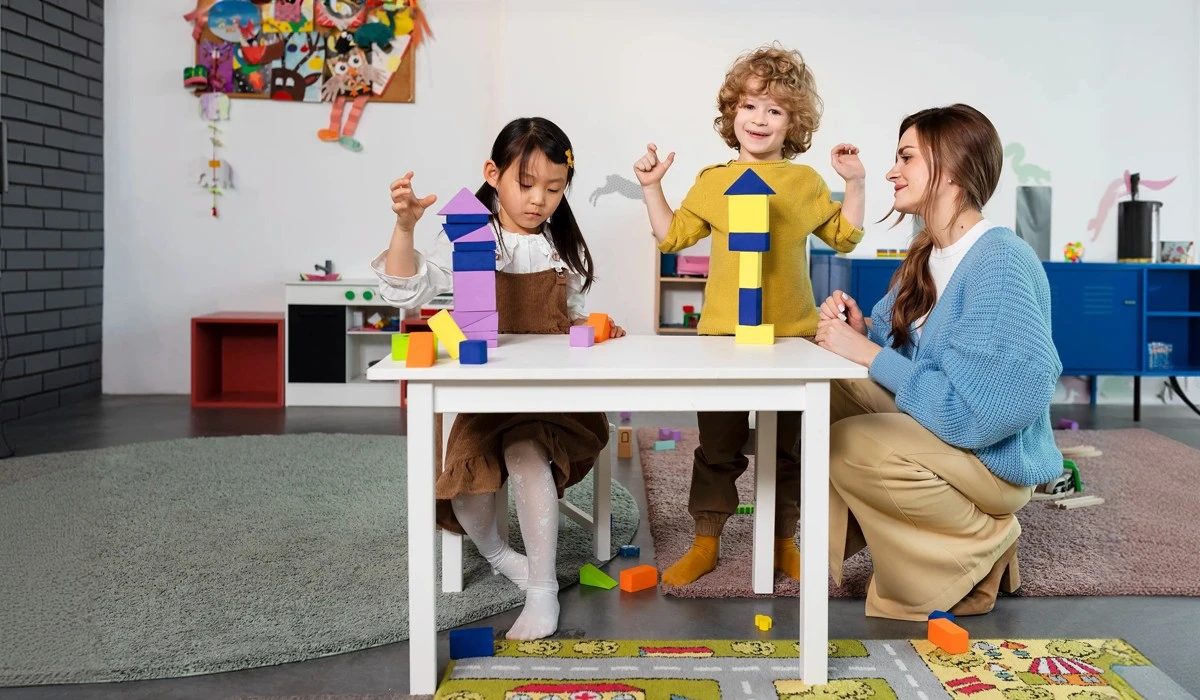
When a child stacks a wooden cube on a flat table, they are testing the weight of the physical world. This simple act actually started in 1837 when Friedrich Fröbel opened the first kindergarten in Germany. He realized that toys are actually tools for the mind. He spent his life creating a system where play serves as the primary way humans understand the universe. Today, we call this the Froebelian Approach. It uses specific early childhood blocks to help children map out the space around them. These kindergarten play methods turn a standard playroom into a laboratory for logic.
Touching, rotating, and balancing these objects helps children build mental habits that last a lifetime. This post explores how this specific method turns basic play into a high-level understanding of space and math.
The Philosophy of Unity and Interconnectedness
Froebel worked as a crystallographer before he became an educator. According to research published in ACS Publications, he spent years studying the repeating patterns in minerals and rocks, infusing his educational models with crystal geometry. As noted by the Froebel Trust, this background led him to believe that every part of nature links to a larger whole, appealing to a child's sense of order. In his classroom, a child holding a sphere sees a shape with no beginning or end. It represents the earth, a seed, or even the sun. The Froebelian Approach uses these physical objects to mirror the patterns found in the natural world. This helps children see how small pieces fit into a big picture. Instead of seeing a pile of wood, they see the potential for a structured system.
Transitioning from Theory to the Playroom
Teachers and parents use these deep ideas to guide how children interact with their toys. They move away from the idea that play is just a way to burn off energy. According to Britannica, what is the Froebelian approach to education? It is a holistic philosophy emphasizing that children learn best through self-directed play and specialized 'Gifts' that were introduced as early educational toys to reveal the mathematical patterns of the universe. Providing the right tools at the right time helps adults guide children to learn physical laws on their own. This self-guided learning makes the lessons stick much better than a lecture ever could. It turns the child into an active explorer of their own environment.
Moving from 2D Visualization to 3D Execution
Going from a flat drawing in a book to a solid block in the hand is a massive jump for a young brain. Early childhood blocks provide the bridge for this mental leap. Froebel designed his blocks on a strict 1-inch or 2-centimeter module. This means every piece mathematically relates to the others. When a child turns a cube in their hand, they practice "mental rotation." This is the ability to imagine an object from different angles. This skill directly predicts success in future STEM fields like engineering or surgery. Children who learn this early have a huge advantage when they start studying geometry.
Symmetry and Proportion in Gift Play
The blocks used in this method are not random. They follow a specific sequence called the "Gifts." Froebel wanted children to understand how shapes change while their volume stays the same. Based on an entry in Britannica, what are the 10 Froebelian gifts? These are a series of educational materials, originally consisting of six sets that began with colored worsted balls, and progressing to detailed geometric blocks, designed to introduce children to increasingly difficult spatial relationships. Famous figures like Frank Lloyd Wright played with these blocks as children. Wright later said that the smooth maple wood stayed in his fingertips and defined his famous buildings. The blocks teach that balance and proportion create both strength and beauty.
Balancing Free Play with Guided Discovery
Many modern classrooms just dump toys on the floor and let children do whatever they want. While free play is good, the original kindergarten play methods offer a more focused path. The teacher acts as a facilitator, not a boss. They use three "Forms" to give the play a specific purpose. "Forms of Knowledge" focus on math and science, like showing that two halves make a whole. "Forms of Life" represent real things like bridges or houses. Finally, "Forms of Beauty" focuses on art and central symmetry. This structure helps children find meaning in their creations without feeling restricted.
Environmental Design for Spatial Awareness
The physical layout of a room changes how a child thinks. If a play area is messy and loud, the child's building will often be chaotic. A true Froebelian Approach environment uses organized storage and clear workspaces. According to a podcast by 99% Invisible, Froebel even introduced a grid system for play tables, famously featuring ruled lines to aid alignment. These tables have 1-inch lines engraved on the surface. This grid serves as a spatial coordinate system. It helps children place their early childhood blocks with extreme precision. This setup encourages them to think about X and Y axes long before they ever see a graph in a math book.
Developing Proprioception and Physical Geometry
Moving and lifting large blocks involves the whole body. Research published in PMC notes that this physical movement helps children develop "proprioception," which is the sense of their own body in space and the movement of their limbs. When a child reaches across a table to place a block, they are measuring distance with their muscles. The Froebelian Approach emphasizes that we learn through our hands and bodies. This creates a "mind-body" connection that makes abstract concepts feel real. A child learns about gravity by feeling the weight of a wooden cube. They learn about stability by balancing their own body while reaching for the top of a tower.
Building Mental Mapping and Navigation Skills
When children build a small town or a farm, they practice a bird's-eye view. They have to think about how roads connect and where buildings should go. As highlighted by a study in MDPI, this type of play builds the same brain circuits used for navigation and map reading, utilizing spatial language and analogical reasoning. They are essentially creating a 3D map of their own thoughts. These kindergarten play methods help children move from simple stacking to advanced planning. Leaving the playroom gives them a better understanding of how to navigate their surroundings. They can visualize paths and structures in their minds with great clarity.
Problem-Solving Through Structural Integrity
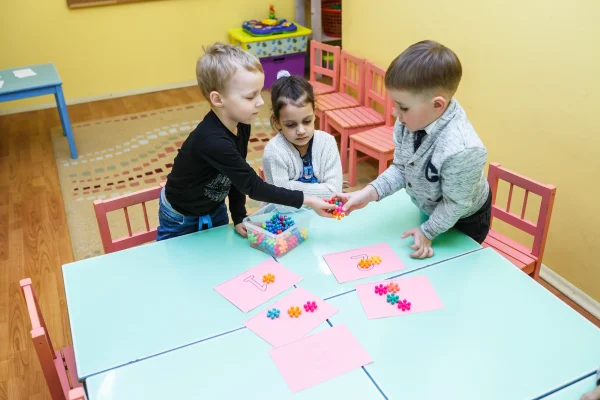
Towers eventually fall. In a typical setting, a child might get frustrated when their building collapses. However, this method teaches that a crash is just new data. A falling tower proves that the base was too small or the center of gravity was too high. The Froebelian Approach encourages children to analyze why the structure failed. This creates a resilient mindset. They treat every mistake as a lesson in physics. They learn to adjust their plans and try again with a more logical design. This is exactly how real engineers solve problems in the field.
The Role of Social Play in Cognitive Development
Building large structures often requires a team. Children have to talk to each other to decide where the next block goes. How does play help a child’s development? According to an article in ScienceDirect, play allows children to experiment with cause and effect, social interactions, and physical laws in a low-stakes environment that simulates alternative scenarios and builds cognitive confidence. As noted by research published in Frontiers in Psychology, when using early childhood blocks, children must explain their spatial ideas to their peers, utilizing spatial language during goal-oriented interaction. They might say, "Put that long block across the two small ones." This forces them to put their mental maps into words. It turns a solitary activity into a lesson in communication and shared logic.
Coding Without Screens via Geometric Patterns
Coding is really just a sequence of logical steps. When a child follows a pattern to build a wall, they are learning the basics of an algorithm. These kindergarten play methods teach children to think in "if/then" sequences. They place a block, check the pattern, and then place the next one. This type of "unplugged coding" builds the logical base needed for computer programming. They learn that small, repeated actions lead to a detailed final result. This teaches them that they can break any large problem into smaller, manageable pieces.
From Blocks to Blueprints
After a child finishes a build, the teacher often asks them to draw what they made. This is an important step in the Froebelian Approach. It forces the child to translate a 3D object back into a 2D representation. This is exactly what architects do when they draw blueprints. It connects the physical reality of early childhood blocks to paper and abstract design. This practice reinforces the child's understanding of scale and perspective. They start to see the relationship between a physical object and a symbolic drawing. This skill is vital for almost every technical career today.
The Future of Spatial Learning with the Froebelian Approach
We often view play as the opposite of serious work. In reality, play is the most intense work a child can do. It is the way they gather data about how the world functions. The Froebelian Approach respects this work by providing high-quality tools and a clear philosophy. Using specific early childhood blocks with a sense of purpose helps us guide children to build a powerful mental framework. These kindergarten play methods provide lasting educational benefits instead of merely acting as entertainment. They develop the spatial logic and resilience that define the next generation of thinkers. When we prioritize this type of intentional play, we give children the best possible start for a life of logic, creativity, and exploration.
Recently Added
Categories
- Arts And Humanities
- Blog
- Business And Management
- Criminology
- Education
- Environment And Conservation
- Farming And Animal Care
- Geopolitics
- Lifestyle And Beauty
- Medicine And Science
- Mental Health
- Nutrition And Diet
- Religion And Spirituality
- Social Care And Health
- Sport And Fitness
- Technology
- Uncategorized
- Videos

