
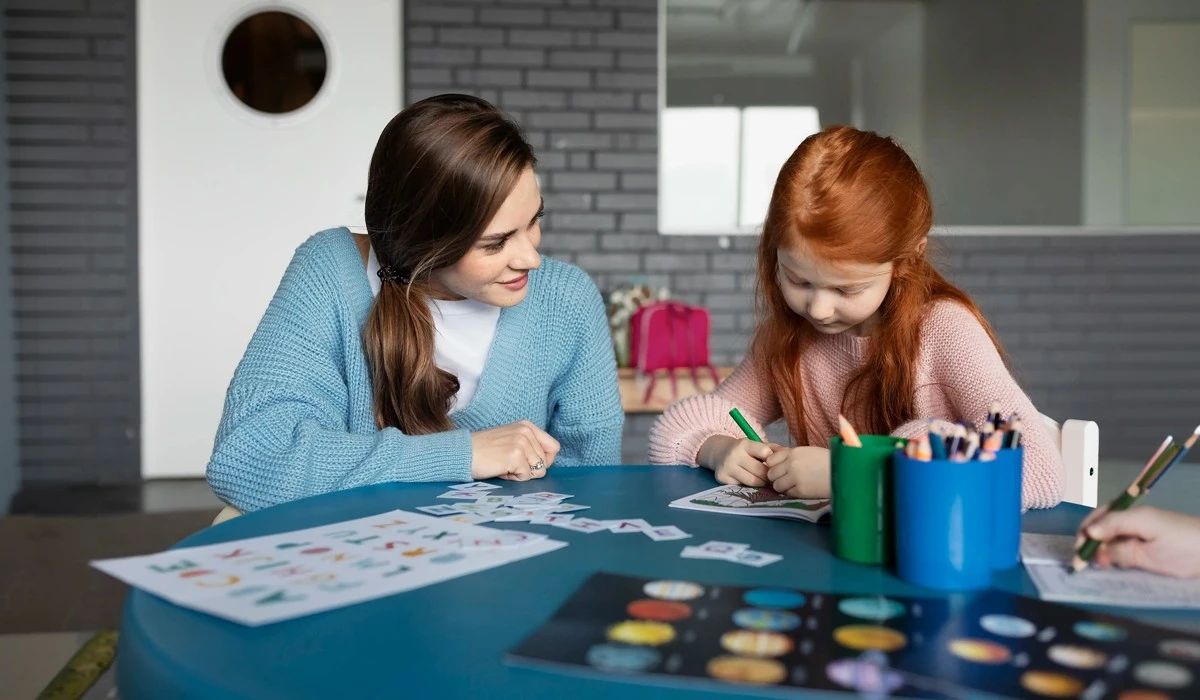
Prepared Environment Design Shapes New Minds
Most classrooms rely on a teacher’s voice to move the day forward. If the teacher stops talking, the learning usually stops too. The students sit in rows and wait for the next command. They rely on an adult to hand out papers, sharpen pencils, and tell them when to think. This setup creates a cycle where children learn to wait rather than act.
When you change the room, you change the child. A child walks into a space where every object sits within their reach. They do not look at a chalkboard for instructions. Instead, they look at the shelves. The room itself tells them what to do and how to do it. This shift relies on Montessori Teaching principles, where the physical space directs the energy. We call this prepared environment design. It turns a standard room into a tool that builds a child’s will and focus. When the need for constant adult permission is removed, we allow the child’s natural curiosity to take the lead.
Core Foundations of Montessori Teaching for Autonomy
Dr. Maria Montessori started this work in 1907 in a poor district of Rome. She opened the Casa dei Bambini, or Children’s House, to test a new theory. According to the American Montessori Society, she proposed that children possess an "Absorbent Mind," which allows them to naturally internalize information from their environment without effort. In her view, Montessori Teaching succeeds when the adult stops being a lecturer and starts being a guide.
The guide does not force a rigid curriculum on every student at the same time. Instead, they observe each child’s natural development. They watch for "sensitive periods" where a child shows a sudden, intense interest in a skill like counting or letter shapes. When the guide identifies these moments, they introduce the right tool at the right time. This approach respects the individual timeline of every learner.
The Role of the Prepared Adult
As noted by the Association Montessori Internationale, the teacher must undergo a mental shift to support this freedom. They must learn to step back and avoid interfering with the child's activity, as this allows the student to maintain concentration. The adult prepares the space so the child can work without help. They act as a link between the child and the materials, ensuring the child knows how to handle each object with care.
Key Pillars of Prepared Environment Design for Growth
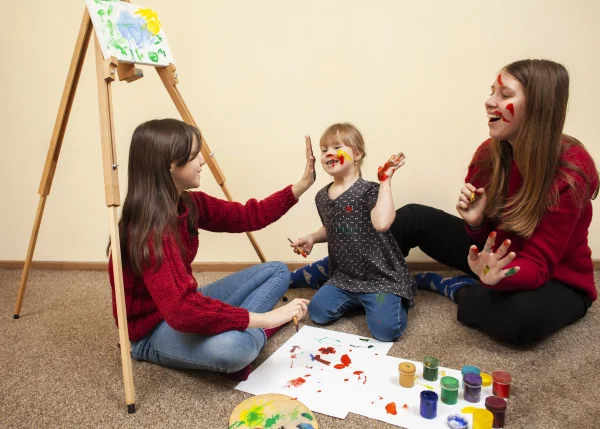
A room must follow specific rules to encourage self-sufficiency. You cannot simply put toys on a floor and call it a classroom. Every item needs a purpose and a place. The Association Montessori Internationale further states that successful prepared environment design ensures the world fits the child’s body through the use of child-sized furniture and tools.
Order provides a sense of security. Research shared by the American Montessori Society highlights that between the ages of one and three, children have a biological need for things to remain in the same place as they develop a sense of order. When the environment stays consistent, the child feels safe enough to take risks. They know exactly where to find the scissors or the counting beads. This predictability reduces anxiety and allows the brain to focus on learning rather than searching for tools.
Child-Sized Functionality
Child-sized functionality involves more than small chairs; it involves using light furniture that a four-year-old can move by themselves. The American Montessori Society also points out that this includes low shelving that displays materials at the child's eye level. When children manage their own needs, they build "functional independence." They pour their own water from small glass pitchers and hang their coats on hooks placed three feet off the ground.
Strategic Layouts to Support Student Autonomy
The physical flow of a room dictates how well Montessori Teaching works in practice. A study published by the American Montessori Society explains that a well-organized room allows children to choose their own work almost all of the time, moving between tasks without asking for permission or direction. This structure reduces friction and helps children enter a state of deep concentration.
In the Practical Life area, children find real tools for real work. They might polish silver, scrub a table, or peel an orange. Findings published in the National Library of Medicine indicate that these tasks develop the fine motor skills required for later writing. Meanwhile, the Math area moves from concrete objects to abstract ideas. The layout guides the child naturally from one zone to the next as their skills grow.
Creating Defined Work Areas
Children use floor mats or small tables to mark their "office" for the hour. This teaches everyone in the room to respect personal boundaries. When a child unrolls a mat, they create a protected space where no one else can interfere. This physical boundary helps children understand social respect without the teacher needing to give a lecture on manners.
Practical Montessori Teaching Tools for Daily Success
The tools on the shelves are not toys; they are didactic materials. Each one has a specific goal, like teaching the decimal system or the parts of a leaf. As described by the Association Montessori Internationale, high-quality Montessori Teaching relies on the "control of error" concept integrated into these tools. The Montessori Academy notes that if a child places a cylinder into the wrong hole in a block, the piece simply will not fit. They see the mistake immediately. Because the materials provide the feedback, the American Montessori Society suggests the child does not look to the adult for a right or wrong answer. They develop the habit of solving their own problems. This builds a strong feeling of ability and internal pride.
Maintenance of Material Integrity
A broken or incomplete set of materials halts learning. If a child goes to use the "Pink Tower" and the smallest cube is missing, the lesson in size progression fails. Maintaining the integrity of the prepared environment design is a daily task. The guide ensures every tray is complete and every pencil is sharp before the children arrive. This respect for the materials encourages the children to treat their environment with the same level of care.
Sensory Focus and Aesthetics in the Learning Space
The American Montessori Society notes that Montessori rooms prioritize beauty and minimalism through calm, uncluttered spaces to help children focus. You won't find neon colors or loud posters on the walls. Instead, you see natural wood, soft colors, and living plants. This creates a "living room" feel that feels calm and inviting. Dr. Montessori believed that beauty "seduces" the child into work.
According to the Renaissance Montessori School, using real glass and ceramic instead of plastic provides sensory information that teaches the child to move with intention. If they drop a glass, it breaks. This natural consequence teaches more about careful movement than a hundred verbal warnings ever could.
Eliminating Overstimulation and Clutter
Too many choices can paralyze a child’s ability to decide. Guides rotate the materials on the shelves to keep the environment fresh but not overwhelming. Removing "visual noise" protects the child’s ability to concentrate. Every object on display should serve a current developmental need of the students in the room.
Evolution of Montessori Teaching Methodologies
The method has evolved since 1907, but the core remains the same. A study in the National Library of Medicine shows that students in these settings often have higher executive function scores. The research also highlights better self-regulation and problem-solving skills. Additionally, the Association Montessori Internationale adds that the principles of self-directed learning and prepared spaces are now applied from infancy through secondary education.
The American Montessori Society explains that in secondary programs, students manage real finances and physical labor to establish economic independence. They apply the same independence they learned at age three to adult problems. The prepared environment design simply grows larger as the student grows. The focus remains on learning through doing rather than sitting through lectures.
Adapting to Diverse Learning Styles
The variety of tactile and visual materials supports many different types of learners. The American Montessori Society highlights that this flexibility makes the method inclusive for neurodiverse students through individualized learning plans. Because the environment allows for movement, children who need to stay active can work while standing or moving across the room. This flexibility helps students who may find traditional classrooms too restrictive.
Harmonizing Beauty and Function for Children
The marriage of physical design and teaching philosophy creates a sanctuary for the mind. When the environment is right, the child’s potential seems limitless. The room acts as a bridge between the child’s current skill and their future proficiency. Montessori Teaching focuses on the child's learning rather than the teacher's performance.
In a high-functioning room, you will hear "the hum." This is the sound of thirty children all working on different tasks at once. Some are talking quietly, others are moving chairs, and many are working in total silence. No one is waiting for instructions because the room has already given them everything they need to begin.
Indicators of a Successful Design
You can tell the design is working when you see spontaneous peer teaching. A five-year-old might notice a younger child struggling with a zipper and offer a quick lesson. You see children cleaning up their own spills without being asked. These behaviors show that the students have taken ownership of their space. They are no longer guests in a teacher’s room; they are experts in their own environment.
Empowering Learners via Montessori Teaching
Creating a space for independence requires more than just buying wooden blocks. It requires a commitment to observing the child and respecting their pace. Montessori Teaching succeeds because it recognizes that children want to be capable. They want to do things for themselves. When we provide a thoroughly prepared environment design, we give them the keys to their own education.
This approach turns the classroom into a training ground for life. Long-term research published in the National Library of Medicine suggests that the skills a child gains—focus, self-discipline, and problem-solving—stay with them long after they leave the room and are linked to higher adult well-being. As emphasized by the American Montessori Society, encouraging independence today builds adults who can think for themselves tomorrow. When we change the way we design our learning spaces, we change the trajectory of a child's growth. We move from a world of passive listening to a world of active, confident doing.
Recently Added
Categories
- Arts And Humanities
- Blog
- Business And Management
- Criminology
- Education
- Environment And Conservation
- Farming And Animal Care
- Geopolitics
- Lifestyle And Beauty
- Medicine And Science
- Mental Health
- Nutrition And Diet
- Religion And Spirituality
- Social Care And Health
- Sport And Fitness
- Technology
- Uncategorized
- Videos

