

Learner-Centred Teaching Targets 32% Focus Rate
You can walk into a classroom that looks perfect on the surface. The students are sitting in neat rows, the room is quiet, and everyone is looking at the board. But if you look closer, you notice the glazed eyes. They aren’t absorbing information; they are waiting for the bell.
We often blame students for this disengagement. We say attention spans are shrinking or that smartphones are winning the war for their focus. But when you force energetic minds into passive boxes, you accidentally train them to check out. You create an environment where the only goal is compliance, not curiosity.
The data backs this up. A massive Gallup Student Poll tracked a steep "engagement cliff" in schools. While 75% of 5th graders felt engaged, that number plummeted to just 32% by 11th grade. We are losing them as they grow. Instead of entertaining them more, the solution involves giving them ownership. This is where Learner-Centred Teaching shifts the balance. It stops the teacher from being the sole provider of facts and turns students into active participants in their own education.
This post breaks down how to rebuild that lost autonomy. We will look at evidence-backed strategies, from psychology to classroom layout, that actually work. Many educators ask, "What is the main goal of learner-centered teaching?" The primary goal is to develop autonomous, lifelong learners through a shift in focus from instruction to the learning process itself, effectively transferring the "heavy lifting" of cognition from the teacher to the student.
Defining Learner-Centred Teaching in Modern Classrooms
To fix the engagement crisis, we first have to agree on what the solution looks like. It is easy to use buzzwords, but Learner-Centred Teaching is a specific pedagogical framework. Rather than simply moving desks into circles, this approach is a basic change in who holds the power in the room.
The Shift from Lecturer to Facilitator
Maryellen Weimer wrote the book on this, literally. In her seminal work Learner-Centered Teaching: Five Key Changes to Practice, she describes a necessary evolution for the educator. According to a report from the University of Washington, educators in a learner-centred model function as a "guide on the side" to facilitate learning. In the traditional model, the teacher is the "sage on the stage." You hold the knowledge, and you pour it into empty vessels.
In this model, your role shifts during class time, even if preparation increases. You use the content as a tool to help students develop learning skills instead of covering it to check a box. You begin asking better questions instead of answering everyone.
Core Principles of the Approach
Weimer outlines several pillars that make this work. The first is Shared Power. In a typical class, the teacher makes every decision: the topic, the pace, the assignment format, and the due date. In a learner-centred room, you give specific choices. You might let students choose between writing an essay and recording a podcast to demonstrate proficiency.
Another pillar is Responsibility for Learning. You explicitly hold students accountable for the climate of the room. If a discussion falls flat, it isn't just your job to fix it; the students must reflect on why they didn't participate. Finally, the Function of Content changes. You don't teach history just so they know dates. You teach history so they learn how to analyze evidence and construct an argument.
Why "Student-First" Doesn't Mean "Teacher-Last"
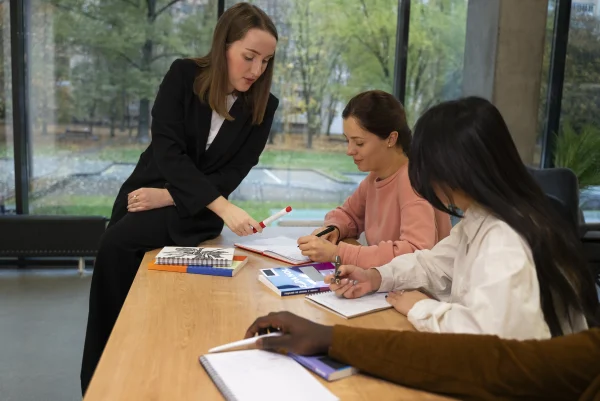
A common fear is that this method creates chaos. Teachers worry that if they give up power, they lose their authority. This is a misconception. Learner-Centred Teaching actually requires higher expertise.
It is easy to read from a PowerPoint slide. It is much harder to design a detailed project that scaffolds students toward a learning goal without telling them the answer. You are still the expert. You are still the authority. But you are using that authority to build their confidence, not just to display your own knowledge. You remain the captain of the ship, but you are letting the crew steer the wheel.
The Critical Link Between Autonomy and Engagement
Why does giving students control lead to better grades? The answer lies in human psychology. When students feel like pawns in a system, they resist. When they feel like players in the game, they commit.
Self-Determination Theory in Action
Research published by Ryan and Deci in 2000 suggests that Self-Determination Theory acts as the blueprint for motivation. The authors argue that every human has three innate psychological needs: competence, autonomy, and relatedness.
Traditional schooling often starves the need for autonomy. We tell students where to sit, when to speak, and what to think. Educators feed that hunger through the introduction of Learner-Centred Teaching. You provide a sense of control. When a student chooses their research topic, they express their identity through their work rather than simply completing homework. According to the study, this prompts intrinsic motivation, which the researchers define as the drive to perform an activity for its own inherent satisfaction rather than for a grade.
Moving Beyond Compliance
We need to be honest about what a "good" student looks like. Phillip Schlechty created a framework for engagement that is eye-opening. He distinguishes between "Authentic Engagement" and "Strategic Compliance."
Authentic Engagement happens when a student gives high attention and high commitment. They care about the work. Strategic Compliance is high attention but low commitment. This is the student who does the worksheet perfectly just to get an 'A.' These students prioritize the transaction over the content. Learner-Centred Teaching aims to move students from compliance to commitment. We want them to solve the problem because the problem is interesting, not because the teacher is watching.
Sparking Curiosity with inquiry-based learning

If autonomy is the goal, inquiry-based learning is the engine that gets you there. This method stops the "memorize and regurgitate" cycle. Instead, it starts with a question and ends with a discovery.
The Four Phases of Inquiry
You cannot just tell students to "go explore." That leads to confusion. Pedaste et al. (2015) outlined a clear cycle to keep inquiry on track.
Orientation: This is the hook. You stimulate interest with a video, a weird object, or a conflicting set of data.
Conceptualization: Students start asking questions and forming hypotheses. They decide what they need to find out.
Investigation: This is the "work." They plan, explore, experiment, and gather data.
Conclusion: As noted in a study published in ScienceDirect, inquiry-based learning usually concludes with a phase where students interpret results and reflect on whether their hypotheses were correct.
This structure gives them freedom within a framework. They aren't lost; they are on a mission.
Designing Questions That Matter
The success of inquiry-based learning relies on the quality of the question. You have to avoid "Google-able" questions. If a student can find the answer in five seconds on their phone, it isn't an inquiry.
For example, don't ask, "What year did the colonies declare independence?" That is just a recall. Instead, ask a Driving Question: "How might we write a play to convince a Loyalist to support the Declaration of Independence?" Researching the arguments of both sides allows the student to synthesize the information and create something new. It transforms them from consumers of information into creators of content.
Teachers often wonder how this looks in practice. "What are examples of learner-centered teaching?" According to research from Springer, common examples include problem-based learning projects where students learn via facilitated problem solving. Additionally, Carleton University highlights peer-led team learning, where successful students are trained to guide small groups of peers as workshop leaders. Other examples include inquiry-based research assignments where students choose their own topics, such as investigating local environmental issues rather than just memorizing textbook definitions.
Practical Strategies for Learner-Centred Teaching
Theory is great, but you have a class to teach at 8:00 AM. You need tactics that work on Monday morning. Here are actionable ways to shift the balance in your room.
Structuring the Physical and Digital Environment
The "graveyard" formation, rows of desks facing the front, kills collaboration. It signals that the only important interaction is between the student and the teacher. Try shifting desks into "pods" or clusters. This physical change forces students to look at each other, inviting peer interaction.
Digital tools also play a huge role. In every class, you have introverts who are brilliant but terrified to raise their hands. If you only use verbal discussion, you lose their voice. Using collaborative documents or digital discussion boards allows these students to participate autonomously. They can type their thoughts without the pressure of the spotlight, ensuring Learner-Centred Teaching reaches everyone, not just the extroverts.
The "Flipped Classroom" Technique
One of the biggest barriers to active learning is the need to deliver information. If you spend 40 minutes lecturing, there is no time for inquiry. The Flipped Classroom solves this.
You record your lecture or curate a video for homework. Students watch the content at home, at their own pace. Passive listening is moved to the home to free up the classroom for application and active doing. A 2014 study on this method showed student engagement in asynchronous video lectures hit 81%, compared to just 38% during live lectures.
Scaffolding for Independence
You cannot toss students into the deep end and hope they swim. You need "Scaffolding," a concept rooted in Vygotsky’s Zone of Proximal Development.
Use the "Gradual Release of Responsibility" model.
I do: Documentation from the Center for Self-Determination Theory explains that the teacher demonstrates the skill during this stage.
We do: You practice it together as a class.
You do: The student attempts it alone.
This safety net allows students to build confidence. You provide support structures—like sentence starters or research templates—and then slowly remove them as the students get stronger. You are building their autonomy brick by brick.
Overcoming Common Implementation Hurdles
Let’s be real: changing your teaching style is hard. It feels risky. You will face obstacles, but they are surmountable if you anticipate them.
Managing the "Messy" Middle
Active learning is loud. When students are debating, building, or investigating, the classroom environment appears messy rather than resembling a disciplined library.
Teachers often panic during this phase. They interpret the noise as a loss of control. But you have to distinguish between "productive noise" and "disruptive noise." If they are arguing about the data, that is the sound of learning. You also have to manage student resistance. Students who have spent years being spoon-fed might get frustrated. They will ask, "Why don't you just tell us the answer?" You have to be transparent. Explain why you are doing this. Tell them you are training them to think, not just to repeat.
Addressing Curriculum Constraints
The biggest pushback is always time. "I have to get through the curriculum for the standardized test. I don't have time for projects."
The evidence suggests the opposite. You actually save time because students retain the information better. As reported in a study published in PNAS, researchers found that active learning reduces failure rates by 55%. The study also reported that students in traditional lecturing classes were 1.5 times more likely to fail. When students actually understand the concept through inquiry-based learning, you don't have to reteach it three times.
However, challenges exist. "What are the disadvantages of student-centered learning?" It can be time-consuming to plan, requires high adaptability from teachers, and some students may initially struggle with the lack of rigid structure, leading to resistance or anxiety during the change phase.
Rethinking Assessment for Independent Thinkers
If you change how you teach, you have to change how you grade. You cannot teach creativity and then give a multiple-choice test.
Formative vs. Summative Assessments
According to the New York State Education Department, traditional schools rely heavily on summative assessments, which measure what students have learned at the end of a unit or semester. This is an autopsy; it tells you what died after it’s too late to save it.
The department also notes that Learner-Centred Teaching thrives on formative assessment, which involves frequent checks of student progress to identify learning needs and adjust teaching appropriately. Carnegie Mellon University describes these as low-stakes checkpoints that typically have low or no point value. Use "Exit Tickets" where students answer one question before leaving class. Use "30-Second Shares" where they explain a concept to a neighbor. This gives you real-time data on their understanding without halting the inquiry process. It keeps the focus on growth, not the score.
The Power of Self and Peer Assessment
Maryellen Weimer advocates for "Assessment as Learning." Research shared by UC Riverside indicates that when students evaluate themselves or their peers, they are forced to understand the standard of quality.
The study suggests providing students with the rubric before the project starts to assist with accurate self-assessment. This prompts the "Competence" need from Self-Determination Theory. When a student can look at their work and say, "I know this is good because it meets criteria X, Y, and Z," they no longer need the teacher to validate them. They have become independent.
Cultivating Lifelong Learners
The ultimate goal of education isn't to create good 10th graders. It is to create capable adults. The methods we choose today shape the citizens of tomorrow.
Building Soft Skills
As noted in a report in PMC, students build the "4 Cs" when engaging in Learner-Centred Teaching: critical thinking, communication, collaboration, and creativity. They learn skills beyond the subject matter.
When they work in a pod, they learn to negotiate. When they pursue an inquiry project, they learn resilience when their first Google search fails. These are the soft skills that employers are desperate for. No boss wants an employee who sits at their desk waiting to be told exactly what to do. They want problem solvers.
Preparing for a Future of Uncertainty
We are preparing students for jobs that don't exist yet, using technologies that haven't been invented. Within an AI-driven society, the ability to recall facts is becoming less relevant. Your phone knows every fact in history.
The value of the human in the loop is the ability to ask the right question. Inquiry-based learning builds the muscle of curiosity. It ensures that when students leave our classrooms, they have the agency to navigate an undefined future. Instead of just waiting for instructions, they will define the path.
Empowering the Next Generation
We have looked at the reality of the "Engagement Cliff" and the power of the "Autonomy Solution." We know that the old methods are failing to capture the minds of modern students. By embracing Learner-Centred Teaching, we stop the slow fade of curiosity.
It requires courage to make this shift. It is scary to let go of the lecture podium. It is tiring to scaffold detailed inquiries. But the data from Freeman, the psychology from Deci, and the frameworks from Weimer all point in one direction. Active, autonomous students fail less, learn more, and leave school better prepared for reality.
You don't have to overhaul your entire syllabus overnight. Start small. Tomorrow, ask one Driving Question. Change the layout of the desks for one hour. Hand the power back to the students and watch them wake up. The results will be worth the noise.
Recently Added
Categories
- Arts And Humanities
- Blog
- Business And Management
- Criminology
- Education
- Environment And Conservation
- Farming And Animal Care
- Geopolitics
- Lifestyle And Beauty
- Medicine And Science
- Mental Health
- Nutrition And Diet
- Religion And Spirituality
- Social Care And Health
- Sport And Fitness
- Technology
- Uncategorized
- Videos

