
Learner-Centred Teaching Shifts Load To Students
You stand at the front of the room, delivering a carefully crafted lecture. You cover every point on the syllabus. You ask questions. You offer clear explanations. Yet, when the test results come back, the average score is stuck at a C-plus. The students seemed attentive, but the information didn't stick. This scenario repeats in classrooms everywhere because the standard model of teaching fights against how the human brain actually learns. When you do all the talking, you do all the learning. The students are merely watching you work.
The pressure to fix this interaction is intense. Administrators want data, parents want results, and you want your students to actually understand the material. The solution requires a core shift in who carries the cognitive load. Learner-Centred Teaching changes the equation. This method treats students as active participants in their own education rather than empty vessels waiting to be filled.
Moving from a lecture-heavy approach to a student-driven one can feel risky. You might worry about losing control or falling behind on the curriculum. However, the flipped classroom model offers a practical way to bridge this gap. Shifting content delivery to the home environment and saving class time for active practice allows you to create a space where grades naturally rise. The students stop watching and start doing.
Gaining a Clear View of the Core of Learner-Centred Teaching
As described in the constructivist model discussed by Alison King, Learner-Centred Teaching (LCT) is a pedagogical framework where the focus moves from what the instructor teaches to what the student learns. Her research suggests that in a traditional setting, the teacher is the "Sage on the Stage," holding all the authority and knowledge. King further notes that in an LCT environment, the teacher functions as a "Guide on the Side," facilitating learning in less directive ways rather than acting as a lecturer. These ideas have practical applications beyond theory; they trace back to educational philosophers like John Dewey, who championed experiential learning, and Lev Vygotsky, who emphasized social constructivism.
The difference lies in power interactions. Research by Maryellen Weimer, author of Learner-Centered Teaching (2002), emphasizes that this method requires sharing power rather than transferring it wholesale. You give students decision-making authority over aspects of their learning, such as pacing or topic selection. This builds buy-in. Many educators ask, what are the characteristics of learner-centered teaching? The essential characteristics include shared power, students taking responsibility for learning, and the teacher acting as a facilitator. It forces students to own their education rather than renting it for a semester.
The Psychology of Ownership

According to the framework of Self-Determination Theory (SDT) developed by Deci and Ryan, this approach works because it satisfies the three innate psychological needs of autonomy, competence, and relatedness. Traditional lectures often strip away autonomy. Students sit where they are told and listen to what they are told. When you hand that responsibility back to them, their engagement deepens because the success or failure of the task belongs to them.
How Learner-Centred Teaching Directly Affects Grades
While this methodology makes students happier, it also leads to better academic performance. Learner-Centred Teaching delivers on this promise by using the way memory works. A landmark meta-analysis published in PNAS by Scott Freeman (2014) reviewed 225 studies on STEM education. His findings revealed that students in active learning environments had exam scores 6% higher than those in traditional lectures. More alarmingly, the study showed that students in traditional lecture courses were 1.5 times more likely to fail.
These results happen because of the "Testing Effect" or retrieval practice. Research by Karpicke and Blunt (2011) showed that students who actively retrieved information, a core component of LCT activities like quizzes, retained 50% more information a week later compared to those who simply re-read their notes. When a student listens to a lecture, they often believe they understand the material because it makes sense in the moment. This is the "illusion of competence." They only realize they don't understand it when they try to apply it alone at home. LCT forces that application to happen in the classroom, where you can correct errors instantly.
Moving from Passive Listening to Active Processing
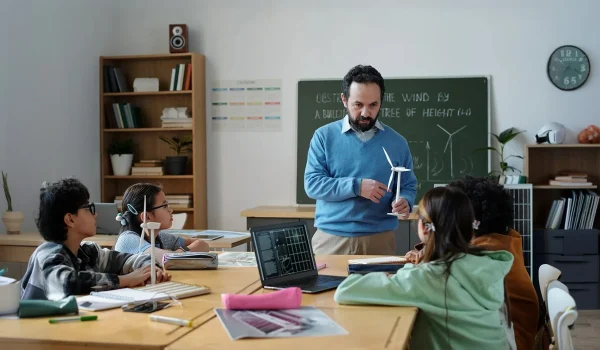
Neurologically, listening and doing are different activities. During a lecture, the brain is often in a passive recording mode. It is receiving data but not necessarily encoding it into long-term memory. As highlighted in a study by Gökçe Akçayır and Murat Akçayır, flipped learning involves direct computer-based individual instruction outside the classroom while using interactive group learning activities inside the classroom. In a related study on the flipped classroom model in pharmacy education, students in the flipped cohort achieved a significantly higher GPA (3.01) compared to the historical control group (2.80). The difference came from the shift in activity. Instead of transcribing words, the students were solving problems, forcing their brains to build new neural connections.
The Flipped Classroom Model as the Perfect Catalyst
Research published in ScienceDirect by Jensen et al. suggests that the most effective way to implement Learner-Centred Teaching without sacrificing content coverage is the flipped classroom model, as it provides the opportunity for structured, active learning and problem-solving. This approach inverts the traditional schedule. As noted in the work of Akçayır and Akçayır, the transfer of information happens asynchronously at home, usually through video or reading, whereas the assimilation or sense-making happens synchronously in class.
Chemistry teachers Jonathan Bergmann and Aaron Sams pioneered the modern iteration of this in 2007. They started recording lectures for absent students and realized the recordings allowed them to stop lecturing in class entirely. If you spend 90% of your class time talking, you cannot be truly learner-centred. There is simply no room for the student to act. The flipped model clears the schedule. It provides the time to walk around the room, talk to struggling students, and challenge the advanced ones.
Reclaiming Class Time for Higher-Order Thinking
According to documentation from the University of Arkansas, this model works by inverting Bloom’s Taxonomy. Their research explains that in a standard class, you help students with the bottom tiers, Remembering and Understanding, during the lecture. The study also highlights that teachers then send students home to do the difficult work of applying and analyzing on their own. This is backward. The flipped model assigns the easy cognitive work (watching a video on the Krebs cycle) as homework. The difficult cognitive work (analyzing a case study on metabolic disorders) happens in class, where the expert is present to help.
Structuring Your First Flipped Lesson
Success relies on a tight workflow. You cannot just assign a video and hope for the best. You need a structure that guarantees preparation. Before you flip a whole unit, start with a single lesson. Choose a topic that students historically struggle with.
The biggest fear for teachers is silence. Teachers often worry about compliance, asking, what if students don't do the reading in a flipped classroom? As stated by the Center for Research on Learning and Teaching at the University of Michigan, the solution lies in holding students accountable for completing pre-class work through entry tickets or low-stakes quizzes before the activity begins. This "Entry Ticket" serves two purposes. It ensures the student did the pre-work, and it gives you immediate data on who is confused.
The Pre-Class Phase (Content Consumption)
When creating content for the home, brevity is key. Use the "1-to-1.5 minute per grade level" rule. If you teach 10th grade, your video should be 10 to 15 minutes max. Data from edX shows that the average engagement time of any video maxes out at six minutes, leading to a significant drop in retention after that point. You don't need to be a filmmaker. You just need to be clear. If you don't want to make videos, curate high-quality readings or existing content from sources like Khan Academy or TED-Ed.
The In-Class Phase (Active Application)
Once students arrive, put them to work immediately. As noted by Kent State University, a classic LCT activity is "Think-Pair-Share," which serves as a cooperative learning activity for any subject.
Think (1 min): The student solves a problem alone.
Pair (2 min): They discuss their answer with a neighbor.
Share (5 min): The pair shares their findings with the class.
According to Reading Rockets, this structure forces every student to engage because discussing with a partner focuses attention and maximizes participation. In a lecture, only the hand-raisers participate. In Think-Pair-Share, everyone must formulate an answer.
Overcoming Resistance to Learner-Centred Teaching
You will face pushback. Ironically, the resistance often comes from the high-performing students. They have spent years learning the game of school thoroughly: sit still, take notes, memorize, repeat. Learner-Centred Teaching changes the rules. It requires cognitive effort, which feels like work.
A 2019 study in PLOS ONE highlighted this friction. Students in active learning classrooms felt they learned less because the process was harder and more confusing than a polished lecture. However, those same students scored significantly higher on objective tests. You must explain this to them. A study by Finelli et al. (2018) found that when instructors explicitly explained the benefits of active learning, better grades and career skills, student resistance dropped by over 30%. You have to sell the method, not just the content.
The "Lazy Teacher" Myth
Students might accuse you of not teaching. They see you walking around the room rather than standing at the podium and assume you are doing less. The reality is the opposite. According to McLaughlin et al., an educator must invest approximately 127% more time in course development for a flipped course compared to a traditional course. You are shifting your workload from presentation to curation and coaching. You are working harder, but your work is now focused on individual student needs rather than broad broadcasting.
Technology Tools That Power Learner-Centred Teaching
You do not need a degree in computer science to run a flipped classroom model, but the right tools save time. The goal is to increase information density and feedback speed.
A guide from Towson University highlights that EdPuzzle is an essential tool because it allows you to modify a video by inserting questions that students have to answer before they proceed. This ensures the video pauses, and the student must provide an answer to continue, which guarantees active watching. You can see exactly who watched the video and which questions they missed. Padlet acts as a virtual whiteboard for collaborative brainstorming. Additionally, research by Wang and Tahir in ScienceDirect notes that Kahoot! turns formative assessment into a game-based learning platform. These tools provide the data you need to be effective.
Using Data to Personalize Instruction
Modern Learning Management Systems (LMS) offer deep analytics to help teachers. Documentation for Canvas states that its Course Analytics provides interactive graphs and tables that allow instructors to track data related to course grades and activity. Similarly, Schoology’s analytics system provides insights into usage and data tracking at both the district and course levels. If you look at the data from your "Entry Ticket" and see that 40% of the class missed question three, you know exactly how to start class. You don't waste time reviewing what they already know. You target the misconception immediately. This is "Just-in-Time Teaching," and it is impossible without the data loop provided by LCT tools.
Assessment Strategies for the Modern Classroom
Changing how you teach requires changing how you grade. Traditional summative assessments (big end-of-unit tests) often come too late to help the student learn. Learner-Centred Teaching prioritizes formative assessment, ongoing, low-stakes checks that guide the learning process.
Black and Wiliam’s famous 1998 review showed that effective formative assessment can improve student achievement by 0.4 to 0.7 standard deviations. That is a massive jump in grades. When redesigning a syllabus, you might wonder, how do you assess learner-centered instruction effectively? Effective assessment relies on frequent, low-stakes feedback loops and peer reviews rather than relying solely on high-stakes final exams. You want to catch the failure while the stakes are low, allowing the student to correct course.
Peer Review and Self-Assessment
One of the most powerful assessment methods is the two-stage exam. First, students take the exam individually. Immediately after, they retake the same exam in groups of four. The group portion turns the test itself into a learning event. Students argue for their answers, explain concepts to one another, and correct misconceptions in real-time. This utilizes Eric Mazur’s "Peer Instruction" method, which has been shown to nearly double learning gains on conceptual tests.
The Future is Learner-Centred Teaching
Boosting grades is about fundamentally changing the role of the student in the room rather than covering more material or assigning more homework. Adopting Learner-Centred Teaching allows you to move students from passive consumers to active architects of their own knowledge.
The flipped classroom model provides the structure to make this happen without sacrificing rigorous content. It requires an upfront investment of time and energy, but the return is a classroom of resilient, autonomous learners who can tackle difficult problems without waiting for you to give them the answer. Learner-Centred Teaching is the shift required for modern education. Don't wait for a new period to start. Flip one lesson next week, hand the power over to your students, and watch the grades follow.
Recently Added
Categories
- Arts And Humanities
- Blog
- Business And Management
- Criminology
- Education
- Environment And Conservation
- Farming And Animal Care
- Geopolitics
- Lifestyle And Beauty
- Medicine And Science
- Mental Health
- Nutrition And Diet
- Religion And Spirituality
- Social Care And Health
- Sport And Fitness
- Technology
- Uncategorized
- Videos

