
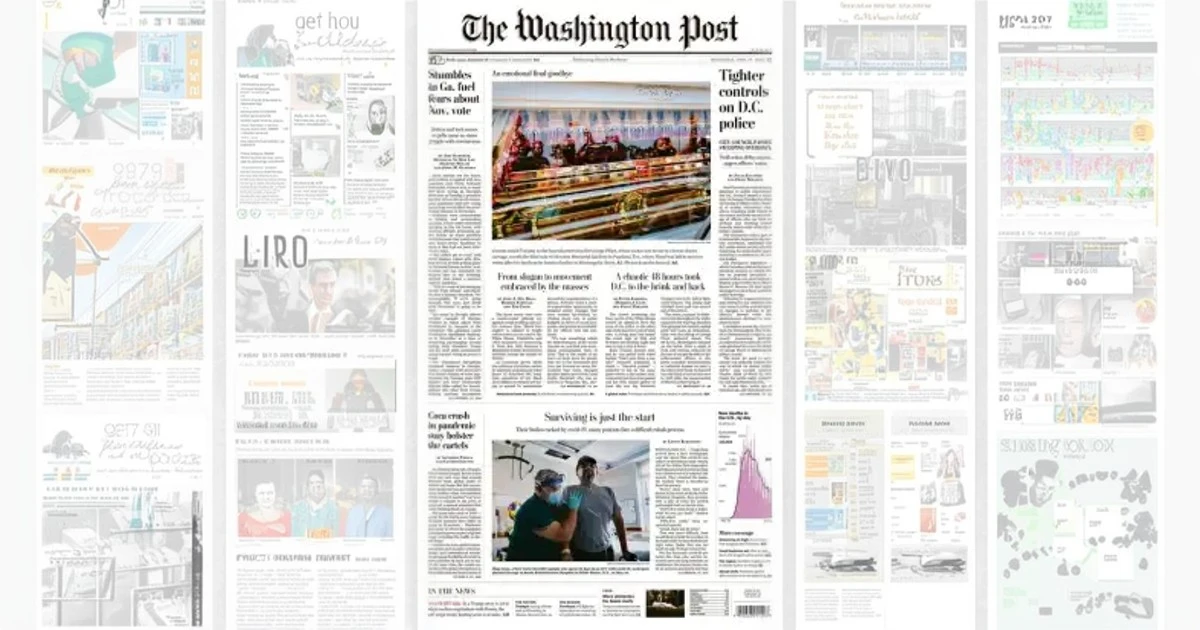
Image credits- By The Washington Post - The Washington Post, Wikipedia
Washington Post Gutted: 300 Jobs Cut in Reset
Great institutions rarely die from a single, loud explosion; they crumble when the people inside stop believing in the assignment. A newspaper survives only as long as its owners value truth over safety. The recent Washington Post layoffs signal a shift far deeper than a simple budget correction. This financial restructuring looks more like a complete retreat from the company’s role in American life.
Management frames this as a necessary evolution for a changing market. Staff members see a surrender. When a newsroom cuts the very reporters who hold power accountable, the public loses its eyes and ears. Tension fills the hallways as journalists wait to see who stays and who goes. The deeper story here involves a clash between corporate strategy and the messy, expensive reality of gathering news.
The Anatomy of a Massacre
A spreadsheet cannot capture the sudden silence of a bustling room. The numbers arriving on a Wednesday morning video call hit the staff with physical force. According to a spokesperson cited by Reuters, the layoff will affect a third of all employees. This cut wiped out approximately 300 journalists from a newsroom of 800. The sheer scale of these Washington Post layoffs dwarfs previous reduction phases.
Staff members watched their colleagues vanish from Slack channels in real-time. The company set April 10 as the official termination date, placing hundreds of reporters on paid leave until then. This "non-work status" creates a ghostly atmosphere where employees technically remain on the payroll but cannot do their jobs.
A History of Cuts
This event follows a pattern of shrinking ambition. As reported by The Washington Post, the paper announced plans late in 2023 to offer voluntary buyouts to decrease head count by 240. A report by The Guardian notes that in the fall of 2024, another 54 employees left the publishing software division. By January 2025, the advertising and print operations lost 4% of their staff. Each phase chipped away at the foundation, but this latest move strikes directly at the newsroom's core.
Strategic Reset or Self-Inflicted Wound?
When leaders speak of "resets," they often mean they ran out of other ideas. Editor in Chief Matt Murray described the cuts as an operational overhaul necessary for long-term survival. He argued that the paper’s connection to the audience had become insufficient. The official rationale claims this "Strategic Reset" will position the paper for future competitiveness.
Critics argue the strategy ignores reality. The paper struggles to reach customers in a crowded media environment because it stopped offering a distinct product. Murray insists the goal is to become essential to daily life again. Yet, slashing the workforce makes differentiation harder. A smaller team produces less original reporting, which leads to fewer reasons for readers to subscribe.
The Financial Picture
Management points to a bleak balance sheet. Estimates from the Wall Street Journal place the paper’s 2024 losses at $100 million. Traffic has plummeted over the last 3 years, with the AI boom citing a major factor in the decline. However, competitors like the New York Times added 450,000 digital subscribers in Q4 of 2025. The contrast suggests the problem lies in execution, not just the industry.
The Market Reality
You cannot cut your way to relevance when your competitors are investing in growth. The Washington Post layoffs arrive as the publication faces a sharp decline in daily story output over a five-year trend. Readers notice when the volume and depth of content drop.
Hundreds of thousands of subscribers canceled their memberships following the paper's decision to withhold an endorsement in the Fall 2024 election. This revenue loss created a hole in the budget. Management blames market conditions, but many wounds appear self-inflicted.
Why is the Washington Post losing subscribers?Subscribers left in large numbers due to editorial shifts, specifically the refusal to endorse a presidential candidate, combined with a general decline in content volume.
Targeted Erasure of Coverage
You learn a company’s true priorities by looking at who they deem expendable. The specific departments chosen for elimination reveal a desire to shrink the paper’s worldview. The "Sports" section, in its current iteration, ended completely. Local news coverage, once the heartbeat of the paper, faces massive restructuring.
The Metro section stands decimated. Reporters covering education and race found themselves out of work. The "Post Reports" podcast, a key tool for reaching younger audiences, saw immediate suspension. The Book World section also faced the axe. These cuts suggest a retreat to a narrow focus on national politics and government, abandoning the broader cultural scope.
Image Credit - By ajay_suresh, Wikimedia Commons
The "Scaled Back" Narrative
Management claims they merely "scaled back" international operations. The reality on the ground looks different. The entire Middle East roster and the Cairo Bureau faced cuts. This happens while global conflicts intensify. A retention of 12 international bureaus sounds stable, but the capacity to cover breaking news diminishes significantly.
The International Retreat
Distance usually provides safety, but in corporate media, it makes you an easy target. Reporters risking their lives in war zones found their bravery offered no job security. As covered by NDTV, a Ukraine correspondent posted on social media that she was laid off in the middle of a war zone, stating she was devastated and had no words.
The definition of "international reduction" includes cutting a Ukraine correspondent stationed in an active war zone. This moves beyond financial prudence into the realm of negligence. According to The New Yorker, Peter Finn, the International Editor, told the reporter that he asked to be laid off. This gesture highlights the deep rift between editorial leadership and corporate management.
Which departments were cut at the Washington Post? The cuts eliminated or severely reduced the Sports desk, the Metro section, the Books section, the Post Reports podcast, and significant portions of the International and War reporting teams.
Leadership in the Crosshairs
Accountability usually flows downward in a crisis, landing on the people with the least power. Staff members direct their anger at Publisher Will Lewis and owner Jeff Bezos. An anonymous editor criticized the leadership for cowardice, citing a lack of face-time with the staff during the announcement.
Employees describe the atmosphere as a massacre. They view Lewis as an enabler of institutional decline. The accusation is that leadership prioritizes political favor over journalistic integrity. Ashley Parker, a former Post reporter now at The Atlantic, called the move a systematic dismantling of a legacy. She described a leadership team devoid of vision, confusing contempt for journalism with business strategy.
The Financial Contradiction
Infinite wealth does not guarantee a willingness to spend it. Jeff Bezos holds the title of the world’s 4th richest person, with a net worth of roughly $260 billion according to the Bloomberg Index. The paper’s $100 million loss represents a fraction of his fortune.
Critics point to his recent $40 million investment in a "Melania" documentary as proof that money exists for projects he values. The Washington Post layoffs therefore appear as a choice, not a necessity. The Post Union argues that the owner is unwilling to invest in the mission. They claim he should sell the paper if he lacks the commitment to sustain it.
How many employees did Washington Post lay off? The organization laid off approximately 300 journalists, which represents roughly one-third of the total newsroom staff.
The Ideological Battleground
Financial excuses frequently cover up uncomfortable editorial shifts. Emmanuel Felton, a race reporter affected by the cuts, labeled his firing as ideological rather than financial. He noted that previous internal data showed race coverage actually drove subscriptions.
Removing these reporters changes the paper's voice. Senator Chris Van Hollen questioned whether the owner prioritizes political appeasement over journalism. He warned that corporate media consolidation threatens democracy. Marty Baron, the former Executive Editor, called this a historic low point. He believes the brand destruction is self-inflicted, citing owner appeasement of Trump as a permanent stain.
The Future of the Fourth Estate
A hollowed-out building struggles to stand against strong winds. The remaining staff must now cover the world with fewer resources and lower morale. A protest planned for Thursday aims to voice collective outrage, but the decisions appear final.
The National Press Club issued a statement warning that empty newsrooms erode the public’s right to know. They predict a lack of oversight on powerful institutions. Matt Murray continues to argue that this painful transformation is required for relevance. He wants the paper to concentrate on differentiation. However, stripped of its local, cultural, and international depth, the paper risks becoming just another generic news feed.
The Hidden Cost of Shrinking the Newsroom
Newsrooms do not run on ink and paper; they run on the trust of their readers and the courage of their owners. The Washington Post layoffs reveal a breach in both. Treating reporters as overhead costs rather than essential assets risks destroying the product leadership claims to save. A smaller, scared newsroom cannot hold power to account. When the dust settles, the savings on the balance sheet will likely cost the publication its soul. The process of decline is now in motion, driven by the very people tasked with stopping it.
Recently Added
Categories
- Arts And Humanities
- Blog
- Business And Management
- Criminology
- Education
- Environment And Conservation
- Farming And Animal Care
- Geopolitics
- Lifestyle And Beauty
- Medicine And Science
- Mental Health
- Nutrition And Diet
- Religion And Spirituality
- Social Care And Health
- Sport And Fitness
- Technology
- Uncategorized
- Videos

