
Image by- Department for Transport, OGL 3, via Wikimedia Commons
Train & Track Unite as Great British Railways
A fragmented system allows blame to shift endlessly between regulators while passengers stand stranded on the platform. When seventeen different companies run the trains and another manages the rails, accountability vanishes into the gaps between contracts. The new plan eliminates those hiding spots by forming a single "directing mind" for the entire network. This shift moves beyond simple rebranding; it forces a structural collision between track and train to stop the finger-pointing. Great British Railways represents the end of this disjointed era and the start of total operational consolidation.
As reported by The Guardian, the unveiling at London Bridge on December 8, 2025, signaled the physical beginning of this change. Government officials presented a unified identity that sweeps away the confusing patchwork of private franchises. Guidance published on GOV.UK explains that by bringing operations back under public rights, the state reclaims the power to set schedules, manage upgrades, and answer directly to the traveler. This project targets the end of 2027 for full renationalisation, merging the disparate pieces of the rail network into one cohesive body.
The Double Arrow Returns: Visual Identity as Strategy
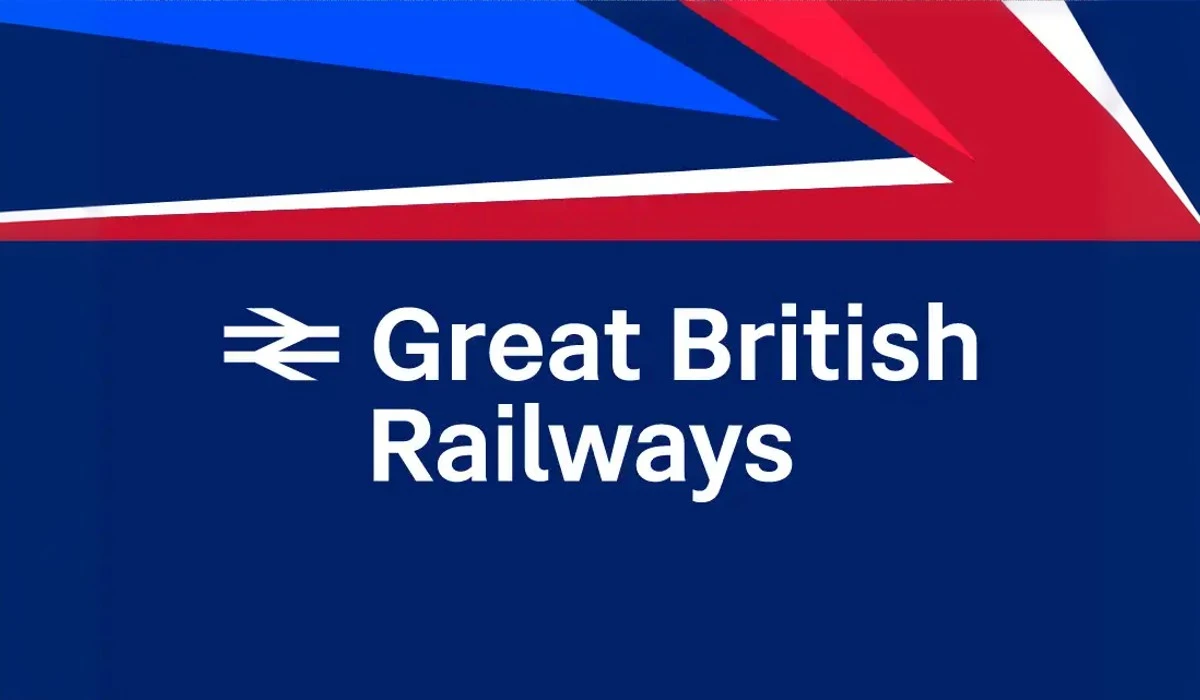
Nostalgia often serves as a Trojan horse for radical structural change. The choice to revive a sixty-year-old symbol suggests a desire to return to a time when the network functioned as a single entity. The new visual identity centers on the "Double Arrow," originally designed by Gerry Barney in 1965 for British Rail. This symbol anchors the entire rebrand. It appears in a sharp red, white, and blue color scheme, utilizing angular forms that mirror the Union Flag.
Using a legacy design creates immediate recognition and implies a restoration of service values. The Department for Transport (DfT) executed this design update in-house. This decision prioritized worth for money over expensive external agencies. A DfT spokesperson described the look as a "nod to Britain’s proud railway heritage" while calling the update "iconic."
The rollout follows a strict schedule. Throughout December 2025, major stations including Birmingham New Street, Glasgow Central, Leeds City, and Manchester Piccadilly will host exhibitions of these designs. A report by Railway-News.com confirms that the public will see the physical application of this brand on trains and websites starting in Spring 2026. This visual unification serves a functional purpose. It tells the passenger that one body now holds responsibility for their journey.
Great British Railways Unification: From Seventeen to One
Complexity thrives in the gaps between seventeen different boardrooms. The core argument for this overhaul is the need to simplify a tangled web of management. Currently, seventeen different organizations run the trains, while a separate entity manages the tracks. This split creates friction, bureaucracy, and delays. The new model dissolves these boundaries.
Great British Railways acts as the single umbrella body. It unifies the track and the train under one roof. This integration removes the competing interests that often paralyze decision-making. The primary goal is to establish that "directing mind" to supervise the entire network.
Current statistics show that seven regulators are already under public control. These publicly run lines account for approximately one-third of all journeys today. The remaining private regulators will hand over to the public sector as their agreements expire or are bought out. This process creates a clean sweep of the industry. The government argues that this model ensures the railways are "owned by the public, delivering for the public" rather than serving private shareholders.
The Timeline of Transfer
Announcing a destination is easy, but moving the machinery of state takes years of bureaucratic maneuvering. The government has set a hard deadline to complete this massive transfer of power. The process moves in distinct phases to prevent system shock.
The legislative foundation creates the rules for this takeover. The Railways Bill, introduced on November 5, 2025, alongside the Passenger Railway Services Act 2024, provides the legal framework. Without these laws, the transmission of contracts and assets would face endless legal challenges.
Key Dates for the Transition:
December 2025: Design exhibitions at major hubs like London Bridge and Manchester Piccadilly.
Spring 2026: Physical rollout begins. The new branding appears on trains, stations, and digital platforms.
End of 2027: Full renationalisation. All target regulators transfer to public ownership.
This timeline allows for a gradual absorption of private entities. Passengers often wonder about the pace of these changes. When will Great British Railways launch fully? The physical rollout starts in Spring 2026, but the complete transfer of all regulators wraps up by the end of 2027. This staggered approach aims to maintain service levels while the back-end management structures merge.
The Digital Gateway: A Single App for All
Friction in the purchasing process discourages travel just as effectively as a cancelled train. Currently, passengers navigate a maze of operator-specific apps and websites to find the best fares. This fragmentation often leads to confusion and hidden costs. The new system centralizes everything.
A single app will handle ticketing for the entire network. This platform functions as a "one-stop shop" for every passenger. Users can check journeys, purchase tickets, and book Passenger Assist services for disabled users all in one place. The removal of "frustrating bureaucracy" stands as a key consumer benefit.
The financial incentive helps drive adoption. The new app removes booking fees entirely. This fee removal creates an immediate saving for passengers who previously paid extra to third-party platforms. Will train tickets be cheaper under the latest system? The government has confirmed a freeze on regulated prices in England and zero booking fees on the app, though there is no blanket guarantee of lower prices overall. This strategy creates a simplified user experience where the ticket price you see is the price you pay.

Image by- Department for Transport, OGL 3 , via Wikimedia Commons
Great British Railways Headquarters and Governance
Location dictates priority, and placing the command center outside the capital signals a shift in focus. The headquarters for Great British Railways will be located in Derby. This selection followed a public poll and a shortlisting process, moving the center of gravity away from London.
Placing the HQ in Derby acknowledges the city's deep ties to rail engineering and manufacturing. It suggests that operational expertise will drive decisions rather than pure political maneuvering. From this base, the organization will oversee the integration of the network.
Heidi Alexander emphasizes that this project "isn't just a paint job." The governance structure focuses totally on delivering a "proper public service." To ensure this, the plan includes a strengthened "Passenger Watchdog." This body holds the new organization accountable. Accountability often fades in large monopolies, so this watchdog serves as a critical check on power. It ensures that the single operator listens to the people it serves.
Operational Reality: Limits of Nationalisation
"Full" ownership often comes with specific, calculated boundaries to keep costs down. While the government promotes the narrative of total nationalisation, several key components of the railway system will remain in private hands. The state has drawn a line between passenger operations and other expensive assets.
Entities Remaining Private:
Freight Services: These continue to operate independently.
Rolling Stock Companies (ROSCOs): The companies that own the actual train cars remain private. Buying them out would require massive capital expenditure.
Open-Access Regulators: Companies like Lumo, Hull Trains, and Grand Central operate outside the franchise system and will remain independent.
Devolved authorities also maintain their operational independence. Transport for London (controlling the Elizabeth Line and Overground), Merseyrail, and ScotRail will not fall under the direct control of the new national body. They will continue to run their own networks. Passengers might ask about the scope of government control. Who owns Great British Railways' rolling stock? Private Rolling Stock Companies (ROSCOs) retain ownership of the trains, leasing them to the public operator to avoid high government debt. This nuance means the "nationalized" railway still relies on private partnerships to function.
Capacity and Service Upgrades
Capacity is not just about the quantity of seats; it is about the efficiency of the schedule that fills them. The unification allows for better utilization of existing assets. Specific regulators are already rolling out significant increases in service under the new directives.
LNER has officially announced plans for a massive expansion of its timetable. The operator aims to add 10,000 extra services per year. According to their statement, this increase provides 60,000 additional seats every week along the East Coast Mainline. This boost targets overcrowding and frequency, making rail travel a more viable option for commuters and long-distance travelers alike.
According to their official website, South Western Railway (SWR) focuses on updating its fleet. The operator confirms that the introduction of Arterio trains will quadruple the number of these modern units in service. This rollout targets a 10% capacity boost. Jacqueline Starr noted that the industry will "work closely with industry partners to support a smooth evolution" to the new system. These improvements rely on the "new railway" forming off old constraints to prioritize volume and reliability.
Digital Previews and Public Engagement
Ownership implies engagement, and the community needs to perceive the future before it arrives. As highlighted by The Guardian, the DfT has partnered with gaming and modeling companies to bring the Great British Railways brand to life before the physical trains are ready. This strategy builds familiarity with the new identity.
The newspaper further details that Train Sim World 6 will feature the new branding, allowing players to drive the new trains in a virtual environment. Hornby, the famous model train manufacturer, will produce physical models. These partnerships put the brand into the hands of enthusiasts and the general public early.
This digital preview creates a sense of momentum. It counters the skepticism that often accompanies long-term infrastructure projects. By seeing the trains in a simulator or on a model track, the concept becomes tangible. It reinforces the message that the change is real and imminent.
A Unified Direction
A single logo forces a single point of accountability, removing the excuses that thrived in a fractured system. The creation of Great British Railways ends the era of disjointed management. By merging track and train, the state accepts full responsibility for the passenger experience. The unveiling at London Bridge and the upcoming rollout mark a definitive break from the past.
This transition involves more than just a new coat of paint. It requires the integration of seventeen organizations, the rollout of a unified digital platform, and the enforcement of a single operational vision. While freight and rolling stock remain private, the core passenger experience falls under one "directing mind." The Double Arrow returns not just as a symbol of heritage, but as a stamp of unified control. The train is leaving the station, and for the foremost time in decades, one driver is steering the engine.
Recently Added
Categories
- Arts And Humanities
- Blog
- Business And Management
- Criminology
- Education
- Environment And Conservation
- Farming And Animal Care
- Geopolitics
- Lifestyle And Beauty
- Medicine And Science
- Mental Health
- Nutrition And Diet
- Religion And Spirituality
- Social Care And Health
- Sport And Fitness
- Technology
- Uncategorized
- Videos

