

Luxury Jet Market: Why Speed Beats Gold Today
Buying a plane often looks like a proof of wealth, yet the real drivers remain strictly practical. When commercial airlines degrade their service to chase thin margins, they inadvertently create the best possible marketing campaign for their private competitors. Wealthy travelers are not fleeing towards champagne and caviar; they are fleeing away from operational drag.
The luxury private jet market has changed course. The industry has abandoned golden faucets and flashy exteriors to sell something far more valuable: time and physical stamina. According to aviation intelligence firm WingX, global private jet flights hit 3.7 million in 2025—a 35% jump from pre-pandemic levels. The data proves this represents a permanent shift in how global business moves rather than a temporary spike.
This surge tracks perfectly with the rise of Ultra-High-Net-Worth Individuals (UHNWI). Knight Frank reports in The Wealth Report that the number of people with assets over $30 million (£22.2m) climbed by 70% between 2020 and 2025. These buyers look at a Gulfstream G700 as a tool. They calculate the cost of a jet against the cost of fatigue and lost hours. As commercial profit margins shrink to a razor-thin 2% to 4%, the gap between public and private transport widens every day.
The Productivity Equation
Airlines chase volume while private makers chase your exhaustion levels. The primary goal of modern aircraft design has moved away from ostentatious displays of wealth toward physiological preservation.
Leading manufacturers like Gulfstream and Dassault now concentrate on "living areas." They engineer cabins to reduce the physical toll of flying. Lower cabin pressure altitudes and reduced noise levels keep passengers fresh. Carlos Brana from Dassault explicitly states their primary metric is passenger freshness upon arrival. The goal is to eliminate the recovery time usually needed after a long-haul flight.
This focus on physiology changes the value proposition. A CEO arriving in Singapore ready to negotiate immediately is worth tens of millions to a corporation. Scott Neal of Gulfstream notes that demand now comes from large corporations and wealthy individuals who view global commerce as a multi-stop sprint. They require streamlined travel that connects points directly without the layout friction of commercial hubs.
You might wonder about the price tag for this level of performance. How much does a Gulfstream G700 cost? A new Gulfstream G700 costs tens of millions of dollars, depending on the specific configuration and options selected by the buyer.
The luxury private jet market thrives on this logic. The value lies in the passenger's condition after landing rather than the flight itself. If a jet saves executives from three days of jet lag, the math starts to make sense for the corporate balance sheet.
Design Priorities in the Luxury Private Jet Market
You buy the plane for yourself while designing it for the next owner. This reality shapes the interiors of the world’s most expensive aircraft more than any personal taste.
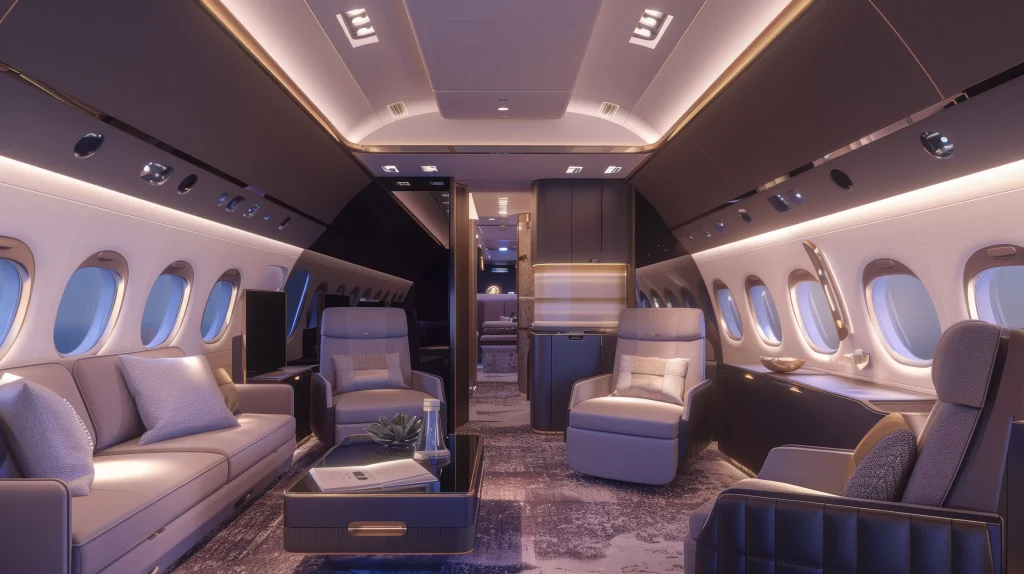
While public perception imagines leopard print and chandeliers, the reality is beige, cream, and neutral tones. Asian buyers, in particular, prefer "bland" interiors. This preference stems from a desire for high resale value. A neutral plane is easier to sell than one customized with distinct, eccentric tastes. Corporate optics also play a massive role here. Executives need to look responsible, not reckless. A subdued cabin suggests serious business; a flashy cabin suggests excess.
David Velupillai of Airbus Corporate Jets confirms that practicality now beats flash. Clients want comfort, but they reject excessive luxury like heavy chandeliers. However, distinct cultural quirks still exist. Some owners request specific tableware or demand immediate staffing for spontaneous trips. Customization teams deal with unique requests, such as convertible Mahjong tables or specific cleaning protocols for ashtrays. Yet, the dominant trend remains understated elegance.
Material quality has replaced visual noise. Dassault aims for elegance through textures and build quality rather than shiny ornaments. The interior must withstand scrutiny without screaming for attention. This restraint keeps the asset liquid. In a market where millions of dollars change hands, a beige seat is safer than a gold one.
The Asia-Pacific Growth Engine
Geography forces the hand of business travelers in this region. The sheer distance between economic hubs in Asia makes private travel a logistical necessity rather than a perk.
Carriers in the Asia-Pacific region added over 600 new routes between 2015 and the present day. This expansion reflects the fragmented nature of the region. Unlike the United States or Europe, where commercial hubs are tightly connected, Asian business centers often require multi-leg connections. Private jets solve this by offering point-to-point speed.
Vietnam, Singapore, and Indonesia are seeing delivery volumes increase. Scott Neal highlights high activity in Southeast Asia, creating a new corridor of demand. While the US still holds about 70% of the global business aviation market, the growth rate in Asia is aggressive. A paper by Alton Aviation Consultancy outlines that international traffic in the Asia-Pacific region is growing at 8%, outpacing the global average of 6.8%.
However, infrastructure remains a hurdle. Dan Kilkeary from Jetcraft points out that Asian markets lack the hangars and terminals found in the West. You can buy the jet, but finding a place to park it is a different challenge. This gap creates a ceiling on growth that governments are only just beginning to address. The Singapore Airshow, Asia's largest aviation fair, often highlights these growing pains alongside the sales figures.
The Westward Migration of Metal
Planes are flowing backward across the Pacific due to a supply gap. While manufacturers chase Asian buyers, the secondary market tells a completely different story.
As reported by Reuters, US buyers are actively importing pre-owned jets from Asia because of a shortage of inventory in the United States. The "China Premium"—where buyers paid extra for new jets in China—has evaporated. Sellers in Asia are now offloading low-utilization jets to eager American buyers.
This migration creates technical headaches. Asian jets entering the US market often require significant modifications. They need voltage conversion to handle 110v systems, English placards to replace local languages, and often paint updates to match Western preferences. Philip Rushton of Aviatrade notes that cost-conscious Asian buyers are driving this trend. They are willing to sell, and the US market is desperate to buy.
Why are private jets moving from Asia to the US?
US buyers are importing jets from Asia because of a severe shortage of available aircraft in the American market, forcing them to source planes globally.
This flow contradicts the narrative that Asia is solely a buying market. This fluid ecosystem moves metal to where the money and utilization are highest. Currently, the US appetite for aircraft absorbs excess inventory from cooling Asian sectors like China.
The Profit Margin Reality
Airlines count pennies while jet makers count millions. The economic model of private aviation relies on high unit prices and service revenues, shielding it from the volatility of ticket sales.
Commercial airlines operate on margins of 2% to 4%. They need to fill every seat to make a profit. Private jet manufacturers operate differently. They sell fewer units but at massive valuations. A single sale generates tens of millions in revenue. Furthermore, the maintenance and parts revenue creates a long-tail income stream that lasts for decades.
This structural difference explains why the luxury private jet market is resilient. It does not need to appeal to the masses. It only needs to convince a small, wealthy subset of the population that their product is essential. With the UHNWI threshold sitting at just over $30 million, the target market is small but incredibly well-capitalized.
Are private jets profitable for manufacturers?
Yes, private jet manufacturers generate significant profits through high unit prices and long-term revenue from maintenance, parts, and service contracts.
Commercial airlines struggle with fluctuating fuel costs and passenger volumes. Private aviation passes these costs directly to the owner. The manufacturer takes the profit upfront and secures revenue on the back end. It is a sturdier business model, provided the global economy produces enough wealthy individuals to sustain the order book.
Sustainability in the Luxury Private Jet Market
Green fuel is the only insurance policy against regulation. The industry knows that environmental scrutiny is its biggest existential threat, so it pushes fuel economy harder than any regulator could demand.
Manufacturers like Gulfstream now boast a 35% reduction in fuel burn in their latest generation of aircraft. This performance gain is massive. It saves owners money, but more importantly, it buys the industry political goodwill. The push for Sustainable Aviation Fuel (SAF) is aggressive. Gulfstream, in partnership with World Energy, successfully completed a trans-Atlantic flight using 100% SAF, while Dassault states their fleet currently supports a 50-50 blend.
The tension here is palpable. Critics point to the high emissions per passenger, while the industry points to its rapid technological gains. Scott Neal emphasizes continued investment in sustainability as a core business strategy. This strategy preserves the business model alongside the planet. If regulations tighten, only the most lean aircraft will remain viable.
Dassault’s heritage aids this push. Their background in combat plane technology transfers directly to business jets. High-speed aerodynamics and lightweight materials developed for fighters make their business jets leaner and faster. The industry frames speed and operational economy as environmental wins. A faster flight burns less fuel over time, and a lighter plane requires less energy to stay airborne.
The UHNWI Buyer Profile
Wealth has hit a specific number that makes flying commercial mathematically illogical. The demographic driving this market has changed from old money to active global operators.
The target demographic has shifted. The core buyers have evolved from celebrities and royalty to corporations and individuals who meet the UHNWI threshold. These buyers demand practical utility. They use jets to eliminate layovers. Carlos Brana notes that high-frequency flyers find private jets cost-effective when compared to purchasing multiple first-class fares for a team, especially when factoring in the value of time.
In Asia, the history of ownership is short. Private ownership in China was illegal until 2003. This recent entry means the market is still maturing. Buyers are learning the ropes of ownership, from maintenance costs to staffing requirements. However, the sheer volume of wealth creation in the region accelerates this learning curve.
Jenny Lau of SinoJet observes that while owners can be demanding, they are generally polite. They view the jet as a service platform. The relationship between owner and operator is professional. The "flashy" owner is becoming a stereotype of the past. The modern owner is a logistics expert who happens to be rich.
The New Logic of Luxury
The luxury private jet market has successfully rebranded itself. It has moved away from the image of excess and firmly planted itself in the territory of necessity. A sharp focus on "living areas," operational economy, and resale value has aligned manufacturers with the practical needs of the ultra-wealthy.
The data supports this shift. With traffic growing, routes expanding, and technology reducing fuel burn by 35%, the industry is adapting faster than its commercial counterparts. Whether it is a beige interior for resale or a 100% SAF blend for sustainability, every decision serves a hard economic purpose.
The glitter of gold has faded. In its place is the cold, hard value of speed. For the people buying these machines, getting to the meeting fresh is worth more than any chandelier. The market has stopped selling luxury to sell the ability to bypass the world's friction.
Recently Added
Categories
- Arts And Humanities
- Blog
- Business And Management
- Criminology
- Education
- Environment And Conservation
- Farming And Animal Care
- Geopolitics
- Lifestyle And Beauty
- Medicine And Science
- Mental Health
- Nutrition And Diet
- Religion And Spirituality
- Social Care And Health
- Sport And Fitness
- Technology
- Uncategorized
- Videos

