
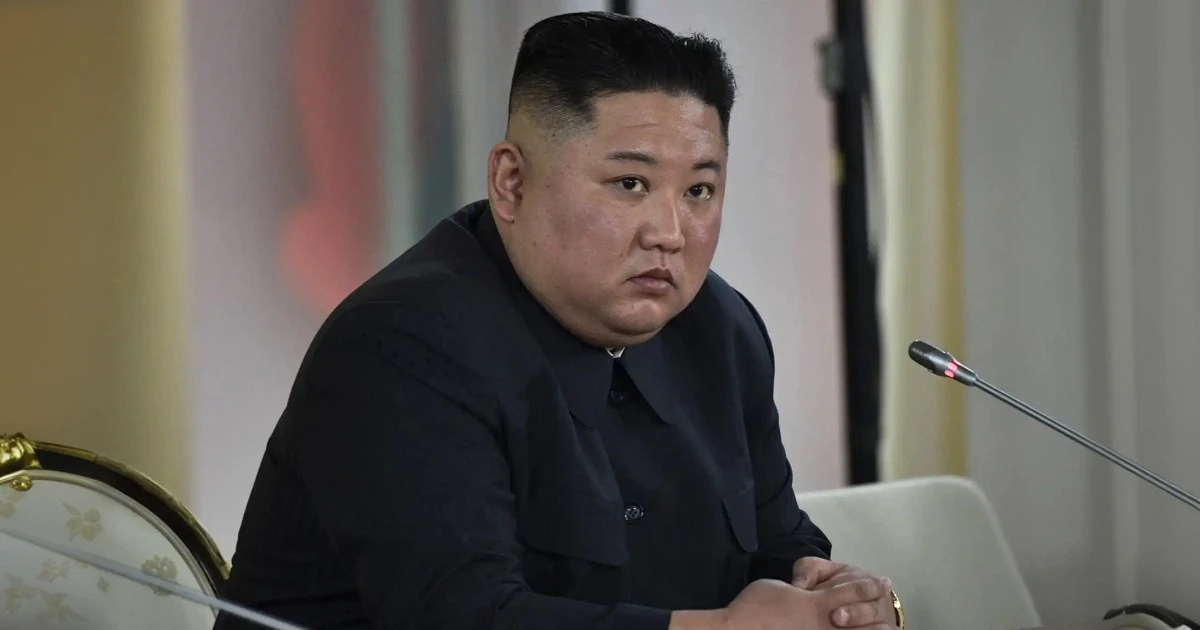
Image Credit - By Kremlin.ru, Wikimedia Commons
Kim Jong Un General Secretary Power Shift
When a dictator secures a unanimous vote, the real story sits in the empty seats of the people who used to clap the loudest. Leaders often use celebrations of unity to hide the aggressive removal of potential rivals. This reality played out clearly on Sunday, February 22, 2026. The 9th Congress of the Workers' Party of Korea (WPK) re-appointed a leader while radically reshaping the ground beneath him.
Kim Jong Un General Secretary solidified his grip on North Korea for another term. According to state media reports cited by Anadolu Agency, the ruling party re-elected him as general secretary on Monday. He begins a 15-year rule extension with a ruthless overhaul of his inner circle. While the state media broadcast images of cheering crowds and fireworks, the personnel charts told a darker tale. Yonhap News Agency reports that nearly seventy officials of the central committee were substituted compared to the 2021 list, meaning more than half of the top officials vanished from the roster. This event marks a turning point. The regime is moving away from the advisors of the past and toward a hardened, militarized future focused entirely on survival and succession.
The Great Purge of the Old Guard
Replacing half your leadership team effectively erases the institutional memory of a time when you were young and vulnerable. Kim Jong Un General Secretary utilized the 9th Congress to strip away the architects of his early regime. The turnover numbers are staggering. Out of 39 Presidium members, over 50% lost their spots. This massive generational shift signals that loyalty now matters more than experience.
The most shocking removal was Choe Ryong-hae. He served as the Chairman of the Supreme People's Assembly and represented as Kim’s right-hand man for years. His exit removes a significant power player who held influence independent of the leader. Park Jung-cheon and Ri Byung-chul, top military advisors who guided previous missile developments, also fell from the core power structure. Why did Kim Jong Un replace top officials? He removed key architects of his early regime to consolidate power and enforce strict discipline within the party levels.
Only 66 of the 139 Central Committee officials managed to keep their jobs. That is a retention rate of just 47.8%. The message to the remaining elites is stark. Past service offers no protection. Yonhap, citing KCNA, notes that Choe Son-hui, the Foreign Minister, bucked the trend and was among the 23 officials recently nominated to the committee. She rose to the Central Committee, signaling a shift in how Pyongyang wants to engage—or confront—the world.
Calculated Instability
This reshuffle creates a paradox. The Supreme Leader appears secure, but the elite class faces extreme instability. The regime prevents anyone from building a rival power base through the constant churning of personnel. The revised party rules now demand strict impartiality in discipline. The goal is the "qualitative consolidation of ranks." This fancy phrasing translates to a simple reality: obey or vanish.
Nuclear Strategy as Survival
Weapons programs often act as internal currency, buying loyalty from generals while starving the civilian economy. International reporting on KCNA statements confirms that the 9th Congress placed nuclear forces at the dead center of the national defense strategy, claiming that the nation’s war deterrence capability has been significantly strengthened, with nuclear forces serving as its central pillar. The language used by state media was aggressive. They claimed these capabilities have been "dramatically upgraded" to target enemies with devastating precision.
Recent displays underscore this threat. As reported by the Associated Press, just before the Congress, the military organised a service to reveal the deployment of fifty newly launched vehicles for nuclear-capable short-range missiles. Kim Jong Un General Secretary described the destruction capability of these weapons in grim terms. He noted that targets would find themselves beyond divine protection upon impact. This rhetoric moves beyond simple defense. It frames nuclear power as the primary tool for national identity and negotiation.
Analysts note that despite crushing international sanctions, the North claims a "radical improvement" in military tech. This assertion challenges the effectiveness of foreign blockades. The leadership frames the nuclear arsenal as a completed project that now requires expansion, not just maintenance. This focus keeps the military happy and justifies the immense economic sacrifices demanded of the population.
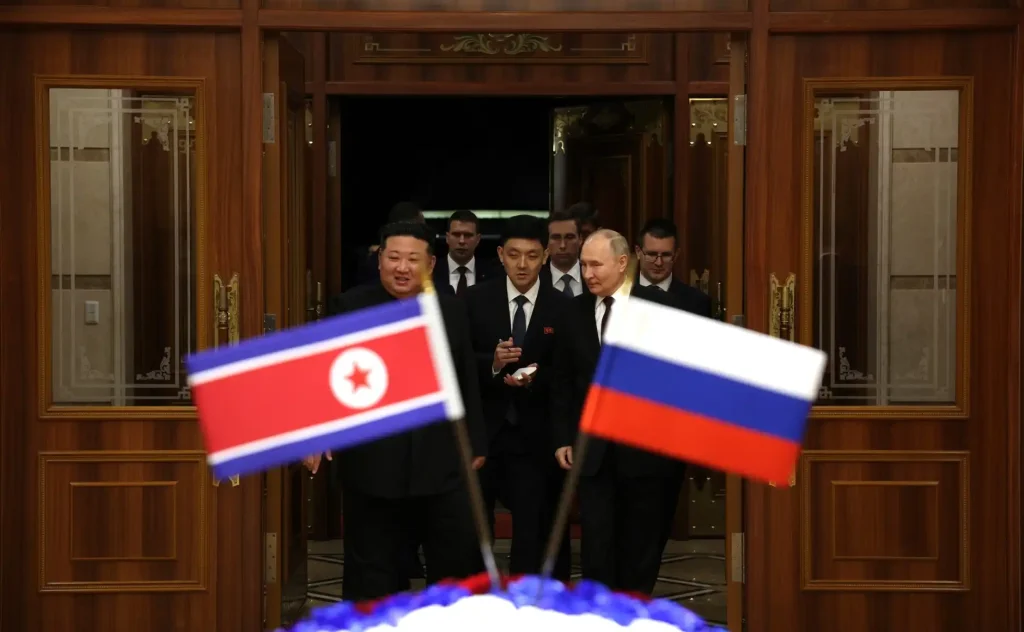
Image Credit - By Kremlin.ru, Wikimedia Commons
The Russia Factor
The nuclear push aligns with shifting alliances. A defense treaty signed with Russia in June 2024 changed the strategic reality. By October 2024, North Korean troops were reportedly supporting the Kursk campaign. This move integrates Pyongyang into a major power conflict, giving their soldiers combat experience and their leaders leverage in Moscow.
The Daughter and the Dynasty
Parading a child at military events signals to aging generals that the bloodline matters more than their rank. The succession question loomed large over the proceedings. Ju Ae, Kim’s daughter, is approximately thirteen years old. She did not receive an official party title during the Congress, but her presence was undeniable. The National Intelligence Service (NIS) assesses her as the likely heir apparent.
Her visibility has shifted from occasional appearances to a consistent pattern. She stands front and center at military parades and missile launches. Is Ju Ae the succeeding leader of North Korea? Intelligence agencies assess her as the likely heir due to her high visibility at recent military events alongside her father. This specific branding links her legitimacy directly to the country’s military might. She represents the future of the nuclear arsenal.
This strategy protects the family's long-term interests. Kim Jong Un General Secretary normalizes the idea of a fourth generation of rule by introducing her early. It forces the elite to vow loyalty not just to him, but to his offspring. The lack of an official title suggests the regime is pacing her ascent. They are building her image before handing her administrative power.
Geopolitical Tightrope: China and Russia
Relying on neighbors for survival creates a debt that eventually demands payment in sovereignty or resources. The 9th Congress highlighted the tangled triangle between Pyongyang, Beijing, and Moscow. Chinese state media, including CGTN, reported that on Monday, February 23, 2026, President Xi Jinping sent a congratulatory message to Kim Jong Un General Secretary upon his election. Xi declared that the friendship amongst the 2 nations was entering a "new phase" and pledged collaboration.
China remains North Korea's prime trade partner and basis of support. This lifeline keeps the lights on in Pyongyang. However, a contradiction exists beneath the warm diplomatic language. China publicly supports the regime but privately fears nuclear destabilization. The growing ties amongst North Korea and Russia complicate Beijing's position. A heavily armed North Korea emboldened by Moscow risks drawing American military assets closer to China’s borders.
Solidarity Against the West
The alignment is clear. Pyongyang frames its foreign policy as solidarity against the United States and the West. The Congress emphasized this geopolitical stance. They present the alliance with Russia and China as a necessary shield. This narrative helps explain the ongoing economic isolation to the domestic audience. It paints the country as a fortress under siege, requiring strong friends and stronger weapons.
Economic Reality vs. Propaganda
Declaring victory over hardship usually serves to distract from the scarcity still sitting on the dinner table. The tone of the 2026 Congress differed sharply from the previous one. In 2021, the party admitted to economic failure. This time, the narrative shifted to "optimism and confidence." Leaders claimed the "worst difficulties" had been overcome.
Yet, the terminology reveals the truth. Kim Jong Un General Secretary spoke of "heavy and urgent historic tasks." He emphasized the necessity to improve the public welfare as an "urgent historical mission." If the economy were truly thriving, the mission would not be urgent. Reports of food shortages persist. The sanctions regime continues to strangle trade.
The focus on the standard of living serves as a pressure release valve. The leadership knows it cannot feed people uranium. They must offer some hope of material improvement. Kim stated that the economic structure requires elevation. He framed the struggle as a "persistent struggle" where "no pause is allowed." This language demands endless sacrifice from the workforce.
The Monolithic System
Codifying absolute obedience turns the law into a weapon that targets hesitation as treason. The 2026 Congress reinforced the "monolithic" power structure. This concept, codified back in 2019, places the Supreme Leader above all else. The decision to re-appoint Kim Jong Un General Secretary was unanimous. In this system, dissent is impossible.
Analyst Hong Min points out a distinct shift in how the regime frames history. The current era is defined as an unprecedented achievement. State media frames the predecessor era as backward in comparison. This boosts the idolization intensity of the current leader. He surpasses the legacy rather than simply continuing it.
Health and Stability
The health of the leader remains a variable in this monolithic equation. Reports from July 2024 indicated issues with obesity, diabetes, and high BP. Officials reportedly sought foreign medication to manage these conditions. What is the 9th Congress of the Workers' Party? This major political gathering determines the country's leadership lineup, military strategy, and economic goals for the subsequent five years.
While the Congress projects strength, the health data adds a layer of urgency to the succession planning. Ensuring Ju Ae is recognized by the military elite becomes a safeguard against any sudden power vacuums. The system is built entirely around one man. If his health falters, the "monolithic" structure faces its greatest test.
The Fortress State
The re-appointment of Kim Jong Un General Secretary serves as a fortification rather than a formality. The 9th Congress stripped away the old guard, elevated a new generation of loyalists, and placed nuclear weapons at the heart of national identity. The regime has successfully pivoted from admitting failure to claiming a new era of optimism, regardless of the economic reality on the ground.
North Korea secures the resources it needs to defy the West by balancing ties with China and Russia. The promotion of Ju Ae ensures the dynasty has a face for the future. The message to the world is clear. The regime is digging in rather than opening up. The purged officials and the nuclear rockets serve the same purpose: to guarantee that the Kim family rule remains the only reality North Korea ever knows.
Recently Added
Categories
- Arts And Humanities
- Blog
- Business And Management
- Criminology
- Education
- Environment And Conservation
- Farming And Animal Care
- Geopolitics
- Lifestyle And Beauty
- Medicine And Science
- Mental Health
- Nutrition And Diet
- Religion And Spirituality
- Social Care And Health
- Sport And Fitness
- Technology
- Uncategorized
- Videos

