
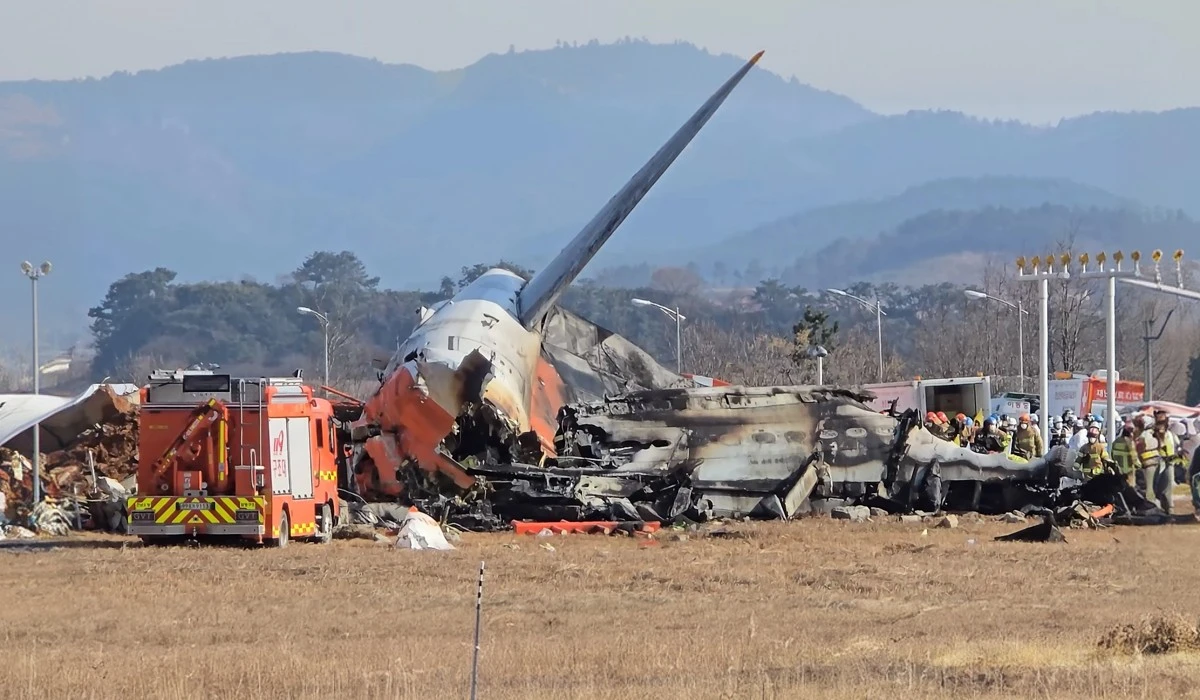
Image Credit - by 자연속으로 into nature, CC BY 3.0, via Wikimedia Commons
Jeju Air Flight 2216 Crash: What Caused It
How does a textbook belly landing turn into a fireball that kills 179 people? The answer lies buried in an airport budget sheet from two decades ago. The Jeju Air Flight 2216 crash directs our attention straight to the boardroom. According to a January Reuters report citing preliminary findings, a flock of migratory ducks initiated the emergency when investigators found duck remains inside the engines. A routine financial decision to avoid leveling uneven ground placed a rigid concrete wall directly in the path of sliding aircraft. This financial shortcut turned a survivable runway overrun into an unavoidable disaster. The upcoming government accident investigation findings will expose a lethal chain of choices. Airport planners prioritized the bottom line over human life. The 181 passengers on board stood no chance against an airport setup designed strictly for cheapness.
A Flawed Routine at Muan International Airport
Airports claim safety zones catch sliding planes, yet South Korean officials quietly approved a massive obstacle directly inside one. On December 29, 2024, a Boeing 737-800 descended toward Muan International Airport. Flight HL8088 had just completed a long trip from Suvarnabhumi Airport in Bangkok. The approach seemed completely standard. Then, a massive flock of Baikal teal ducks crossed the flight path. What caused Flight crash? Reuters reported in July 2025 that a bird strike destroyed the right engine, followed by a pilot error that shut down the working left engine, causing the plane to belly-land into a concrete mound. Blood and feathers instantly choked the right turbine.
The Immediate Crisis
The sudden loss of thrust demanded immediate action. The pilots faced an intense workload as they tried to stabilize a heavy aircraft dropping rapidly toward the tarmac. Every single second mattered. Flight deck confusion caused a fatal misjudgment regarding the damaged engine. The crew needed to act flawlessly. The extreme pressure of the moment ruined their decision-making process.
The Fatal Choice During The Flight Crash
Training manuals condition pilots to isolate damaged engines, but high-stress environments frequently trick the brain into disabling the functioning equipment. As noted by Reuters in July 2025 citing cockpit voice recordings and physical switch data, the flight crew accidentally shut down the undamaged engine. This specific mistake eliminated all remaining forward power. A belly touchdown became the only physical option for the pilots. To make matters worse, the landing gear system malfunctioned.
The Emergency Descent
The plane slammed onto the runway. Sparks flew as the metal belly scraped against the tarmac. The heavy jet began a massive 250-meter skid past the runway. Aeronautical Science Professor Kim Kwang-il notes the pilots likely preferred immediate ground contact over trying to glide an engineless commercial jet. He praises their expert execution of the emergency belly touchdown. Under standard conditions, the people involved in the Jeju Flight crash should have walked away with only minor injuries.
A Wall Built for Budgets
Engineers design runway buffers to yield under crashes, but planners regularly swap flexible safety materials for cheap, rigid concrete to save terrain-leveling costs. According to a March 2026 Reuters report citing the Board of Audit and Inspection, the ministry of transport built a massive 2.4-meter concrete localiser mound directly in the overrun path. The report also suggests officials originally approved this construction back in 2003 without conducting a basic risk assessment, erroneously certifying operating permits for up to 22 years. The Korea Airports Corporation raised serious safety concerns in 2007. Administrators completely ignored these warnings.
Worsening the Danger
Crews ignored the hazard and reinforced the structure with concrete in 2019. They even added an extra concrete slab in 2023. Why was there a concrete wall on the Muan runway? As noted in the same Reuters coverage of the auditor's findings, planners built a concrete mound to hold an antenna, selecting a cheap design to avoid leveling the sloping ground and trim excavation expenses. This cost-reduction strategy placed a rigid block in a zone meant strictly for deceleration.
The Simulation Results
The recent audit board report revealed a devastating truth. According to a separate government-commissioned report cited by a lawmaker from the opposition and reported by Reuters in March 2026, computer simulations show a universal passenger survival probability if that concrete barrier had never existed. The plane would have stopped safely in the dirt. The article also states the rigid antenna support structure caused a sudden fireball explosion. Only 2 flight attendants survived the brutal crash.
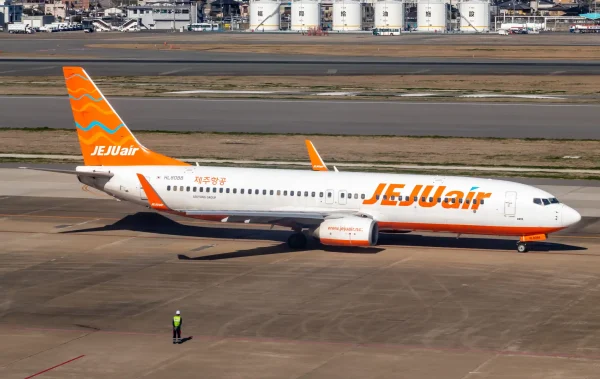
Image Credit by- Anton Homma, CC BY-SA 2.0, via Wikimedia Commons
Conflicting Causes: Who Is Actually to Blame?
Investigators look for a single point of failure, while different regulatory groups constantly point fingers at each other to avoid legal liability. A bitter debate rages over the primary cause of the tragedy. The victims' families, the pilots' union, and government auditors point directly at the lethal concrete barrier. They argue the cost-cutting design guaranteed a slaughter. ARAIB investigators take a vastly different stance. They aggressively blame the flight crew for the incorrect engine deactivation.
The Official Stance and Expert Reality
Officials fiercely defend the strict standard compliance of their runway safety areas. They claim the airport setup perfectly mirrors European and North American facilities. International aviation experts disagree entirely. ICAO guidelines specifically recommend a 90m to 240m buffer zone completely free of rigid obstacles. Other airports like Gimpo and Incheon use flexible, ground-level localiser systems. Aviation safety expert David Learmount calls the structural placement abhorrent. Learmount describes the rigid obstacle as an unprecedented hazard. Meanwhile, aviation website editor Geoffrey Thomas notes the barrier remains irrelevant if pilots utilize the correct touchdown zone. He views the disaster as the terminal result of sequential cascading errors.
The Aftermath and Bureaucratic Failures
Governments rush to project an image of control after a disaster, quickly hiding gruesome recovery flaws behind official press conferences. The the administrative handling of the crisis generated massive public outrage. Recovery teams heavily mishandled undiscovered victims' remains for weeks. Workers delayed the retrieval of body parts and personal belongings. First responders casually stored human remains inside standard rubble sacks. When families appealed for a thorough site re-examination, officials dismissed them entirely.
Raids and Directives
Public anger reached a boiling point by a recent Thursday. The President issued a direct mandate for a new inquiry into the mishandling of remains. Did the government apologize for the crash? The ministry of transport eventually offered an apology, but victims' families called it insufficient and comparable to a second slaughter. The victims' families representative publicly condemned the tardy ministry remorse. According to a March 2026 report by Reuters, police raided the headquarters of the ministry of transport in Sejong by a recent Friday as part of a widening probe into regulatory lapses. The families refuse to accept any media briefings until the government completes an exhaustive, transparent review.
Legal Battles After the 2216 Crash
Corporate entities deploy fleets of lawyers to isolate blame on individual operators, effectively shielding the system that permitted the danger. The fight for accountability officially moves into the courtroom. As reported by Reuters in May 2025, lawyers representing the families formally accused 15 individuals in a criminal complaint, including the CEO of Jeju Air and state officials, for professional negligence. The legal team aims to prove corporate leadership failed to ensure adequate pilot training for sudden engine-loss scenarios.
The Boeing Lawsuit
The families also launched a lawsuit against Boeing on October 2025. They firmly allege the landing equipment contained a fatal defect. The landing gear deployment failure directly contributed to the harsh belly touchdown. The families want the court to hold the manufacturer completely responsible for the mechanical breakdown under extreme pressure. They believe proper gear deployment would have drastically altered the sliding trajectory.
Why This Overrun Became Unsurvivable
Regulatory agencies mandate frangible structures to absorb kinetic energy, yet airport operators quietly bypass these rules using legacy building clauses. The audit board mandate explicitly requires a frangible design for all runway safety zones. A frangible structure easily shatters upon a collision. This yielding design safely bleeds off the kinetic energy of a sliding 60-ton commercial jet. Muan International Airport blatantly ignored this basic safety principle.
The Final Moments
The massive concrete mound stopped the 737-800 instantly. The sudden deceleration caused catastrophic structural failure across the entire aircraft. Fuel lines ruptured immediately upon contact. The resulting explosion completely consumed the fuselage before emergency services could even mobilize. The accident investigation findings will officially drop mid-year. Experts expect the report to heavily criticize the airport's avoidance of sloping terrain leveling expenses. The decision to save money on dirt removal directly killed 179 people.
Final Thoughts on the Jeju Air Crash
The Jeju Air Flight 2216 crash exposes a lethal conflict between aviation safety guidelines and local budget sheets. A flock of Baikal teal ducks initiated the terrifying emergency. A highly stressed flight crew subsequently worsened the problem with a tragic engine error. The main reason for the mass fatality sits firmly in the concrete. When planners trade flexible safety zones for rigid financial shortcuts, they eliminate the margin for human error entirely. The 179 victims died because an airport refused to pay for leveling dirt. This devastating tragedy demands a complete overhaul of global runway inspection protocols. Governments must aggressively dismantle legacy hazards sitting at the very ends of commercial runways before another plane slides into a concrete wall.
Recently Added
Categories
- Arts And Humanities
- Blog
- Business And Management
- Criminology
- Education
- Environment And Conservation
- Farming And Animal Care
- Geopolitics
- Lifestyle And Beauty
- Medicine And Science
- Mental Health
- Nutrition And Diet
- Religion And Spirituality
- Social Care And Health
- Sport And Fitness
- Technology
- Uncategorized
- Videos

