
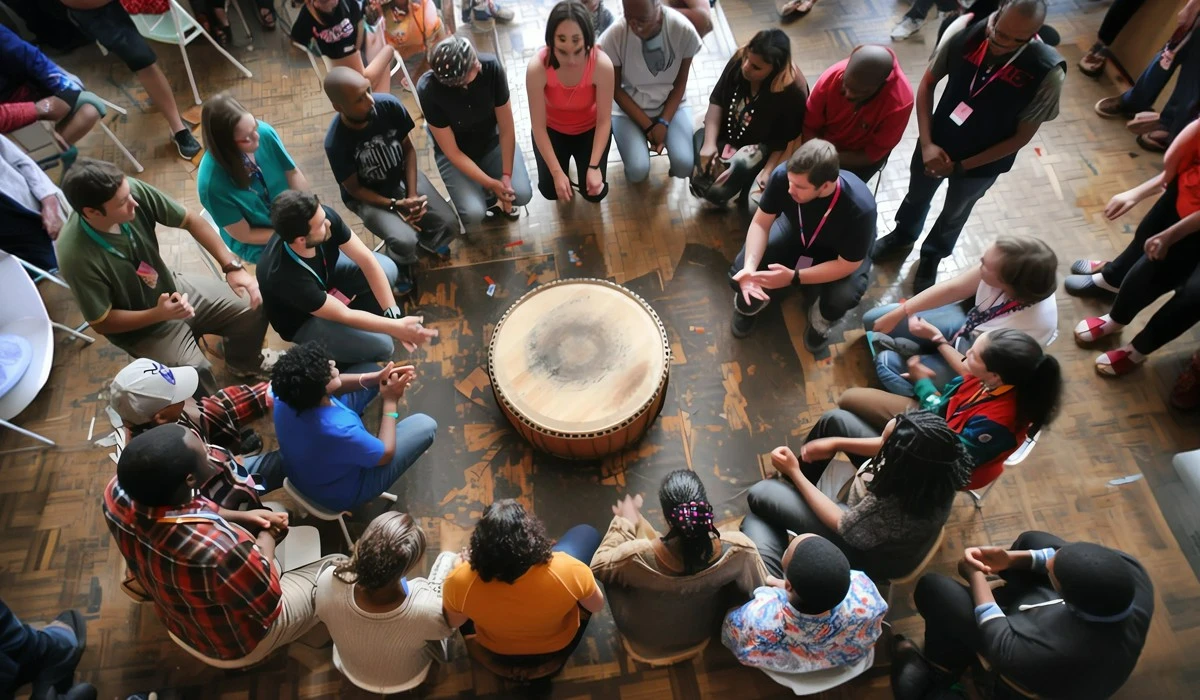
Drum Circle Leadership Forges Resilient Teams
Research published in Scientific Reports indicates that when a team stops listening, productivity dips, and the physiological rhythms of the group, such as heart rate, lose their synchronization. Most managers try to fix burnout with more meetings, but more talking often leads to more silos. In reality, humans possess a biological drive to move together that corporate slide decks are unable to reach.
This deep-seated need for synchronization explains why a Drum Circle changes a room of strangers into a unified force. Through drum circle leadership, a facilitator uses the body’s own rhythm to rebuild trust from the basics. These sessions replace the friction of office politics with a steady, collective pulse.
A resilient team adapts, communicates, and supports its members without needing a script. You cannot force this through a memo. Professional drum circle leadership instead creates an environment where everyone contributes to a single, strong sound. This approach addresses the biological roots of team stress instead of acting as a typical workshop.
The Biological Basis of a Drum Circle
According to a study in PLOS ONE, rhythmic activities alter how the brain handles stress. Further research in Scientific Reports suggests that when people drum together, their internal clocks begin to align. This process, known as entrainment, is described by researchers in PMC as the synchronization of internal rhythmic processes to external periodic cues such as beats. The Scientific Reports study notes that this alignment occurs when heart rates and brainwaves match the external beat, moving the brain from high-anxiety Beta frequencies into relaxing Alpha frequencies.
Dr. Barry Bittman’s 2005 research proved that specific drumming sessions actually reverse 19 genetic stress markers. This means the beat works at a molecular level to repair the body. Meanwhile, your natural killer cell activity increases, which strengthens your immune system against viruses and exhaustion. Evidence published in the American Journal of Public Health highlights that across a 10-week drumming program, there was a shift away from a pro-inflammatory profile toward an anti-inflammatory immune profile.
Building Group Flow States
Collective rhythm creates a state of flow where individual egos fade away. In this "group mind" state, people stop worrying about their own performance and focus on the collective output. The music becomes self-sustaining because everyone feels the same internal timing.
You might wonder, what are the benefits of a drum circle for employees? Research in the American Journal of Public Health indicates that a drum circle provides immediate stress reduction and encourages a deep sense of belonging by synchronizing team members through wordless, rhythmic cooperation. The study also found that this feeling of unity is maintained for at least three months after the instruments are put away.
Defining the Effect of Professional Drum Circle Leadership
A professional session is quite different from a disorganized jam session. Without clear guidance, a group often creates noise rather than music. This is where drum circle leadership becomes essential. The leader works from within the circle itself instead of standing at the front like a traditional conductor.
Arthur Hull, who founded Village Music Circles in 1980, changed how we view this practice. He moved drumming from a performance art to a tool for community building. A facilitator uses specific signals to guide the group from total silence to a multi-layered groove.
Facilitation vs. Direction
Traditional management relies on top-down orders, but facilitation encourages organic growth. A leader in this setting models agility. They listen to the room and adjust the energy levels in real-time. This mirrors how a great manager should handle a fluctuating market or a shifting project deadline.
Professional leaders use their own body language to signal changes in tempo. This wordless communication teaches the team to pick up on subtle cues. When the facilitator says less, the group achieves more. The focus stays on the shared goal rather than the person in charge.
Cultivating Psychological Safety Through Shared Rhythm
Fear of failure often paralyzes a talented team. In a corporate Drum Circle, this fear disappears because the environment removes the concept of "wrong" notes. Every sound is simply a variation that adds to the texture of the music. This creates a safe space for people to take creative risks.
Remo Belli’s invention of synthetic Mylar drumheads in 1957 made this possible for everyone. These durable tools allow non-musicians to hit the drum as hard or as soft as they need without breaking the instrument. Participants feel free to experiment because the stakes are low while the social reward is high.
Reducing Social Anxiety and Hierarchy

The circle format naturally levels the playing field. When everyone sits in a ring, the CEO and the intern become equal contributors to the rhythm. There is no "head of the table" in a circle. This physical arrangement breaks down the mental walls that usually prevent lower-level employees from speaking up.
How does drum circle leadership differ from traditional management? Drum circle leadership focuses on active listening and empowering participants to contribute their unique voices to the collective whole, whereas traditional management relies on hierarchy. This change allows the team to see one another as human beings first and job titles second.
How a Drum Circle Disrupts Toxic Team Hierarchies
A drumming session acts like a laboratory for observing how a team actually functions. If the group is too loud, they can’t hear the subtle beats of their colleagues. If they are too timid, the music lacks energy. A facilitator uses these moments to show the team how they are competing rather than collaborating.
Through the HealthRHYTHMS protocol, leaders address these toxic dynamics directly. This evidence-based framework helps participants identify when they are dominating the conversation or when they are hiding in the background. The drums don't lie about the group's current state of unity.
The Power of Non-Verbal Communication
"Call and response" patterns train the brain for active listening. The facilitator plays a short rhythm, and the group must repeat it exactly. This requires intense focus on what the other person is saying—or playing—before responding.
This practice translates directly to the office. When a team practices call and response, they become better at reflecting information back to their coworkers. They stop waiting for their turn to speak and start listening to understand. This reduces misunderstandings and speeds up project timelines.
The Tactical Skills of Effective Drum Circle Leadership
To move a group from noise to harmony, a leader uses specific tactical skills. One primary method is "Sculpting." The leader silences most of the group to highlight the sound of a specific section, like the shakers or the low-tuned djembes. This allows the team to hear how different departments contribute to the overall success.
Another tool is "The Pulse." The leader keeps a steady, low-frequency beat on a surdo or large floor drum. This provides a safety net for anyone who loses their way. It keeps the group grounded even when the rhythms become multi-layered or fast-paced.
Encouraging Individual Autonomy
Great drum circle leadership eventually encourages individuals to take "solos." While this sounds intimidating, it actually builds massive confidence. When the whole group supports one person's beat, that individual feels a surge of accountability and pride.
Can anyone participate in a drum circle? Absolutely, as these sessions are specifically designed for all skill levels and require no prior musical training to achieve a high-quality team result. The leader ensures that even the most hesitant person feels like a key part of the group.
Changing from Individual Performance to Collective Resilience
The true value of a Drum Circle appears when the rhythm falls apart. Professionals call these "train wrecks." Instead of stopping the session, the leader uses the moment to teach resilience. They show the group how to find "The Pulse" again without panic.
This mirrors a project crisis in the boardroom. If a deadline is missed, a resilient team doesn't look for someone to blame. They look for the beat. They use the same grounding techniques learned in the circle to stabilize their workflow and get back on track.
Dealing with Group Train Wrecks
When the timing slips, the leader might use "Weighting." They add their own strong beat to a struggling section to help them regain their footing. This demonstrates that support should be given where it is needed most, rather than criticizing the struggle.
These rhythmic metaphors stick with employees. They begin to view "noise" in the office as a signal to recalibrate. Resilience becomes a physical memory they can recall when the work environment gets loud or chaotic. They learn that harmony is a choice the group makes every second.
Measuring the ROI of Rhythmic Team Building
The financial effect of drum circle leadership is significant. Research shows that the HealthRHYTHMS protocol reduces employee burnout by 28%. Given that turnover costs can reach 400% of a specialized employee's salary, this reduction represents a massive saving for any company.
Organizations like NASA and Toyota use these sessions to dissolve silos. They recognize that group drumming reduces "presenteeism," which BMC Health Services Research defines as a behavior where an employee is physically at work but demonstrates lower performance due to illness or other reasons. Research in PubMed indicates that drumming increases the ratio of DHEA to cortisol in the body, which helps keep the workforce sharp and engaged.
Social Resilience and Retention
A 2016 study found that a 10-week drumming program increased social resilience scores by nearly 11 points. This translates to better conflict resolution and faster recovery after high-stress events. Teams that drum together tend to stay together longer because the social bond is deeper.
This session serves as a measurable investment in social capital rather than a simple fun break from work. When you improve the biological health of your staff, you improve the bottom line. Resilience becomes a competitive advantage in a fast-changing market.
Sustaining the Rhythm of Success
Resilience is a muscle that needs regular exercise rather than a permanent trait. A Drum Circle serves as the gym where this muscle grows. Removing job titles and jargon allows your team to reconnect on a human level that is both ancient and effective.
The principles of drum circle leadership teach us that everyone has a unique voice that matters to the collective whole. When a leader facilitates rather than dictates, the team finds its own path to harmony. This agility is what keeps a company alive during difficult times.
Take the lessons from the rhythm back to your office. Listen more than you speak, find the shared pulse during a crisis, and always support the person sitting next to you. When you forge a team through rhythm, you create a bond that no market shift can break.
Recently Added
Categories
- Arts And Humanities
- Blog
- Business And Management
- Criminology
- Education
- Environment And Conservation
- Farming And Animal Care
- Geopolitics
- Lifestyle And Beauty
- Medicine And Science
- Mental Health
- Nutrition And Diet
- Religion And Spirituality
- Social Care And Health
- Sport And Fitness
- Technology
- Uncategorized
- Videos

