
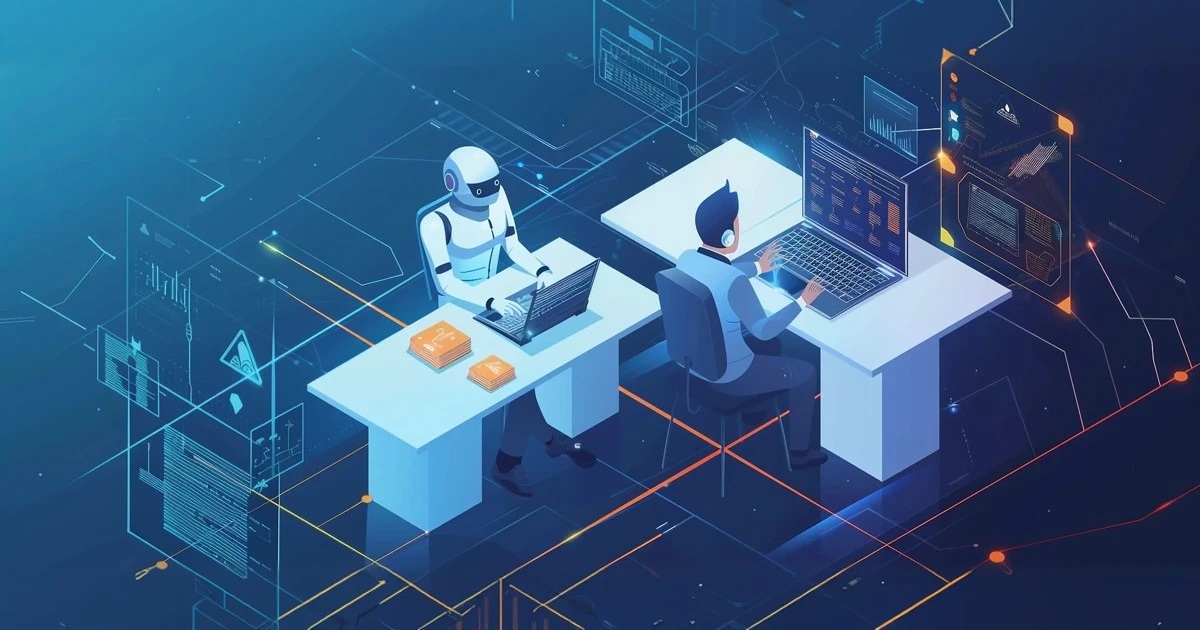
AI Threat Pushes White Collar To Manual Trades
We spent the last fifty years convincing ourselves that the brain was more valuable than the hand. Schools funneled students into universities with the promise that a degree was a shield against poverty. That promise just expired. While the world worried about robots replacing factory workers, algorithms quietly came for the corner offices instead. Now, the ability to write a contract or code a website is cheap, but the skill to fix a leaky pipe is premium. This reversal forces a brutal question upon the middle class: What happens when your mind is no longer your greatest asset?
The shift is not coming; it is already here. Writers are becoming bakers. IT professionals are picking up drills. AI displacing white-collar jobs has triggered a migration from air-conditioned offices to construction sites. This is not just a change in employment stats. It is a fundamental rewriting of social status and survival. The safe path is now the risky path, and the manual labor we looked down on is the only lifeboat left.
The Great Reversal of Value
Intelligence used to command a high price, but now it is the cheapest commodity on the market. For decades, we operated under the assumption that "thinking" jobs were safe. We believed computers could calculate, but they could not create. That assumption shattered in 2023. The UK Department for Education released reports showing professional roles were the most exposed to automation. By 2024, freelance writer Jacqueline Bowman watched her entire industry evaporate.
Clients did not just stop calling; they brazenly celebrated the end of human overhead. They replaced seasoned writers with Large Language Models (LLMs). The market dried up overnight. Bowman, who also worked as a therapist, saw the writing on the wall. The work did not disappear, but the value of it did.
The New Math of Freelancing
The financial reality for creatives is grim. Clients now offer AI-editing gigs instead of original writing contracts. They pay 50% less for these roles. They assume the computer does the heavy lifting. The reality is different. Bowman found that fixing AI-generated content takes four hours, whereas writing the piece from scratch took only two. The machine does not just make mistakes; it hallucinates. About 60% of the content is fabricated. The human worker spends hours fact-checking lies for half the money.
Can AI writers replace human creativity completely? Current AI models frequently hallucinate facts and lack nuance, forcing human editors to spend double the time fixing errors for lower pay.
This is the trap. You do more work for less money, training the very system that is destroying your career. Bowman calls the AI text "oddly familiar," suspecting the models trained on her past work. Famous authors can sue. Freelancers like Bowman cannot afford the legal fees. She had to move her wedding date forward to January 2025 just to secure health insurance.
The Physical Pivot
Retraining feels like a fresh start until you look at the pay stub and realize you just reset your career clock by fifteen years. The data from King’s College London in October 2025 confirmed what many already felt: wages for software and consultancy roles are in freefall. This decline pushes workers like Richard, a former Health and Safety professional, into the trades. He began training in electrical installation in September 2025.
Richard’s logic is sound. Corporate liability laws prevent AI from holding a legal duty. You cannot sue an algorithm if a building burns down. You need a human signature. Therefore, skilled trades remain necessary. However, the financial cost of this safety is high.
The Five-Year Gap
Switching from a white-collar salary to an apprentice wage is a financial shock. Richard estimates it will take five to ten years to match his previous earnings. The "AI-Proof" pivot is not a lateral move. It is a step down to eventually step up.
The trade-off is absolute. You exchange mental strain for physical exhaustion. Janet Feenstra, a former editor who became a baker, describes the shift vividly. Rolling dough is tactile and pleasant. It offers a satisfaction that staring at a screen never did. But the commute is longer. The fatigue is bone-deep. The pay is lower. She feels gratitude that AI forced her to change, but that gratitude mixes with bitterness.
Do manual trades offer better job security than office jobs? Yes, skilled manual trades currently offer higher security because robots lack the dexterity and legal liability status required for physical repair work.

The Entry-Level Crisis
Corporations cut the bottom rung of the ladder to save money today, forgetting that nobody can climb to the top without it.
The most dangerous impact of AI displacing white-collar jobs is the destruction of entry-level roles. Anthropic predicts that 50% of entry-level white-collar jobs will vanish within five years. Companies use tools like GitHub Copilot and Amazon CodeWhisperer to replace junior engineers.
The logic is simple. Why pay a graduate to write basic code when an AI does it instantly? But this creates a broken pipeline. If no one hires juniors, no one becomes a senior.
The Hired-less Generation
The stats from the Hult School are alarming. 89% of employers now avoid hiring fresh graduates. 39% explicitly prefer AI over Gen Z workers. This is not a future projection; it is happening now. Stanford data shows a 13% employment drop for 22–25-year-olds in AI-exposed fields since 2022.
The Oxford academic Carl Benedikt Frey argues that high interest rates are driving this squeeze. He claims we are not seeing mass displacement yet. But tell that to the graduates facing a closed door. The result is a lost generation of office workers who never got to enter the office.
Is AI responsible for high youth unemployment? AI tools have significantly reduced the need for junior staff, causing a sharp decline in hiring for recent graduates in tech and finance.
The "Vibe" Shift and Identity Loss
Your job title often anchors your self-worth, so changing your uniform changes who you think you are. The transition from "Consultant" to "Electrician" or "IT Specialist" to "Cafe Worker" is not just about money. It is a loss of status. The middle class spent decades defining itself by intellectual labor. When that labor loses value, the identity crumbles.
Bethan, a former IT worker, experienced this firsthand. Her helpdesk closed to make room for an AI kiosk. Management prioritized budget cuts over accessibility for non-native speakers. Bethan moved to hospitality work in a cafe.
The Body Breaks
The shift to physical labor reveals physical limits. Bethan suffers from hypermobility. The cafe work damages her body in ways the IT job never did. The narrative that "everyone should just learn a trade" ignores the physical reality of the workforce. Not everyone can pour concrete or wire a house.
For many, this "vibe shift" is a forced adjustment to a working-class identity. The premium for human interaction remains only in specific fields: therapy, arts, and religion. Everywhere else, the human element is a cost to be cut.
Corporate Strategy vs. Human Reality
Executives describe efficiency with spreadsheets, while workers experience that same efficiency as an eviction notice. The corporate strategy is clear. Do more with less. Palantir set a goal of 10x revenue growth while reducing headcount by 12%. Salesforce cut its customer support staff from 9,000 to 5,000. Amazon CEO Andy Jassy explicitly stated the goal is higher output with leaner staff via AI fluency.
This is the engine driving AI displacing white-collar jobs. It is a deliberate restructuring of the labor market. Goldman Sachs predicts this is the start of a multi-decade shift. 6–7% of the US workforce is immediately at risk, primarily in operational and support roles.
The Auto Industry Warning
The auto industry offers a glimpse of the future. A Phyron survey indicates that 50% of dealers expect AI to handle the full sales process by 2027. We are removing the salesperson, the writer, and the support agent.
Jim Farley, the CEO of Ford, admits that the white-collar workforce will be left behind. He emphasizes that skilled factory roles are crucial for oversight. This reinforces the core tension: if you can touch it, you can keep your job. If your work exists only on a screen, you are vulnerable.
The Contradictions in the Data
Experts claim the transition is slow, yet the unemployment lines for young graduates are growing faster than interest rates can explain.
We see conflicting narratives. JPMorgan and the New York Times suggest AI will create new "maintenance" roles. Yet, internal memos from Amazon suggest managers should avoid hiring 160,000 people to fill those types of gaps.
Richard believes his trade is safe because of dexterity requirements. BMW, however, is already testing humanoid robots. The safety of manual labor might be temporary. Today, robots are clumsy. In ten years, they might not be.
The Timing Mismatch
Carl Benedikt Frey at Oxford says the displacement is not massive yet. He blames the economy. But the Stanford data on youth unemployment contradicts him. The displacement is massive for a specific slice of the population: the young and the unestablished.The disconnect comes from where you look. If you look at total employment, things seem stable. If you look at the quality and type of employment available to a 22-year-old, the cliff is visible.
The Future of the "Safe" Career
Stability used to mean a salary and a desk, but now it means a toolbox and a van. The definition of a good career has inverted. Tobi Lutke, the CEO of Shopify, told employees they must prove a task is impossible for AI before they can request resources. This is the new standard. The burden of proof is on the human to justify their existence.
This pushes the workforce into two camps. The first camp controls the AI. The second camp fixes the things AI cannot touch. The middle ground—the mediocre writer, the average coder, the support staff—is gone.
The Human Premium
There is a silver lining, but it is thin. Clients still pay a premium for human interaction in high-stakes fields. Therapy and religion remain human-centric. But for how long? Even therapy is seeing an influx of chatbots.
The "AI-Proof" pivot is a survival strategy. It is a recognition that the digital world is no longer human territory. To survive, workers are returning to the physical world, where friction, gravity, and liability still protect them from the code.
The Return to Hands-On Reality
The era of AI displacing white-collar jobs marks the end of the "knowledge economy" as we knew it. We trained millions of people to think, only to build machines that think faster. Now, those people must learn to build, bake, and fix. The transition is painful. It involves lower pay, physical pain, and a loss of identity. But it also offers a strange clarity. The screen lied to us. It promised infinite value for cognitive labor. The real world—the one of dough, wires, and pipes—is reclaiming its value. We are not just changing jobs; we are remembering that we have hands.
Recently Added
Categories
- Arts And Humanities
- Blog
- Business And Management
- Criminology
- Education
- Environment And Conservation
- Farming And Animal Care
- Geopolitics
- Lifestyle And Beauty
- Medicine And Science
- Mental Health
- Nutrition And Diet
- Religion And Spirituality
- Social Care And Health
- Sport And Fitness
- Technology
- Uncategorized
- Videos

