
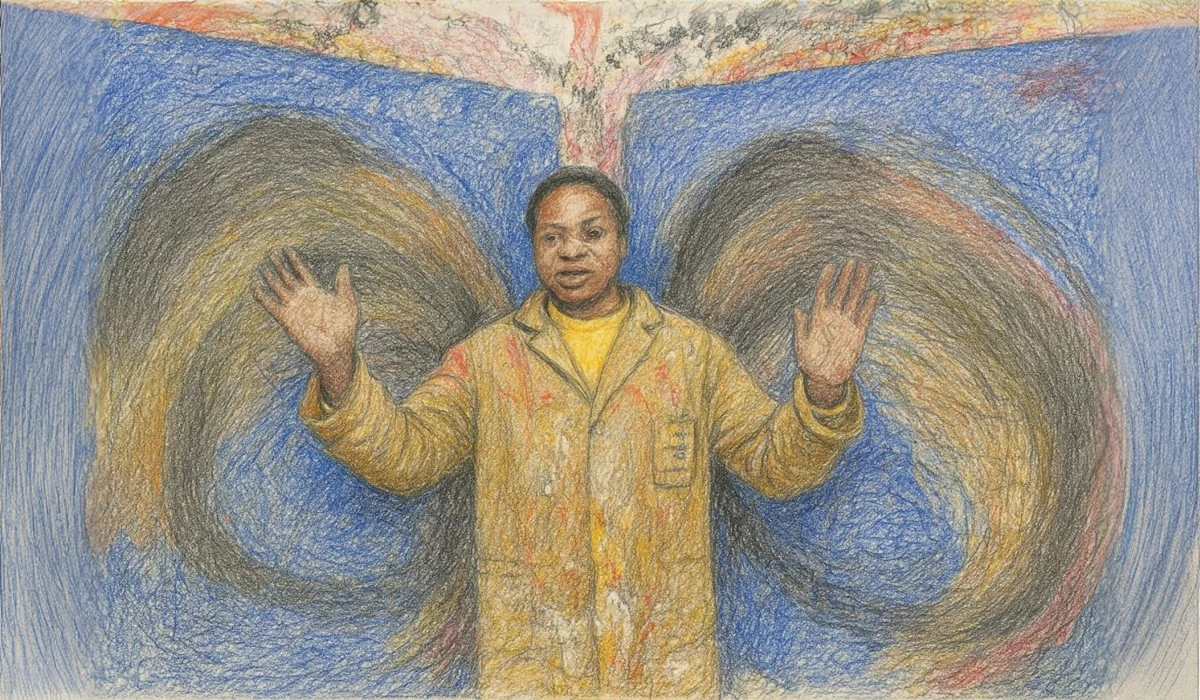
Turner Prize 2025 Crowns Nnena Kalu
The modern art world usually demands you explain your work before you show it. Success often depends on how well an artist speaks, not just what they build. Nnena Kalu smashed this unwritten rule by forcing judges to value raw creation over academic talk. Her victory exposes a long-standing bias that favors verbal articulation over visual impact.
Kalu took home the prestigious award at a ceremony in Bradford, marking a permanent shift in cultural history. According to AP News, at 59 years old, she became the foremost artist with a learning disability to have won the UK's most desired art prize. Sky News reported that the judges bypassed the usual need for theoretical justification and focused entirely on the "bold and compelling" nature of her work.
This moment proves that artistic merit stands independently of an artist's ability to navigate social or academic hierarchies. The victory for Nnena Kalu at the Turner Prize 2025 forces a re-evaluation of who gets to participate in high culture. It challenges the establishment to look past the artist's biography and stare directly at the art itself.
The Win That Defied Expectations
Critics often assume diversity awards happen to fill quotas rather than acknowledge talent. This victory proved that quality can silence even the harshest skeptics of identity politics.
Tuesday night in Bradford became the setting for this historic disruption. The jury awarded Kalu the £25,000 prize, ending a debate that lasted only two or three hours. Alex Farquharson, the director of Tate Britain and chair of the judging panel, made the reasoning clear. He insisted the choice relied completely on merit. As reported by the Hindustan Times, the panel did not choose Kalu simply to make a statement about neurodiversity; they chose her because the work demanded it.
Farquharson described the decision as a breakdown of the walls between neurotypical and neurodiverse artists. He emphasized that the quality of Kalu's practice drove the decision. Her identity and her art remain inseparable, yet the prize recognizes the power of the work above all else. This distinction matters. It moves the conversation away from charity and toward genuine artistic respect. The result for Nnena Kalu in the Turner Prize 2025 stands as a testament to excellence, not just inclusion.
Turning Trash Into Treasure
We tend to value materials that cost money, assuming marble or bronze equals high art. Kalu flips this value system by turning literal trash into objects of intense desire.
Her sculptures dominate the room with bright colors and chaotic textures. She constructs these forms using materials most people throw away. Layers of ribbon, string, card, and shiny VHS tape wrap around each other to create massive, intricate shapes. Critics describe them as "cocoons" or "vortexes." They hang from the ceiling or sit at eye level, demanding attention from every angle.
The work resembles three-dimensional abstract expressionist paintings. Kalu uses tape and fabric like brushstrokes. She translates gestural energy into physical objects. What materials does Nnena Kalu use? She builds her sculptures from recycled items like VHS tape, cling film, cardboard, and flexible ducting tape. These humble components transform into something grand through her repetitive, labor-intensive process. The result creates a feeling of "joyous uplift" that keeps viewers returning for another look.
The Long Climb from Obscurity
Overnight success is usually a myth that hides decades of repetition in the dark. Kalu spent twenty-five years working in obscurity before the spotlight finally found her.
According to ActionSpace, she began her journey with the organization in 1999. This London-based charity supports artists with learning disabilities, providing them with studio space and guidance. For most of those years, the mainstream art world ignored her. Charlotte Hollinshead, who worked with Kalu for a quarter of a century, noted the frustration of those early days. She recalled how the industry viewed Kalu's work with disinterest or disrespect. People did not see it as "cool."
Kalu faced significant discrimination. The art establishment frequently undervalued artists with learning disabilities. Hollinshead described the journey as a battle to challenge preconceptions. She viewed the win as a "seismic" moment that shattered a stubborn glass ceiling. How long has Nnena Kalu been an artist? She has developed her practice with ActionSpace for over 25 years, starting in 1999. This persistence paid off. The Turner Prize 2025 win for Nnena Kalu validates validates decades of ignored effort and proves that talent eventually forces its way to the surface.
Analyzing the Competition
Art prizes often become echo chambers where every nominee speaks to the same political moment. The other nominees focused on specific identity politics and conflict, while Kalu focused on pure, irreducible form.
The field included strong contenders like Mohammed Sami, Rene Matić, and Zadie Xa. Many critics tipped Sami as the favorite. His painting "The Hunter’s Return" presented a colossal dream of combat forces, drawing on his experiences with conflict in Iraq. Alastair Sooke of The Telegraph called Sami's work unnerving and practically guaranteed him the prize. Nancy Durrant of The Times also backed Sami, praising his execution and evocative style.
Rene Matić, the second youngest-ever nominee, explored themes of "Britishness" and the tension between Blackness and whiteness. Zadie Xa presented a mystical, folkloric exhibition featuring Korean figures and shamanic traditions. Critics had mixed reviews for Xa, with some calling the work "overwrought." Amidst these heavy narratives, Kalu’s work stood out for its visceral, immediate impact. Who were the 2025 Turner Prize nominees? Bradford 2025 lists the four nominees as Nnena Kalu, Mohammed Sami, Rene Matić, and Zadie Xa. The jury ultimately decided that Kalu's "bold and compelling" presence outshined the thematic complexity of her peers.
The "Merit vs. Identity" Debate
A common bias suggests that acknowledging a marginalized group means compromising on quality. The judges dismantled this assumption by proving Kalu’s work stood tall regardless of her background.
The conversation around the Nnena Kalu and her Turner Prize 2025 victory inevitably touches on her identity as an autistic artist with partial verbal communication. However, Alex Farquharson stressed that this was not a "sympathy vote." He stated clearly that they did not want to give the prize to a neurodiverse artist as a primary driving factor. The driving factor remained the uniqueness of the practice itself.
This perspective shifts the narrative. It suggests that the art world previously missed out on great art because of its own prejudices. The "boundary" Farquharson mentioned acted as a blinder, preventing experts from seeing high-quality work produced outside traditional academic routes. By removing that blinder, the jury revealed a richer landscape of contemporary art. The win dissolves the border between "outsider art" and "fine art."
Global Recognition Before Local Fame
Domestic awards often follow international trends rather than set them. Kalu’s rise began globally before the UK establishment finally caught up to her influence.
Her reputation has built steadily over past years. While London serves as her base, her work has traveled far beyond the UK. According to ActionSpace, she secured a major commission for "Manifesta 15" in Barcelona, where she installed "Hanging Sculpture 1-10" in a previous power station. The installation featured ten large, brightly colored sculptures that commanded the massive industrial space.
She also exhibited "Conversations" at the Walker Art Gallery in Liverpool. Her trajectory includes a show with Laure Prouvost in 2016 and an appearance at the Glasgow International in 2018. Her first commercial gallery show took place only last year. The momentum continues with her first major institutional exhibition scheduled for 2025 at Kunsthall Stavanger in Norway. The award for Nnena Kalu at the Turner Prize 2025 serves as the crowning achievement of this international ascent.
The Artistic Process
We assume complex art requires complex planning. Kalu proves that greatness often comes from the simple, rhythmic insistence of doing the same thing until it evolves.
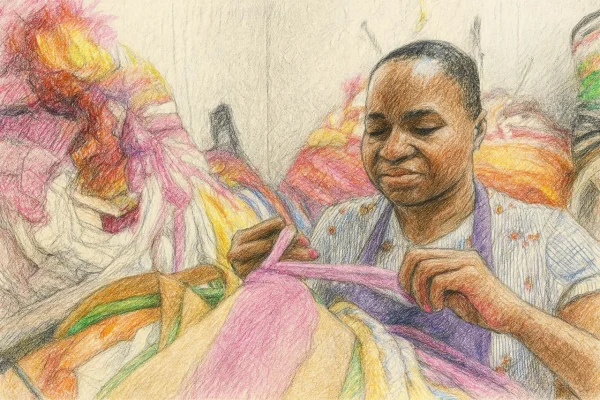
Her process relies on repetition. She winds materials around flexible ducting tape, over and over. This motion creates the "swirling vortexes" that define her drawings and the "cocoons" that define her sculptures. The physical act of making the art is as important as the final product. Critics noted the "beautiful intricacy" of her drawings, which mirror the wrapping technique of her 3D work.
Mark Hudson described her sculptures as having a "sense of joyous uplift." This joy stems from the energetic, gestural creation process. The materials capture the motion of her hands. Every knot and layer serves as a record of her movement. This approach resonates with the history of performance art and abstract expressionism. Kalu does not just make objects; she captures energy in physical form.
Bradford’s Cultural Moment
A city’s reputation changes when it hosts history. Bradford used this ceremony to cement its status as a serious cultural hub.
The award ceremony took place at Bradford Grammar School, the former school of David Hockney. This location added a layer of artistic heritage to the evening. The exhibition itself runs at Cartwright Hall gallery until February 22, 2026. This timing coincides with Bradford’s celebrations as the UK City of Culture for 2025.
Hosting the Turner Prize brings national attention to the city. The event highlights Bradford's commitment to the arts. By crowning a winner like Kalu, the city associates itself with progressive, boundary-breaking culture. The win for Nnena Kalu at the Turner Prize 2025 will likely remain a key highlight of Bradford's cultural year.
Shattering the Glass Ceiling
Systems of exclusion rely on the lack of a counter-example to persist. Kalu’s victory permanently destroys the argument that neurodiverse artists cannot lead the contemporary conversation.
Charlotte Hollinshead called the win "seismic" for a reason. It proves that the art world can—and must—make space for differently abled artists. The disability charity Sense hailed the nomination as "richly deserved and long overdue." For years, artists like Kalu faced systemic undervaluation. Their work often stayed in the realm of "therapy" rather than "art" in the eyes of critics.
This prize changes that classification. Kalu’s rosette, which read "Idol, legend, winner, whatever," captures the spirit of the moment. She occupies the center of the stage now. The discrimination she faced, which Hollinshead notes remains till date, suffers a major blow from this high-profile validation.
A New Standard for Criticism
Critics often hide behind jargon to avoid admitting they simply like how something looks. Kalu’s work forced them to abandon the dictionary and trust their eyes.
Reviews of the exhibition showed a divide, but the strongest voices rallied behind Kalu. The Guardian’s Adrian Searle called her the standout artist of the show. He described her work as "irreducible" and stated there was "no fudging." He compared her to legends like Judith Scott and Hanne Darboven. To him, she deserved the win unequivocally.
This type of criticism focuses on the visual power of the object. It moves away from the "overthought" exercises seen in some other works, such as Zadie Xa’s installation, which Searle criticized as "woozy." Kalu’s victory signals a possible return to valuing aesthetic impact and formal quality over purely theoretical concepts.
The Legacy of 2025
History remembers the winners who change the rules. The victory of Nnena Kalu at the Turner Prize 2025 will be cited for decades as the moment the definition of a "great artist" expanded.
The Turner Prize has a history of controversy. Founded in 1984, it has crowned provocateurs like Damien Hirst and Grayson Perry. Kalu joins this list not by shocking the public with dead sharks, but by shocking the establishment with her presence. She represents a demographic previously excluded from this level of success.
Her win aligns with the 250th anniversary of JMW Turner’s birth, the prize's namesake. It fits the year's theme of "identity and belonging in flux." Kalu’s presence questions who belongs in the canon of British art. Her victory answers that question decisively: anyone who creates powerful work belongs.
A New Era for Art
Art history rarely shifts in a single night, but this Tuesday in Bradford felt different. The Turner Prize 2025 win for Nnena Kalu did more than award than award £25,000 to a deserving sculptor. It dismantled the outdated idea that an artist must fit a specific intellectual mold to succeed.
Nnena Kalu spent twenty-five years binding materials together, creating complex forms that the world finally learned to see. Her victory forces the art establishment to look for genius in places it previously ignored. The walls between neurotypical and neurodiverse artists have not just lowered; they have been smashed. As the art world moves forward, it does so with a wider, richer perspective, thanks to the undeniable power of Kalu’s work.
Recently Added
Categories
- Arts And Humanities
- Blog
- Business And Management
- Criminology
- Education
- Environment And Conservation
- Farming And Animal Care
- Geopolitics
- Lifestyle And Beauty
- Medicine And Science
- Mental Health
- Nutrition And Diet
- Religion And Spirituality
- Social Care And Health
- Sport And Fitness
- Technology
- Uncategorized
- Videos

