
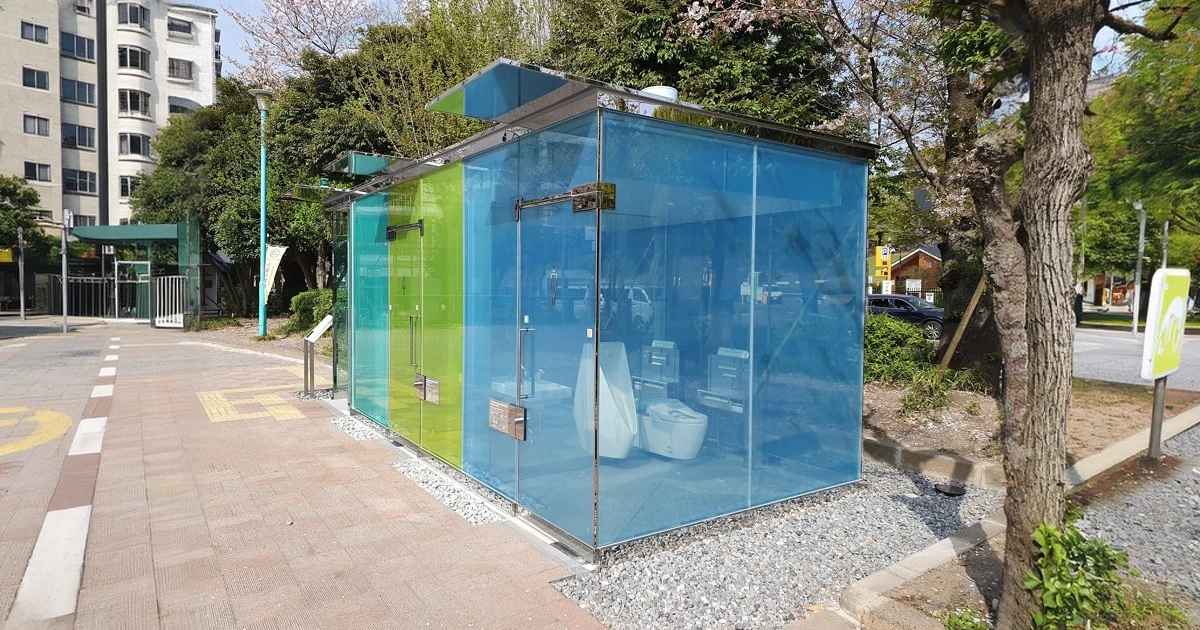
Image Credit - By Syced, Wikimedia Commons
The Secret Tech Making Every Tokyo Toilet Clear
We assume walls must block a view to keep us safe, but sometimes total concealment is exactly what makes a place dangerous. Traditional concrete barriers protect you from the outside world, yet they also prevent anyone from seeing if danger waits inside. The Tokyo Toilet Project flipped this logic in Shibuya. Instead of thick bricks, they used glass. You see everything before you enter.
This initiative uses transparency to force a sense of security. As reported by The Guardian, the Nippon Foundation aimed to address the common misconception that public facilities are dark, dirty, smelly, and frightening. Architectural Digest noted that the project reimagined Shibuya's restrooms ahead of the 2020 games, while the Nippon Foundation confirmed the schedule was adjusted for completion by spring 2021. This system uses visibility to build trust. It turns a private necessity into a public conversation about safety and hygiene.
The Science of Smart Glass
The technology relies on a constant electrical state that changes only when a human makes a deliberate choice. The structures at Yoyogi Fukamachi Mini Park and Haru-no-Ogawa Community Park use "smart glass." When the facility is vacant, electricity aligns the particles in the glass. This makes the walls completely clear. You can see the sink, the floor, and the toilet bowl from the street. This proves the stall is empty.
Once you step inside and lock the door, the circuit cuts. The glass instantly turns into a powdery, opaque pastel shade. You are concealed in plain sight. How do transparent toilets turn opaque? The glass walls rely on a smart film that becomes cloudy and private the instant the manual lock is engaged inside the stall.
The system requires user participation. The privacy activation depends entirely on the latch hardware. If you forget to turn the lock, the glass stays clear. This design forces the user to be mindful of their surroundings.
Solving the Public Restroom Fear
The Guardian highlights two main anxieties regarding park toilets: checking if the interior is clean and ensuring no one is secretly waiting inside. Public perception drives this design. The Nippon Foundation identified a core problem: people view public toilets as dark, dirty, smelly, and scary. A solid wall hides the condition of the room. You have to open the door to find out if it is safe. That moment of uncertainty causes anxiety.
The Tokyo Toilet Project removes the mystery. You verify hygiene status from the exterior. You check for occupancy without touching a handle. Transparency acts as a filter. It creates a space where nothing can fester in the dark. Why are Tokyo toilets transparent? Designers made them see-through to prove cleanliness and ensure no one is hiding inside before a user enters.
This approach changes the behavior of everyone involved. Users feel safer entering. Cleaners feel more pressure to keep the visible space spotless.
A Roster of Heavyweights
Usually, city infrastructure goes to the lowest bidder, but this initiative treated sanitation like high art. This was not a standard municipal contract. According to the official project website, sixteen global creators were invited to redesign facilities at seventeen spots. The Nippon Foundation highlights that this roster includes four Pritzker Architecture Prize laureates: Shigeru Ban, Toyo Ito, Tadao Ando, and Fumihiko Maki. They treated these functional spaces like small museums.
Each location has a unique identity. Fumihiko Maki created a "Squid Toilet" with a curved roof. Masamichi Katayama designed a "Modern Kawaya" referencing ancient river huts. Nao Tamura used "Origata" wrapping concepts. Tadao Ando built a circular shelter called "Amayadori." These structures serve as landmarks rather than simple bathrooms. The designs transcend utility to add value to the urban environment.
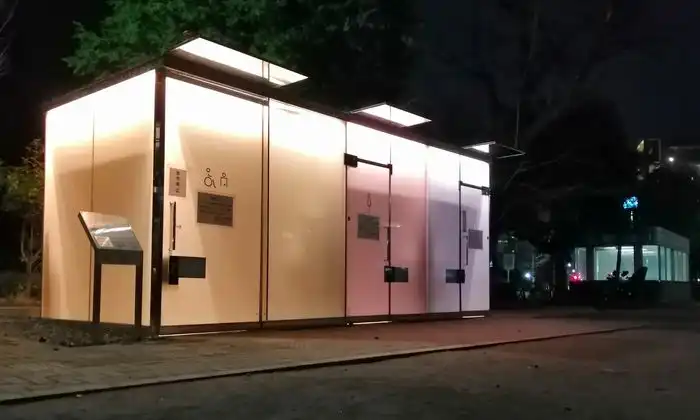
Image Credit - By 鋸香具師, Wikimedia Commons
The Tokyo Toilet Project as a Night Light
A dark building repels people, but a glowing structure naturally pulls a community closer to it.Safety often depends on lighting. Dark corners in parks invite trouble. The transparent designs change this situation completely. After the sun goes down, these colorful glass cubes light up. An architect on the project described them as "beautiful lanterns."
They function as beacons that illuminate the surrounding park. The light spills out from the glass compartments. This visibility discourages bad behavior while guiding users to safety. The structures become a focal point rather than a place to avoid. They turn a nighttime park from a place of fear into a place of community.
The Psychology of Exposure
Trusting a machine to hide you is harder than trusting a solid wall, even if the result is the same. Walking into a glass box requires courage. Even when the Tokyo Toilet Project walls turn opaque, the feeling of exposure lingers. Inside, mirrors installed between the compartments make the space feel bigger. Some users report feeling like they are still visible to the outside world.
This psychological unease is a persistent factor. A CNN report noted that the interior mirrors create an illusion of transparency even when privacy is active. The user must trust the tech. Are see-through toilets actually private? Yes, the glass becomes completely opaque when locked, though mirrors inside can create a psychological feeling of being exposed.
The distinctive lock is located below the handle. The risk of user error is real. If the latch is not fully engaged, the walls remain clear. The design demands full attention from the person inside.
Cultural Roots and Omotenashi
Cleanliness in this culture acts as a spiritual bridge rather than a simple hygiene requirement. Japan values "Omotenashi," or deep hospitality. The organizers wanted to show this spirit to the world. The Nippon Foundation stated that while the initiative involved heavyweights like Daiwa House Industry and Toto Ltd., the timeline for the remaining facilities was set for spring 2021.
Shinto traditions link cleanliness to godliness. A dirty toilet is seen as a spiritual failure. These high-tech units honor that tradition. They serve as a demonstration of inclusivity. A project coordinator, Ueki, noted that traditional facilities often fail guests with diverse needs. These new designs prioritize universal access. They offer three specific compartments: Men, Women, and Multi-use. This ensures that hospitality extends to everyone, regardless of ability.
Technology Meets Maintenance
Advanced hardware fails quickly without a dedicated human team to scrub the floors. TOTO Ltd. provided the internal tech, including their famous Washlets. They offered advice on layout and equipment. But technology cannot clean itself. The Nippon Foundation partnered with the Shibuya City Government to ensure strict maintenance.
A clear wall shows every smudge. There is nowhere to hide dirt. This transparency acts as a strict standard for the cleaning crews. If the restroom is dirty, the whole street sees it. This accountability ensures the facilities remain pristine. The Tokyo Toilet Project turns the restroom into a stage where cleanliness is the main performance.
When Transparency Builds Trust
We usually build walls to separate ourselves, but these glass barriers force a connection between the private user and the public gaze. The Tokyo Toilet Project proved that privacy does not always require darkness. Through the use of glass, Shibuya turned a scary utility into a source of civic pride.
The transparent walls demand trust from the user and care from the cleaner. It redefines public space. When you have nothing to hide, you have nothing to fear.
Recently Added
Categories
- Arts And Humanities
- Blog
- Business And Management
- Criminology
- Education
- Environment And Conservation
- Farming And Animal Care
- Geopolitics
- Lifestyle And Beauty
- Medicine And Science
- Mental Health
- Nutrition And Diet
- Religion And Spirituality
- Social Care And Health
- Sport And Fitness
- Technology
- Uncategorized
- Videos

