
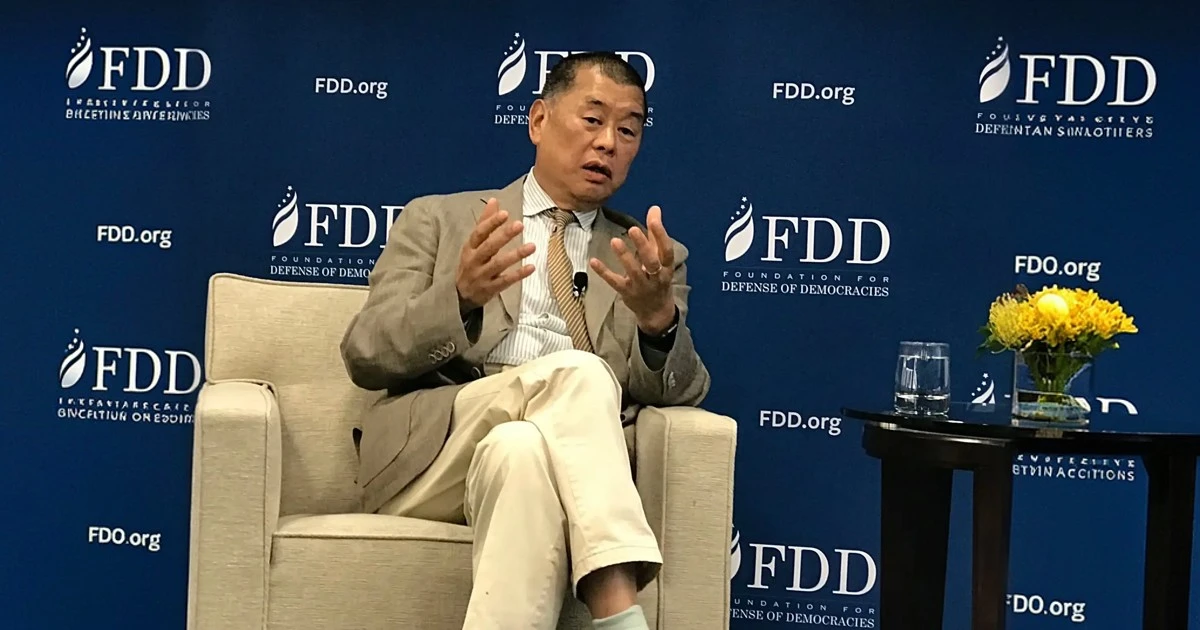
Image Credit - By Wikimedia Commons
The 20-Year Verdict That Ends Jimmy Lai Life
Most tycoons in Hong Kong learned long ago to nod politely at Beijing to keep their fortunes safe. Jimmy Lai spent thirty years shouting back. That refusal to play by the unspoken rules of the elite just cost him the rest of his life. According to Reuters, a courtroom in West Kowloon delivered a judgment on February 9, 2026, that effectively buries the 78-year-old media mogul under a 20-year prison term, bringing an end to the city's largest national security case. This sentencing marks the harshest penalty ever handed down under the city’s National Security Law (NSL).
Le Monde reported that the courtroom session persisted less than 15 minutes, leaving observers stunned. Three government-vetted judges sealed the fate of a man who once arrived in the city as a penniless stowaway. Prosecutors painted him as an "architect" who weaponized his newspaper to incite hatred against the Communist Party. Lai watched the proceedings from the dock, knowing he would likely die behind bars. He did not plead for mercy. This moment signals the final shift of Hong Kong’s legal environment from a common law system to a patriot-only governance model. The time of dissent in the financial hub has officially ended.
From Stowaway to Enemy of the State
Economic freedom often fools people into thinking they have political protection. Jimmy Lai built his entire life on the promise of Hong Kong’s open market, only to find that money offers no shield against the state. His story began in 1959 when he arrived from mainland China as a child laborer. He worked in garment factories for the equal of $8 USD a month. As noted by the AP, he clawed his way up to found Giordano in 1981, an affordable casual clothing chain that grew into an international brand and made him a billionaire.
Most businessmen stop there. They buy yachts and stay quiet. Lai took a different turn in 1989 after the Tiananmen Square Massacre. The violence shattered his political apathy. He founded Next Digital and later Apple Daily in 1995, using his wealth to challenge the very government that controlled his homeland. The authorities tolerated him for decades because he was just a noisy businessman. That tolerance evaporated when he started funding and organizing actual resistance.
The state finally struck back in August 2020. Police raided his home and offices, arresting him under the newly imposed National Security Law. Why was Jimmy Lai arrested? Authorities charged him with conspiring with foreign forces and sedition for allegedly inviting international sanctions against Hong Kong and China. The government froze his assets and forced his company to shut down. The message was clear: wealth and vocal opposition are mutually exclusive.
The Newspaper That Became a Weapon
A tabloid usually chases celebrity gossip, but this one chased the government until the government chased back. Apple Daily was never a standard newspaper. It mixed paparazzi culture with hard-hitting political investigations. It used sensational headlines to grab attention and then directed that attention toward the failings of the Chinese Communist Party (CCP).
The prosecution argued that Lai used this platform to "incite rabid hatred" against Beijing. John Lee, Hong Kong’s Chief Executive, described the media outlet as weaponized. He claimed the paper praised violence under the guise of human rights and stirred up social conflict. During the 2019 pro-democracy protests, Apple Daily printed slogans for marchers to carry. It became the operational manual for the unrest that paralyzed the city.
The judges agreed with this assessment. In their ruling, they stated that the defendant possessed "extreme animosity" toward the party. They cited his intent to replace Chinese values with Western ideology. What happened to Apple Daily? A report by Reuters indicates that the government forced the newspaper to close in 2021 just days after freezing its assets and arresting its top editors. The closure silenced the only major outlet in the city that dared to criticize the leadership openly.
The Collusion Charge and the Courtroom
Modern trials in sensitive cases often resemble political confirmations rather than legal debates. The judicial process for Jimmy Lai stripped away many traditional Hong Kong legal protections. No jury heard his case. Instead, a board of three judges handpicked by the government decided his guilt.
The core of the prosecution’s case rested on the idea of "collusion." They accused Lai of meeting with foreign officials, including Mike Pence and Mike Pompeo, to beg for support. Lai testified that he only asked for support and sanctions, denying he ever took orders from Donald Trump or other Western leaders. The court dismissed this distinction. The judges ruled that inviting international critique now qualifies as criminal collusion.
Defense lawyers argued that Lai simply advocated for Hong Kong values, the rule of law, and freedom of speech. They framed his actions as a pursuit of democracy rather than treason. The court rejected this view entirely. The judges asserted that his goal was the removal of Xi Jinping and a total shift in the region's political alignment. Through the expansion of the definition of collusion, the court set a precedent where talking to a foreign politician can equal a prison sentence.
Life Inside a Concrete Box
The system breaks a person through quiet isolation rather than loud torture. Jimmy Lai has spent years in solitary confinement leading up to this sentencing. He sits alone in a cell at Stanley Prison, cut off from the general population.
His daily routine is a stark contrast to his former life of luxury. He spends up to 6 hours a day in prayer. He sketches religious images to pass the time. Figo Chan, a fellow activist and friend, expressed surprise at Lai’s diet. The former tycoon now prefers simple rice and ginger over the lavish meals he once enjoyed. He views his incarceration as a path to redemption rather than a punishment.
His health is failing. His family reports that he suffers from diabetes and frailty. They claim he receives no independent medical care. The Hong Kong government disputes this, insisting his care is "adequate and comprehensive." How long is Jimmy Lai's prison sentence? The court sentenced him to 20 years, though legal experts note he has already served over 5 years for previous fraud charges. The isolation continues regardless of the timestamp on his file.
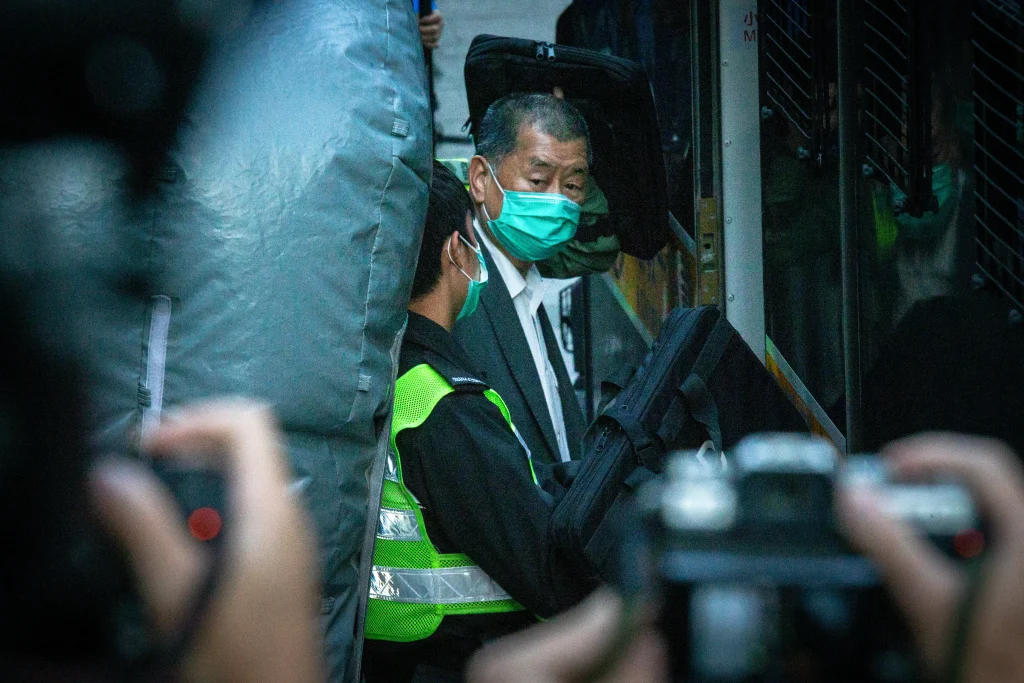
Image Credit - By Studio Incendo, Wikimedia Commons
The Global Standoff Over One Man
A prisoner often becomes more valuable as a symbol than they ever were as a free man. Jimmy Lai has evolved from a prisoner into a diplomatic bargaining chip. His son, Sebastien Lai, calls the verdict the death of the legal system. He warns that Western relations with China now depend entirely on his father’s release.
Donald Trump, as President-elect, has already weighed in. He expressed sorrow regarding the judgement and claimed to have initiated communication with Xi Jinping. Trump described Lai as brave and significant. This places Beijing in a difficult position. Releasing him looks like weakness; keeping him looks like cruelty.
According to Xinhua, China’s Foreign Ministry spokesman, Lin Jian, rejected all foreign criticism, labeling Lai the "principal instigator" of the riots who deserved harsh punishment, and called the sentencing lawful and beyond reproach. To Beijing, the law is essential for stability. They view the 2019 protests as chaos that required a firm hand. Human Rights Watch sees it differently, equating the 20-year sentence to a death penalty given Lai’s advanced age. The gap between these two views is unbridgeable.
Why This Sentence is Different
Laws usually punish past actions, but security laws punish future fears. This 20-year sentence concerns ensuring no one else dares to act as much as it concerns Jimmy Lai's past actions. The court calculated the term based on the severity of the "collusion."
Previous prison terms for dissent were shorter. Lai himself served five years and nine months for fraud charges related to lease violations. This new sentence escalates the cost of opposition. The judges emphasized that Lai showed "rabid hatred" and had no mitigation factors. Steve Li, from the National Security Police, stated that Lai made zero positive contributions to Hong Kong.
The sentencing reflects the new "patriot-only" governance model. The goal is to move from the chaos of 2019 to absolute governance. The state confirms that the old time of "One Country, Two Systems" has shifted through the act of locking away the most prominent critic for two decades. The system now prioritizes national security over all other rights.
The Final Stand of a Tycoon
Martyrs usually don't start out as billionaires. Jimmy Lai could have fled. He had the money, the connections, and the warning signs. Yet, he chose to stay. Before his arrest, he spoke of a "debt owed to the city." He felt that Hong Kong gave him everything, and he could not abandon it when the situation turned dark.
Herbert Chow, a former business rival, noted that the same traits that made Lai a success led to his downfall. He had a willingness to disrupt industries and a fearlessness in making enemies. In business, that made him rich. In politics, it made him a target.
His daughter, Claire Lai, described the punishment as cruel. She believes her father is destined for martyrdom. Lai’s testimony in court revealed a man at peace with his choices. He denied being an architect of violence but admitted to promoting universal freedoms. He traded his freedom for his principles.
The Silence After the Gavel
The sentencing of Jimmy Lai to 20 years in prison is the closing chapter of a specific version of Hong Kong. A man who arrived with nothing and built an empire will likely end his days in a 7-square-meter cell. The severity of the punishment sends a shockwave through the city, silencing the last whispers of organized dissent.
This verdict confirms that the legal firewall between Hong Kong and mainland China has dissolved. The courtroom proved that wealth and status offer no immunity against the National Security Law. Jimmy Lai bet his life on the hope that Hong Kong could remain free. The court’s decision ensures that his gamble failed, but his imprisonment leaves a permanent mark on the city's history.
Recently Added
Categories
- Arts And Humanities
- Blog
- Business And Management
- Criminology
- Education
- Environment And Conservation
- Farming And Animal Care
- Geopolitics
- Lifestyle And Beauty
- Medicine And Science
- Mental Health
- Nutrition And Diet
- Religion And Spirituality
- Social Care And Health
- Sport And Fitness
- Technology
- Uncategorized
- Videos

