
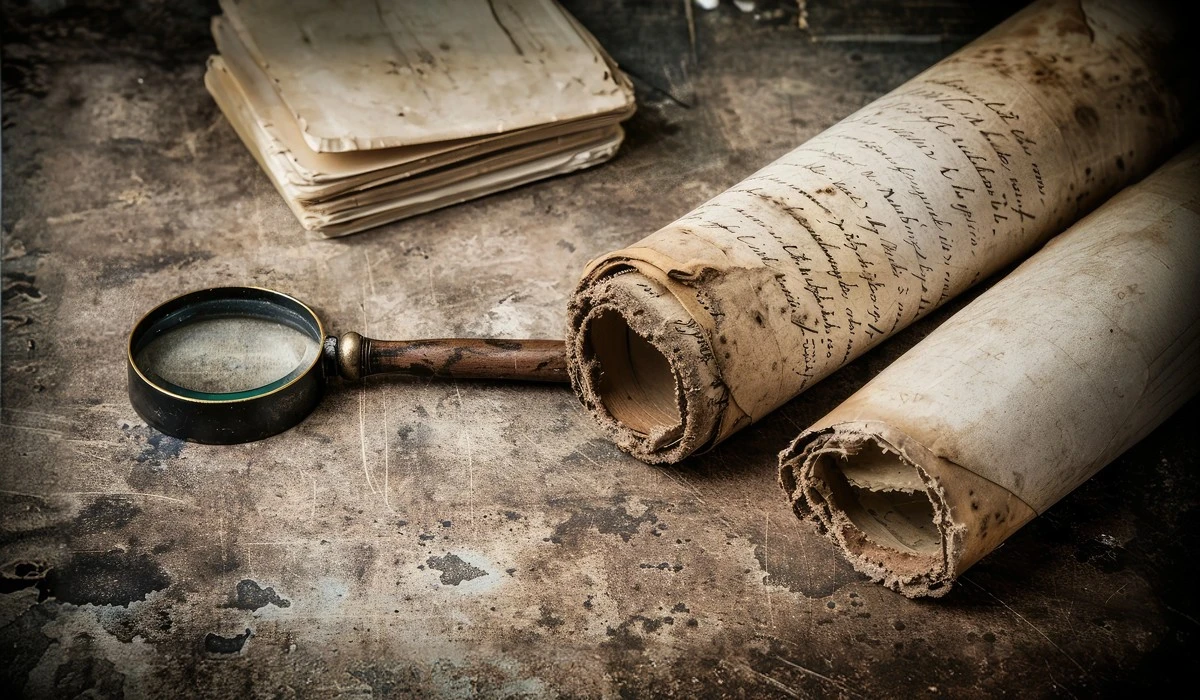
Palaeography Reveals Secrets of Ancient Manuscripts
You stand over a heavy wooden table, staring at a piece of sheepskin that left the farm a thousand years ago. The ink looks like a tangled mess of thorns. To most people, these are just old scratches. However, every curve and tilt of the pen tells a specific story about a person who lived ten centuries ago. If you misread one tiny stroke, you might accidentally rewrite a king's law or a monk's prayer.
This is where Palaeography changes everything. It turns a confusing page into a clear map of the past. Through the use of medieval manuscript handwriting analysis, scholars look beyond the words to find the person behind the pen. They see the shaky hand of an old man or the rushed work of a tired student. This skill lets us step through time and hear voices that have been quiet for an age.
The Core Principles of Palaeography and Script Evolution
Every letter on a medieval page follows a set of strict physical rules. Scribes constructed letters using specific movements instead of simply writing in the modern sense. Experts call this the ductus. It describes the number of times the pen hits the parchment and the direction the ink travels.
The Anatomy of a Letterform
According to the University of Alberta’s guide to manuscript studies, the scribe creates the shape of a letter using minims, which are the shortest and simplest strokes. The guide also notes that a scholar must look at the ascenders—the parts of the letter that reach toward the top of the page—and the descenders that drop below the line. These small details identify the century and location of the writer.
Understanding the Writing Support
Ancient writers once used papyrus, but this material crumbled easily. When the Western world moved to parchment made from animal skins, the way people wrote changed forever. Parchment allows for sharper lines and more decorative flourishes. How do you date a manuscript by its handwriting? Experts look at the specific evolution of letter shapes and the presence of localized abbreviations to pin a text to a specific decade. The comparison of unknown scripts to 'dated' benchmarks allows scholars to establish a reliable chronological window for the parchment.
Learning Medieval Manuscript Handwriting Analysis
To truly understand an old book, you must recognize the regional "fonts" of the Middle Ages. Scribes in Ireland did not write like scribes in Italy. According to research published by the National Center for Biotechnology Information, Hebrew paleography recognizes six regional styles, and these variations helped monasteries maintain their unique identities. Palaeography allows us to categorize these different hands with high precision.
Identifying Regional 'Hands'
The Insular script from Ireland and England features famous "wedge-headed" strokes on the tops of letters. Meanwhile, an article from Transkribus describes the Carolingian style from the time of Charlemagne as having clear, rounded letterforms of uniform heights that look similar to our modern alphabet. The HMML School notes that if a reader sees angular strokes known as 'broken minims,' they are likely looking at the Beneventan script from Southern Italy.
The Role of the Scriptorium
Monastic scriptoria functioned like professional offices. The head scribe enforced a specific style so that every book produced by that monastery looked uniform. However, medieval manuscript handwriting analysis still catches the tiny differences. Even when trying to follow a standard style, every human makes unique choices in how they angle their wrist or apply pressure to the quill.
Decoding Scribes through Advanced Palaeography
Handwriting acts like a fingerprint for the soul. We often think of medieval books as anonymous objects, but individual personalities live in the ink. Palaeography reveals these forgotten people by focusing on their habits and mistakes.
Spotting the Scribe’s 'Quirks'
Every scribe has a "tell." One writer might always cross a 't' slightly higher than his peers. Another might use a unique loop at the end of a word. When a researcher finds these same quirks in three different books across two different libraries, they have found the work of a single person. This connects the dots between historical locations.
Collaborative Manuscripts
Large books were expensive and took years to finish. Often, a senior scribe started the work, and a student finished it. A study regarding scribal identification in the National Library of Medicine explains that researchers can identify 'hand shifts' where a new scribe took over production; in some manuscripts, columns from the first and second halves were found in two distinct zones, indicating the presence of two main scribes. This often reveals the hierarchy and workflow within a medieval monastery.
The Concealed Logic of Medieval Abbreviations
Medieval parchment cost a fortune. To save space and money, scribes developed a detailed system of shorthand. These abbreviations make a page look like a secret code to the untrained eye. Accuracy in medieval manuscript handwriting analysis requires becoming proficient in these symbols.
Suspension and Contraction Systems
Scribes used two main ways to shorten words. They either cut off the end of the word (suspension) or squeezed out the middle (contraction). For example, they might write "DS" with a line over the top to mean "Deus." These marks, called titivilli, told the reader to fill in the missing letters mentally.
Tironian Notes and Symbols
Scribes also used specific symbols that stood for entire words. The most famous is the Tironian 'et', which looks like a modern number 7. When a researcher sees this symbol, they know they are reading a text that follows a tradition going back to the Roman Empire. These symbols are vital for any fast and accurate medieval manuscript handwriting analysis.
Exposing Historical Forgeries with Forensic Palaeography
In the Middle Ages, owning a document that "proved" you owned land or held power was worth a lot of money. Because of this, many people created fakes. Palaeography serves as a lie detector for history. As noted in a report in the National Library of Medicine, paleography is essential for identifying and dating historical texts; for instance, a forger in the 1400s might try to produce a document appearing to be from the 1100s, but will often use a letter shape that had not been invented yet.
Detecting Anachronistic Scripts
A forger in the 1400s might try to write a document that looks like it came from the 1100s. However, they almost always slip up. They might use a letter shape that hadn't been invented yet. If a "12th-century" document uses a Gothic 's' that only appeared 200 years later, the expert knows immediately that the document is a fraud.
Chemical Analysis vs. Script Analysis
Scientists can test the age of the parchment using carbon dating, but that only tells you when the animal died. It doesn't tell you when the ink hits the surface. Only Palaeography can tell you if the writing style matches the claimed date of the document. This makes it more reliable than chemical tests for finding the true intent of the creator.
The Digital Frontier of Medieval Manuscript Handwriting Analysis
Modern technology provides us with a new way to look at old ink. We are no longer limited to just our eyes. New digital tools are expanding the reach of medieval manuscript handwriting analysis by seeing through time and damage.
Multispectral Imaging
Some parchments are palimpsests. This means a later scribe scraped off the original text to write something new. The application of different wavelengths of light allows researchers to see the "ghost" of the original writing. This technology has recovered lost works by famous thinkers like Archimedes that were hidden under prayer books for centuries.
Machine Learning and Pattern Recognition
Computer programs now help scholars sort through thousands of pages of text. Research published in the National Center for Biotechnology Information states that computer models can assist through the sharpening or modification of estimates, though the human expert is still required to provide the historical context and interpretation of the data. Technology acts as a powerful magnifying glass, but the final verdict remains a scholarly human effort.
Why Palaeography Remains Essential for Modern Historians
Because digital fonts and instant printing are now standard, it is easy to forget that for most of human history, every single copy of a book was a unique physical performance. This discipline preserves the link between the thought and the physical hand that recorded it.
Correcting Past Interpretations
In the 1800s, early historians often misread difficult scripts. They sometimes changed names or dates by mistake. Modern researchers use updated Palaeography standards to fix these errors. This often changes our entire understanding of a specific battle, law, or religious movement.
Preserving Human Connection
When you look at a manuscript, you see the scribe's life. You might see a smudge where a thumb rested or a spot where the ink ran because the writer sneezed. These moments bring the past to life. No other field of study offers such a direct, physical connection to the people of the Middle Ages.
A New Perspective on Ancient Ink
Every stroke on a piece of parchment serves as a bridge to a world we can no longer see. Palaeography gives us the key to cross that bridge. It transforms a cold, dusty archive into a vibrant conversation with our ancestors. When we apply medieval manuscript handwriting analysis, we see decisions, mistakes, and triumphs in addition to the letters themselves.
Learning the basics of this craft changes how you look at every book and document. It forces you to slow down and appreciate the effort behind every word. History stays alive because we take the time to read it correctly. Through the study of the way people wrote, we ensure that their truths remain clear for the next thousand years.
Recently Added
Categories
- Arts And Humanities
- Blog
- Business And Management
- Criminology
- Education
- Environment And Conservation
- Farming And Animal Care
- Geopolitics
- Lifestyle And Beauty
- Medicine And Science
- Mental Health
- Nutrition And Diet
- Religion And Spirituality
- Social Care And Health
- Sport And Fitness
- Technology
- Uncategorized
- Videos

