
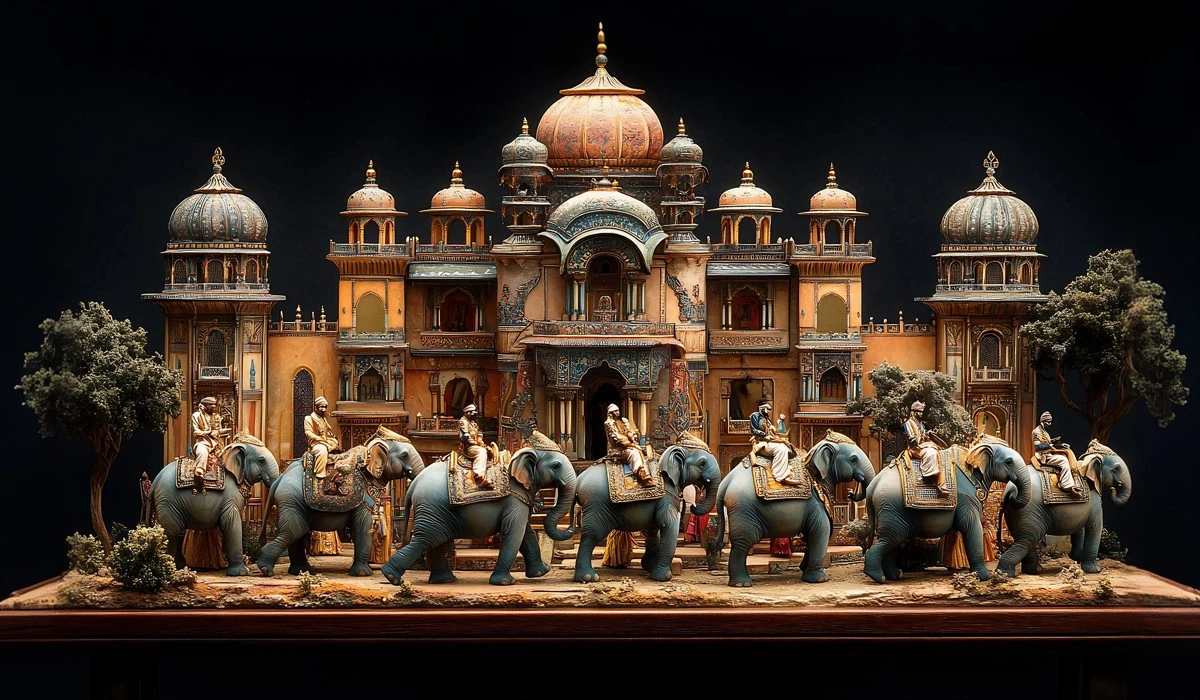
Medieval Indian History: The Zabt Tax System
Akbar faced a dangerous problem in 1560. His empire grew every day, but his treasury stayed empty. Local leaders collected taxes from farmers and kept most of the gold for themselves. The King had no way to know if a village produced ten bags of wheat or a hundred. This lack of data nearly broke the empire before it truly began. Raja Todar Mal changed everything as he built a system based on hard numbers rather than guesses.
This shift defines Medieval Indian History because it moved the government from brute force to mathematical logic. It created the Medieval Indian Mughal revenue system we study today. Mughal officials measured every inch of soil and tracked prices for a decade; this action took power away from corrupt middlemen. They placed that power into the hands of a central bureaucracy. This change allowed the empire to fund massive armies and build monuments that still stand.
To see how this period functioned, one must look at how money actually moved from a dusty field to the imperial vault. Most stories focus on battles and kings, but the real power lived in the ledgers of tax collectors. We see the true genius of the period in the way the state finally learned to count its own wealth.
Evolution from Sher Shah in Medieval Indian History
Akbar did not invent tax reform out of thin air. He looked back at the rulers who came before him to find a better way to manage wealth. Sher Shah Suri, the Afghan ruler who briefly ousted the Mughals, provided the first spark of inspiration. Sher Shah realized that a king cannot rule effectively if he does not know the value of his land.
The Rai System Legacy
According to materials from the National Institute of Open Schooling, Sher Shah Suri introduced the Rai system, which established a schedule of rates for crops across the state. The study explains that land was classified into three simple groups, good, middling, and bad, to estimate productivity via sample cutting. The government then took an average of these three categories to decide the tax. It is further noted that Akbar used this Rai system during his early years. He quickly found that it contained major flaws because a single average did not work for a massive empire.
The Problem of Annual Settlements
The early Medieval Indian History Mughal revenue system struggled with timing. Officials had to calculate new prices and tax rates every single year. This created a massive administrative burden that slowed down the entire government. You might wonder, how did the Mughal revenue system work before the reforms? Initially, it relied on annual price lists from across the empire, which often led to delays and localized corruption until the Zabt system standardized the process.
Because prices changed constantly in different markets, the central government could never keep up. Local officers often lied about prices to steal money from the state. Akbar realized he needed a permanent solution that did not require a total recalculation every twelve months. According to research published in eGyanKosh Unit-19, this led to the creation of the Zabt system, which stabilized agriculture by using price averages from the ten-year period between 1570 and 1580.
Measuring the Land with the Jarib Revolution

Accuracy became the obsession of the Mughal court. Before the Zabt reforms, measurement was a sloppy process. If a tax collector used a short rope, the farmer paid too much. If the rope was long, the King lost money. Akbar demanded a tool that stayed the same regardless of the weather or the person holding it.
From Hemp to Bamboo
In the early days, collectors used hemp ropes called tanabs to measure fields. These ropes caused constant arguments. Hemp stretches when it gets wet and shrinks when it dries in the sun. This meant a field could "change size" between the rainy season and the summer. Akbar replaced these ropes with the Jarib. This tool consisted of bamboo sticks joined together by iron rings. The iron and bamboo did not change length, ensuring that every measurement remained honest and repeatable.
Standardizing the Bigha and Gaz
To make the Medieval Indian History Mughal revenue system work, everyone had to use the same units. Akbar standardized the Ilahi Gaz, a unit of length equal to about 33 inches. He also defined the Bigha as a square of 60 Gaz by 60 Gaz. The state fixed these units and created a universal language for land. A Bigha in Agra now meant the same thing as a Bigha in Lahore. This precision allowed the state to levy a zabitana tax of one dam per unit to pay for the measurement teams.
Deciphering the Four Categories of Land Fertility
The Mughals understood that not all dirt is equal. Taxing a dry, sandy plot at the same rate as a lush riverbank field would cause a peasant revolt. To prevent this, the state developed a sophisticated grading system for every piece of land in the empire.
Polaj and Parauti
The state identified Polaj as the best land available. Farmers grew crops on the Polaj land every year without ever letting it rest. Because it produced the most wealth, it paid the highest taxes. Documents from eGyanKosh Unit-2 explain that Parauti land was also of high quality, but it needed to rest for a year or two to regain its strength, though it was taxed at the same rate as Polaj when cultivated. This showed a rare level of fairness in Medieval Indian History.
Chachar and Banjar
Some land required more work to remain productive. Chachar land stayed fallow for three or four years. Banjar land sat uncultivated for five years or more. If you're looking for specifics, what are the types of land in the Mughal revenue system? The state categorized land into four distinct types based on the regularity of cultivation, ensuring that farmers were taxed only on the actual productivity of their soil. The source further states that the Mughals provided massive tax breaks, charging Chachar and Banjar land at a concessional rate to encourage farming on difficult soil. A farmer who cleared Banjar land might pay almost nothing for the first few years until the soil became healthy again.
The Dahsala System and the Ten-Year Price Average
The year 1580 marked a turning point for the empire. Raja Todar Mal completed a massive project that changed how the state viewed time and money. He realized that using a single year of data was a mistake because one bad drought could ruin the numbers.
The 1570–1579 Data Audit
Todar Mal ordered his officers to collect data for ten years, from the 15th to the 24th year of Akbar’s reign. They recorded every crop yield and every market price in every district. This ten-year audit provided massive evidence. They used this data to find a "permanent" average. This prevented the tax rate from jumping up and down wildly based on a single good or bad harvest.
Fixing the Dastur-ul-Amal
The state used this ten-year average to create the Dastur-ul-Amal, or schedules of rates. They organized these schedules into revenue circles called Dasturs. Each circle had its own specific rates based on its local climate and market access. This meant a farmer near a big city paid a different rate than a farmer in a remote village. This localized approach made the Medieval Indian Mughal revenue system the most advanced in the world at that time.
Administrative Titans in Medieval Indian History
A system is only as good as the people who run it. Akbar built a massive hierarchy of officers to ensure that no one cheated the state. This bureaucracy acted as the eyes and ears of the Emperor in every corner of the country.
The Karori Experiment
In 1574, Akbar launched the Karori experiment. According to eGyanKosh Unit-28, he divided the empire into blocks that each produced an estimated ten million (one crore) copper dams in revenue. He appointed a Karori officer to manage each block. These men had to measure all the land and record the names of every farmer. While some Karoris became corrupt, the experiment provided the state with the raw data it needed to launch the final Zabt reforms. This data-heavy approach is a hallmark of Medieval Indian History.
Amils, Bitikchis, and Qanungos
Under the Karori, several other officers kept the wheels turning. The Amil acted as the main collector who met with farmers face-to-face. The Bitikchi served as the head clerk, writing down every detail in the Khasra, or land record book. Finally, the Qanungo acted as a local expert. These men usually came from families who had lived in the area for generations. They knew the history of the land and ensured the state didn't ask for more than the soil could provide.
Peasant's Perspective in the Medieval Indian History: Mughal Revenue System
The Zabt system changed daily life for millions of farmers. It moved the relationship between the King and the subject away from traditional sharing and toward a formal legal contract. This created both opportunities and immense pressure for the common person.
Change to a Cash Economy
The state eventually demanded that farmers pay their taxes in cash rather than grain. This forced peasants to take their crops to local markets, or mandis, to sell them for silver and copper. A common question arises: who introduced the Zabt system in India? While Emperor Akbar gave the decree, it was his finance minister Raja Todar Mal who refined the system into its final form in 1580, providing a stable fiscal foundation for the empire. This cash requirement helped grow the economy, but it also made farmers vulnerable to market price drops.
Taccavi and Remissions
The Mughals knew that a dead farmer cannot pay taxes. To protect their "human capital," they offered Taccavi loans. These were low-interest or interest-free loans that helped farmers buy seeds, bullocks, or dig new wells. As observed in eGyanKosh Block-4, the state often issued remissions of land revenue when natural disasters like famines, floods, or droughts occurred. This safety net kept the Medieval Indian History Mughal revenue system from collapsing during natural disasters.
Geographical Reach and Regional Variations
The Zabt system was powerful, but it was also expensive to run. It required thousands of trained surveyors and constant record-keeping. Because of this, the Mughals did not use it everywhere. They chose to deploy it only where it made the most sense.
The Zabti Provinces
The core of the empire used the Zabt system almost exclusively. Reports from eGyanKosh Theme-III indicate that this included the fertile provinces of Delhi, Agra, Awadh, Allahabad, Lahore, and Multan. In these regions, the land was flat and easy to measure, and the markets were busy enough to support a cash-based tax. These provinces became the financial engine of the Mughal state.
Alternatives like Batai and Nasq
In rugged mountains or distant swamps, the Zabt system failed. As documented in eGyanKosh Block-1, in rugged mountains or distant swamps, the state used alternative methods like Batai (crop sharing), Kankut, or Nasq (group estimation). In Batai, the collector simply stood in the field and took every third bag of grain. In Nasq, the state and the village elders agreed on a total tax amount for the whole village without measuring every single plot. These flexible methods allowed the Medieval Indian History Mughal revenue system to function even in places where the Jarib could not go.
Legacy of Fiscal Reform in Medieval Indian History
The Zabt system filled the Emperor's pockets while creating a standard for governance that lasted for centuries. Akbar and Raja Todar Mal replaced fuzzy guesses with hard data and taught the world how to manage a large-scale economy.
When the British arrived in India centuries later, they did not start from scratch. They studied the Mughal records and used the same units of measurement and land categories for their own tax systems. The Patwari (village accountant) is a role that still exists in modern India, directly descending from the Mughal bureaucracy.
This period of Medieval Indian History proves that a great empire stands on its ledgers, not just its swords. The change to a scientific, measured revenue system allowed the Mughals to maintain peace and order across a massive, diverse territory. It turned the collection of wealth into a transparent contract between the ruler and the ruled. Even today, the echoes of the Jarib and the Dahsala remain in the way we think about land, value, and the state.
Recently Added
Categories
- Arts And Humanities
- Blog
- Business And Management
- Criminology
- Education
- Environment And Conservation
- Farming And Animal Care
- Geopolitics
- Lifestyle And Beauty
- Medicine And Science
- Mental Health
- Nutrition And Diet
- Religion And Spirituality
- Social Care And Health
- Sport And Fitness
- Technology
- Uncategorized
- Videos

