
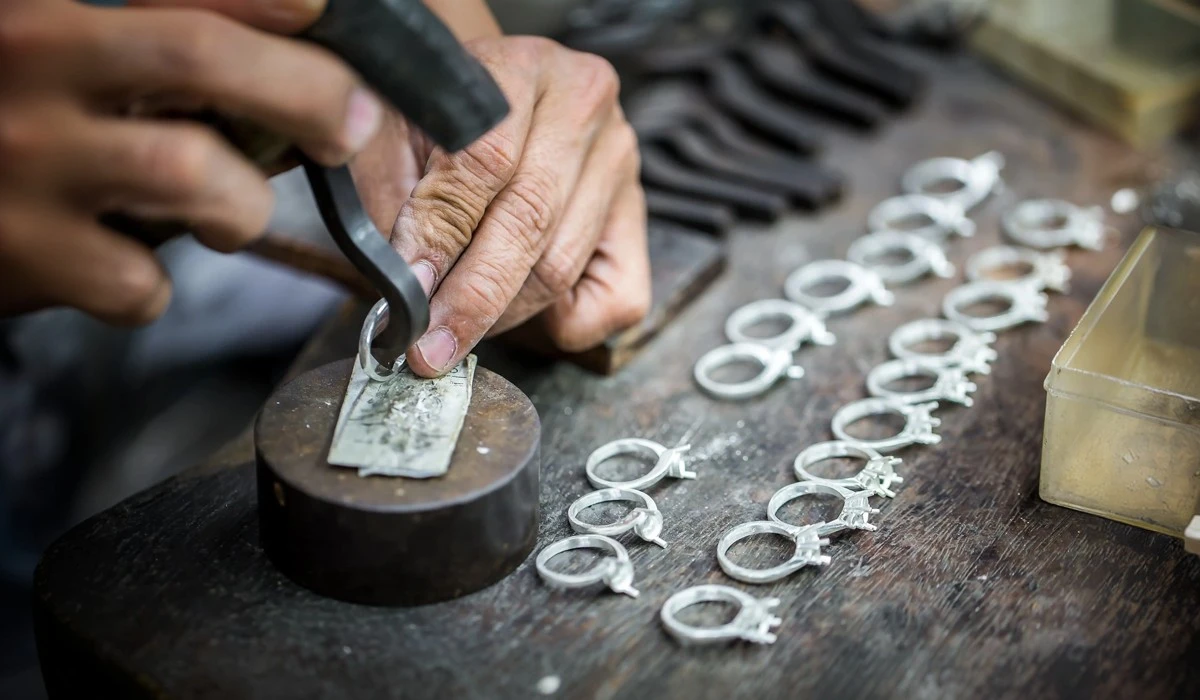
How Jewellery and Silversmithing Coaxes Metal
A flat sheet of silver appears to be a solid wall. In reality, the metal acts as a slow-moving liquid when you strike it with intent. Most people see the finished curves of a bowl or a heavy cuff and assume a machine pressed the shape into a mold. They miss the unseen reality of the artisan moving millions of atoms by hand.
This internal movement defines the highest level of jewellery and silversmithing. Rather than relying on force to crush metal into a shape as seen in mass production, repoussé encourages the metal to grow. Through the displacement of atoms, volume is created without removing any material. This "pushing back" creates a depth and soul that defines rare expert works. When one understands how a smith coaxes a flat surface into a three-dimensional sculpture, the true divide between commercial trinkets and museum-grade art is revealed.
The Historical Evolution of Jewellery and Silversmithing
According to Britannica, repoussé is a method of decorating metals and is recognized as one of the oldest decorative arts known to man. It began when early smiths found that precious metals like gold could stretch without breaking. These ancient techniques allowed craftsmen to create massive, ornate objects that remained lightweight enough for ritual use.
Ancient Origins and the Mycenaean Influence
Early metal movement appears most famously in the "Mask of Agamemnon" from roughly 1550 BCE. A report from the Met Museum explains that the original mask was likely raised from a single sheet of gold, which shows that ancient smiths hammered these sheets into carved wooden or stone molds to achieve high-prestige results. This time proved that jewellery and silversmithing could capture human likeness through manual displacement. These early artisans lacked the involved chemical pitch used today, yet they achieved remarkable detail using simple hide or wooden supports.
The Renaissance Bloom
The shift to modern sophistication happened during the 14th and 15th centuries. Benvenuto Cellini’s 1568 Treatise on Goldsmithing finally documented the move from stone backings to pine-resin pitch. This shift allowed for a level of precision previously impossible. Renaissance experts used this newfound control to create liturgical vessels and royal armor that looked more like cast sculptures than hammered sheets. They refined the detail of the obverse side, known as chasing, to a razor-sharp finish.
Essential Tools for Traditional Silversmithing Methods
The kit of every expert smith resembles a surgical tray rather than a construction box. High-level work requires specific resistance and precision that store-bought tools rarely provide. The tactile feedback of the hammer tells the smith exactly how the metal reacts to each blow.
Liners, Planishers, and Custom Punches
Expert smiths often forge their own punches from high-carbon tool steel. They temper these tools to a specific "straw" color at 475°F. This ensures the tip stays harder than the workpiece without becoming brittle enough to shatter. Liners displace metal into sharp borders without cutting the grain fibers. Meanwhile, planishers feature highly polished, flat faces that remove hammer marks and condense the surface molecules. The use of traditional silversmithing methods means the hammer and punch are treated as extensions of the nerves.
The Importance of the Pitch Bowl
A heavy, cast-iron hemispherical bowl serves as the foundation for all repoussé. This bowl contains Chaser’s pitch, a mixture of pine rosin, brick dust, and tallow. As stated by Ganoksin, chasing and repoussé are carried out on various surfaces using steel punches to strike and manipulate sheet metal or cast objects. Britannica clarifies the difference between these techniques by explaining that while repoussé involves hammering from the back to create volume, detail, and definition are then added from the front through chasing. The pitch supports the metal from behind while allowing it to move under the hammer's force.
Rare and Specialized Repoussé Techniques in Jewellery and Silversmithing
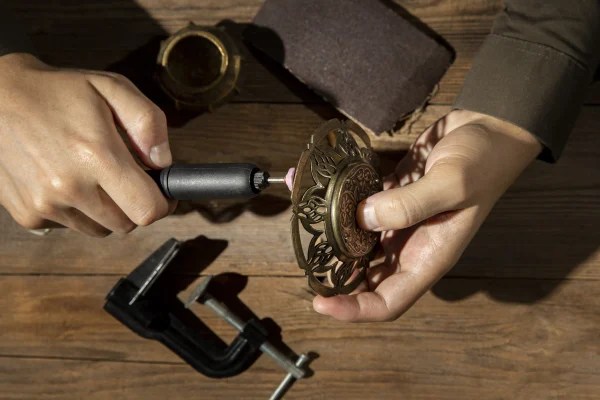
Beyond basic volume, rare methods allow artisans to create "impossible" shapes. These techniques push the physical limits of the metal, often requiring hundreds of hours for a single piece. They represent the pinnacle of jewellery and silversmithing skill.
High-Relief "Repoussé en Ronde-Bosse"
This 14th-century French technique produces nearly fully three-dimensional figures in gold. The smith raises the metal so far from the base that it appears detached. Artisans often encrust these forms with "basse-taille" translucent enamels to add color and depth. To create such high relief, perfect control over metal thickness is required to avoid "blow-outs" or holes.
Undercutting and Negative Space
To achieve extreme realism, experts use undercutting punches. These tools tuck the metal back under a raised form. This creates a physical shadow line that makes a floral motif or a face seem to float above the surface. Only rare methods allow for these overlapping layers in a single sheet of metal. This technique creates a level of visual detail that no machine-stamping process can replicate.
Material Mastery: Working with Diverse Metals
Different alloys react uniquely to traditional silversmithing methods. A smith must understand the molecular structure of the metal to prevent it from cracking under pressure. Through annealing, or heat-treating, the metal stays soft enough for manipulation.
The Malleability of Fine Silver vs. Sterling
Sterling silver requires constant attention because it work-hardens quickly. To maintain malleability, the metal must be heated to approximately 1,100°F until it shows a dull cherry-red glow. Quenching the silver in water immediately after annealing resets the crystalline structure. Can you repoussé any metal? While most non-ferrous metals like gold, silver, and copper are ideal, harder metals like steel require specialized heat treatments and much heavier tooling. The softer the metal, the more fine detail that can be achieved through traditional methods.
Repoussé in High-Karat Gold
The handling of 18k or 22k gold offers a different experience. High-karat gold possesses incredible ductility, allowing for extreme stretching without the frequent annealing required by silver. However, the high cost of the material increases the stakes of every hammer strike. Gold responds with a buttery smoothness that allows for the microscopic fine detailing found in royal jewellery and silversmithing pieces.
The Alchemy of Pitch and Resistance
The pitch bowl acts as the "unsung hero" of the workshop. It provides a unique balance of solid support and fluid movement. This balance changes depending on the temperature and the specific recipe of the pitch.
Hard vs. Soft Pitch Formulations
Smiths maintain different grades of pitch for different stages of the work. Soft pitch allows for the initial deep stretching of the metal. As the design becomes more refined, the smith moves to a harder pitch formulation. Hard pitch provides the rigid resistance needed for crisp, final chasing. This thermal ductility allows the pitch to flow when heated, but stand firm at room temperature.
Heat Management and Metal Fatigue
The smith must monitor the Vickers Hardness Scale (HV) of the metal throughout the project. Sterling silver starts at 56 HV when annealed, but can reach 180 HV through repeated strikes. If you exceed this limit, the metal will fatigue and tear. The management of these molecular changes is a core part of jewellery and silversmithing. Research published on Academia.edu indicates that skilled artisans can use the sound of a hammer blow to diagnose if a section has become dangerously thin.
Contemporary Applications in Jewellery and Silversmithing
Modern artisans find ways to blend ancient wisdom with 21st-century aesthetics. These applications prove that hand-raised metal still holds a place in a high-tech world. Current jewellery and silversmithing trends favor the unique textures that only hand tools can create.
The Combination of CAD and Hand-Repoussé
Some modern workshops use Computer-Aided Design (CAD) to map out complicated geometries before they pick up a hammer. They might use 3D-printed molds for initial "sinking" and then finish the piece with hand-repoussé. This hybrid workflow saves time but relies on the human hand for the final artistic soul. The irregularities of handwork make the piece more valuable to modern collectors.
The Rise of Wearable Sculpture
According to a guide from Cooksongold, smiths use anticlastic raising to curve metal around two axes by forming it around a ring die with a hammer, which results in a saddle-type shape used for lightweight, high-strength cuffs and necklaces that resemble organic forms. Is repoussé hard to learn? It is widely regarded as one of the most difficult metalworking skills to gain expertise in because it requires a deep intuitive understanding of how metal flows and thins under pressure. Most smiths spend years practicing on copper before moving to precious metals.
The Preservation of the Legacy of Traditional Silversmithing Methods
As industrialization favors speed, these rare methods face the threat of extinction. True repoussé cannot be rushed or automated. This scarcity contributes to the high market value of hand-raised silver and gold.
The Value of the Maker's Mark
Through the identification of the maker's mark, collectors recognize high-end work. These marks, stamped with proprietary punches, prove the piece originated in a specific expert's workshop. Unlike machine-pressed items, hand-raised pieces show subtle variations that tell the story of their creation. The adoption of traditional silversmithing methods ensures that no two pieces are ever identical.
Educational Initiatives and Expert-Apprentice Cycles
Organizations around the world now work to keep these skills alive. The expert-apprentice cycle remains the only way to pass on the "feel" of the metal. Books can explain the chemistry, but only an expert can show a student how to hear the difference between a healthy strike and a potential crack. Preserving these traditional silversmithing methods protects a thousand-year-old human legacy.
The Future of Jewellery and Silversmithing
The enduring appeal of repoussé lies in its resistance to the digital age. A machine can calculate a shape, but it cannot feel the thinning of a silver wall or the softening of the pitch. The human touch provides a depth of character that defines the very best in jewellery and silversmithing.
Every hammer strike leaves a permanent record of the artisan's intent. As we move further into a world of mass-produced goods, the value of hand-crafted excellence only grows. Rare repoussé methods remind us that some of the deepest beauty comes from the simple meeting of fire, steel, and a patient hand. The metal will always move for those who know how to listen.
Recently Added
Categories
- Arts And Humanities
- Blog
- Business And Management
- Criminology
- Education
- Environment And Conservation
- Farming And Animal Care
- Geopolitics
- Lifestyle And Beauty
- Medicine And Science
- Mental Health
- Nutrition And Diet
- Religion And Spirituality
- Social Care And Health
- Sport And Fitness
- Technology
- Uncategorized
- Videos

