

Image by - Andrzej Barabasz, CC BY-SA 4.0, via Wikimedia Commons
Chris Rea Preferred Pit Lane Over Pop Fame
Most musicians chase the spotlight until it burns them out, but some treat global fame like a distraction from their actual job. Chris Rea built a massive career on the specific feeling of being stuck in a car while wanting to be somewhere else. He viewed the music industry’s demands as obstacles to his real work, yet he still managed to sell millions of records by accident. This friction between commercial success and artistic integrity defined his entire trajectory. He passed away on December 22, 2025, leaving behind a legacy that defies the standard pop star formula.
The Accidental Pop Star Strategy
Labels often create a persona for an artist that the actual human being spends decades trying to dismantle. Chris Rea found himself trapped in this dynamic immediately after his 1978 debut album, Whatever Happened to Benny Santini? The record label wanted a polished hitmaker. He wanted to be a serious introspective poet.
This tension produced his breakout track, "Fool (If You Think It's Over)." While the public loved the smooth sound, the song stood apart from his true identity. It remains the only track in his catalog that does not feature his signature guitar work. He built the foundation of the song on piano chords instead.
He viewed his early marketing as a misunderstanding. He spent years pivoting away from the bright lights of pop stardom toward the gritty authenticity of the blues. He rejected the rock star lifestyle entirely. He famously stated he would rather be a mechanic in the pit lane changing tires than a VIP guest in the lounge.
Finding Rhythm in the Engine
Some composers need total silence to write, but others require the mechanical hum of an engine to organize their thoughts. Chris Rea sourced his best ideas from the road. Automobiles served as his primary muse rather than just transport.
He owned an impressive collection, including a Ferrari Dino, a Lotus 6, and a Land Rover Series 1. He saw the road as a metaphor for life’s direction. This connection between internal thought and external motion fueled his creativity. The film La Passione, released in 1996, allowed him to finally merge his love for motor racing with his composition skills.
This drive for authenticity often clashed with industry expectations. When an artist values the journey more than the destination, they make decisions that confuse their business managers. He consistently chose projects that reflected his passion for cars and driving over guaranteed chart-toppers.
The Holiday Hit Chris Rea Didn't Want
Commercial gold often comes from the moments an artist considers a throwaway joke. The massive success of "Driving Home for Christmas" originated from a moment of pure observation rather than a calculated attempt at a holiday hit. Chris Rea wrote the lyrics while watching miserable drivers stuck in traffic.
He noticed the streetlights illuminating their frustrated faces. He started joking about the situation, and the singing followed naturally. The composition came rapidly. He initially opposed the release of the track in 1986. His label insisted.
He believed the song didn't fit his serious image. History proved the label fortunate in their persistence. The track became a seasonal staple. Years later, he admitted the song emerged subconsciously from that traffic jam. He noted that modern traffic jams now provoke sing-alongs to his voice, creating a strange loop where his observation of misery brings others joy.
Fighting a Body That Kept Breaking Down
Survival instincts kick in hardest when your physical ability to create is the very thing under attack. Chris Rea battled a series of severe health crises that threatened to silence his career permanently. His medical history reads like a battle map.
He suffered from Type 1 diabetes and survived a severe bout of peritonitis in 1995. Reports on his cancer battle show conflicting timelines. Some sources claim he received a pancreatic cancer diagnosis and underwent a Whipple procedure at age 33, while others place this battle much later, around 2001.
In 2016, a stroke nearly ended his ability to perform. The incident left him with slurred speech and reduced movement in his arm. He feared he had lost his pitch perception. He required constant reassurance from others that he was hitting the right notes. Many people wonder about the specifics of his condition. What illnesses did Chris Rea have? He battled pancreatic cancer, Type 1 diabetes, and suffered a stroke in 2016 that affected his movement and speech. He recovered enough to tour again, proving that his drive to play outweighed his physical limitations.
The Bluesman Beneath the Charts
True musical identity survives even when marketing teams try to polish all the grit away. Chris Rea always identified as a slide guitar specialist influenced by Delta blues, despite his pop radio success. Critics and fans often compared his style to legends like Mark Knopfler and Eric Clapton.
He started his journey with a Hofner V3 guitar, though some accounts suggest it might have been a model 173. He used these tools to craft a sound that was distinctly his own. He prioritized musical authenticity over fame. He saw his illnesses as an opportunity to reset his priorities.
He moved away from the commercial sound of his early years to embrace the blues fully. This pivot allowed him to produce 25 solo albums. His global reach was immense. How many albums did Chris Rea sell? He sold between 30 and 40 million albums globally throughout his career.
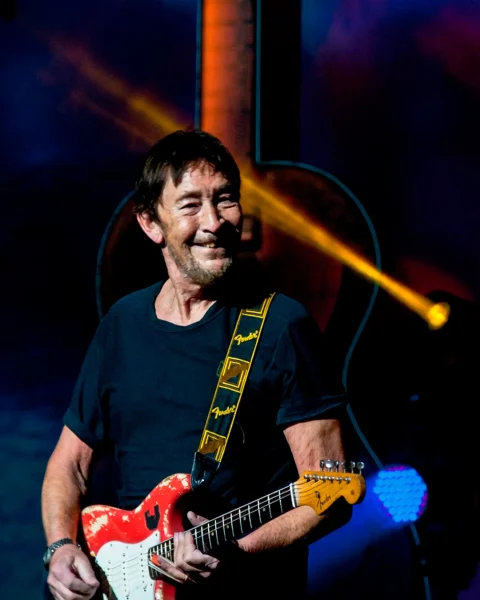
Image by - Andrzej Barabasz, CC BY-SA 4.0, via Wikimedia Commons
Politics and the Outsider Perspective
Standing on the edge of a community provides a clearer view of its flaws than standing in the center. Chris Rea grew up in Middlesbrough with Irish-Italian heritage. He felt like an outsider from an early age. This perspective shaped his worldview and his politics.
He supported the Labour party and praised Jeremy Corbyn. However, he maintained a skeptical view of the European Union. He differentiated between a unified market and cultural forcing. He believed that forcing different cultures together politically created friction rather than unity.
His willingness to hold nuanced views mirrored his approach to music. He refused to fit into a single box. He observed couples in transit and questioned their relationships. He watched the world through a windshield, separated by glass but deeply attentive to the details.
The Final Lap for Chris Rea
A legacy cements itself not by the records sold, but by the authenticity maintained until the very end. The later years of his life saw him embracing the specific quirks of his career. In 2014, he finally performed "Driving Home for Christmas" live for the first time.
The crew hired 12 snow cannons for the show. The cleanup cost £12,000. He laughed about the artificial snow, accepting the spectacle he had once rejected. He continued to record and tour until his health finally gave way.
He passed away in a hospital on December 22, 2025, following a short illness. He was 74 years old. He left behind seven siblings and a massive catalog of work. His death marked the end of a long road for a man who always preferred the journey.
A Life Spent on the Road
Chris Rea proved that an artist can succeed wildly while actively rejecting the trappings of that success. He turned a traffic jam into a holiday anthem and a cancer diagnosis into a reason to play the blues. He never let the industry dictate his speed or his direction. He kept his hands on the wheel until the engine finally stopped.
Recently Added
Categories
- Arts And Humanities
- Blog
- Business And Management
- Criminology
- Education
- Environment And Conservation
- Farming And Animal Care
- Geopolitics
- Lifestyle And Beauty
- Medicine And Science
- Mental Health
- Nutrition And Diet
- Religion And Spirituality
- Social Care And Health
- Sport And Fitness
- Technology
- Uncategorized
- Videos

