

China Mega-Embassy in London Raises Risks
When a government consolidates scattered diplomatic outposts into a single, massive fortress, they do not just simplify their logistics; they establish a permanent, impenetrable base of operations on foreign soil. The debate surrounding the proposed China mega-embassy in London often focuses on the aesthetics of the building or the politics of the decision. However, the real tension lies in the shift of power that comes with physical presence. As noted by The Guardian, by moving from seven separate locations to one centralized compound, Beijing gains a capability that goes far beyond issuing visas.
According to Reuters, the UK government currently faces a deadline of January 20, 2025, to approve or reject this project. Ministers argue, as reported by The Guardian, that placing all Chinese personnel in one location makes them easier to monitor compared to dispersed sites. Intelligence experts argue the exact opposite. They warn that this specific location sits directly on top of the digital arteries of London’s financial sector. This creates a standoff where economic interests collide with national security. The China mega-embassy represents more than a construction project; it is a test of how much access the UK is willing to grant a global rival in exchange for diplomatic stability.
The Scale and Ambition of the Project
Size in diplomacy usually signals prestige, but in this case, the sheer scale signals a massive expansion of operational capability. The proposed site at Royal Mint Court covers five acres and spans roughly 600,000 square feet. This is not a standard upgrade. CBS News reports that the plans reveal a complex that would dwarf the current embassy in London by about ten times. It is also three times the size of China’s embassy in Washington, D.C.
This drastic increase in footprint changes the dynamic of China’s presence in the UK. Currently, Chinese diplomatic operations are split across seven different sites. This fragmentation limits coordination and capacity. The new plan brings everything under one roof. The site itself was purchased in 2018 for £255 million ($350 million). Since then, it has sat in a state of limbo, waiting for permission to transform into the UK’s largest diplomatic mission.
The acquisition of the former Royal Mint Court carries heavy symbolism. This location once produced the nation's currency. Now, it stands as a potential sovereign enclave for a foreign superpower. The sheer volume of space allows for a staff capacity of over 200 people. This is a significant surge in personnel numbers. Critics argue that a facility this large suggests an intent to expand activities well beyond standard diplomatic duties.
The Security Monitoring Argument
Bringing a target into a single, defined zone often creates a false sense of control for the watcher. The UK government supports the move based on this logic. A spokesman for the Prime Minister stated that replacing seven dispersed locations with a single complex offers a clear enhancement of protective oversight. The theory is simple: when your counterparts are in one place, you know exactly where to look.
Government officials believe this centralization strengthens the UK's security posture. Monitoring seven different buildings across London requires vast resources. It stretches surveillance capabilities thin. By funneling all activity into the Royal Mint Court, security agencies theoretically gain a tighter grip on who enters and leaves.
However, this argument assumes that external monitoring is enough to mitigate risk. It ignores what happens inside the walls. Why does China want a mega embassy in London? They need a centralized hub to house over 200 staff and manage diplomatic operations more efficiently. While this efficiency helps Beijing, it complicates the job for UK intelligence. A single, fortified compound is harder to penetrate than seven smaller, less secure offices. The government’s position relies on the idea that containment equals safety. Opponents suggest that containment at this scale is impossible.
The Location and Data Risks
Real estate value usually depends on the view, but in the world of intelligence, the true value lies in what flows beneath the street. The Royal Mint Court sits in a uniquely sensitive spot. It is located near critical infrastructure, including major fibre optic cables that serve as data conduits for the City of London’s finance sector. This proximity has raised alarms among former intelligence chiefs.
Sir Richard Dearlove, the former head of MI6, explicitly warned that placing the embassy atop these critical cables creates a significant vulnerability. He argues that the location allows for the potential interception of financial data. In the digital age, information travels through physical cables. Getting close to those cables offers opportunities that remote hacking cannot provide.
Nigel Inkster, a former director at MI6, added that the appetite for foreign data acquisition is limitless. He noted that breaching "air-gapped" systems—computers disconnected from the internet for security—often requires physical closeness. You cannot hack an isolated server from another continent, but you might breach it if you are next door. The China mega-embassy would place sophisticated equipment and personnel within touching distance of London’s economic nervous system.
The Housing Strategy and Staff Control
When employees live inside their workplace, the boundary between professional duty and state control completely disappears. One of the most contentious aspects of the plan is the inclusion of approximately 200 on-site residential units. This breaks from the standard Western model. Most embassies house their staff in off-site apartments, allowing for some integration with the local community.
The Chinese plan creates a self-sustaining ecosystem. Staff would live, work, and socialize within the compound. This arrangement implies a high level of control over personnel. It allows for rapid mobilization of staff at any hour. It also drastically reduces the opportunities for UK intelligence officers to approach or recruit Chinese diplomats. If they never leave the secure zone, they remain out of reach.
Is the China mega embassy dangerous? Experts claim the location near critical data cables poses a significant risk of information interception and espionage. Beyond the technology, the human element is crucial. A closed loop of 200 people living on-site creates a fortress mentality. It isolates the diplomats from British society, making the embassy less of a diplomatic bridge and more of a closed silo.
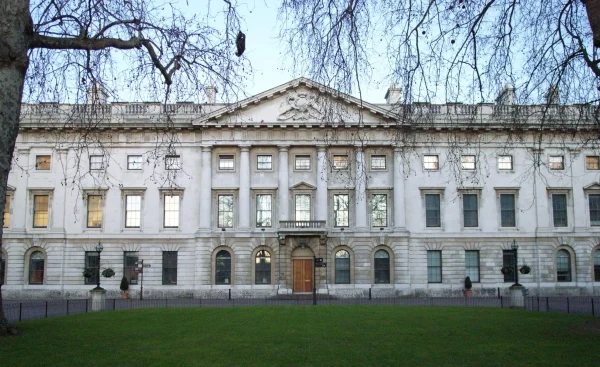
Image by- Steve Cadman from London, U.K., CC BY-SA 2.0, via Wikimedia Commons
Political Delays and Strategic Leverage
Bureaucratic delays often look like incompetence, but they frequently signal a high-stakes negotiation happening behind closed doors. The timeline of this project reveals the intense political friction involved. After the site was bought in 2018, the Tower Hamlets Council rejected the planning permission in 2022. That local rejection stalled the project, but it did not kill it.
In the summer of 2024, the Labour government took over the decision-making authority. This moved the power from the local council to the national stage. Since then, as detailed by Reuters, the decision has been postponed three times. The latest deadline is set for January 20, 2025. These delays are not accidental. They coincide with broader diplomatic maneuvers.
Prime Minister Keir Starmer plans to visit Beijing. The approval of the China mega-embassy could serve as a bargaining chip. It might be a "quid pro quo" deal to secure a new UK embassy in Beijing or to improve trade terms. The alignment of the deadline with these diplomatic trips suggests the building is being used as leverage. The government faces a dilemma: approving the site might please Beijing, but it risks domestic backlash and security gaps.
Opposition and Transparency Concerns
Silence during a public inquiry often speaks louder than the arguments actually presented. Critics accuse the government of rushing the process and hiding critical details. James Cleverly, the Shadow Housing Secretary, claims that ministers have suppressed criticism. He asserts that intelligence agencies were blocked from submitting confidential testimony to the inquiry.
The transparency of the approval process is under fire. Opposition figures argue that critical blueprints were redacted, preventing a full assessment of the building’s capabilities. They claim the approval process lacks adequate scrutiny. If the intelligence agencies cannot speak freely about the risks, the decision-makers operate in the dark.
When will the China mega embassy be built? The final decision is expected by January 20, 2025, after multiple delays by the government. Activists also worry about the impact on human rights. Simon Lau, a Hong Kong activist, described an autocratic base in the heart of the capital as unacceptable. He fears that dissidents will be followed by community proxies. There are reports of bounties offered for information on critics. A massive embassy provides a resource hub for these surveillance activities against individuals in the UK.
The Chinese Perspective and Response
Labeling a security review as "political bias" turns a technical safety check into a diplomatic insult. The Chinese government views the repeated delays as an erosion of mutual trust. A spokesperson for the Chinese Embassy deplored the postponements. They urged prompt approval to prevent further damage to bilateral cooperation.
From Beijing’s viewpoint, the objections are politically motivated. They argue that they purchased the land legally and are entitled to build their diplomatic mission. They see the security concerns as unjustified paranoia. The Chinese position emphasizes that a new embassy would facilitate better relations and trade.
Prime Minister Keir Starmer has tried to walk a fine line. He rejects the "binary choice" between trade and safety. He claims his policy is grounded in realism and recognizes Beijing as a defining global force. However, the Chinese side sees the stalling as a sign of weakness or hostility. They want the China mega-embassy built, and they view the planning permission battle as a proxy for the wider state of UK-China relations.
Gaps in UK Defenses
A locked door is useless if the legal system leaves the window wide open. The debate over the embassy highlights a specific legislative gap in the UK. Unlike Australia, the UK lacks a specialized operational unit dedicated to prosecuting foreign espionage. This makes it harder to act against spies even if they are caught.
Furthermore, China is currently absent from the "enhanced tier" of the Foreign Influence Registration Scheme (FIRS). Only Russia and Iran are currently listed. This means Chinese agents do not face the same registration requirements as those from other hostile states. This legal loophole weakens the UK’s ability to track influence operations.
Local residents also feel exposed. CBS News observes that currently, only a simple wooden fence separates the massive site from the neighborhood. Residents fear eventual displacement and the expansion of a high-security zone into their streets. They worry about becoming collateral damage in a geopolitical struggle. The lack of formal objections from the Home Office or Foreign Office has left many confused. Reports suggest MI5 and MI6 agreed on a risk management strategy, but former chiefs disagree with this assessment.
The Permanent Shadow
The controversy surrounding the China mega-embassy reveals a fundamental struggle in modern diplomacy. It is not just a question of urban planning; it is a question of strategic territory. The government believes it can manage the risk through centralization. Critics believe the location itself grants Beijing an advantage that cannot be undone.
By placing a 600,000-square-foot compound on top of the City’s data lines, the UK invites a permanent, fortified presence into its financial heart. The decision due in January 2025 will define the relationship between the two nations for decades. Whether it becomes a hub for cooperation or a fortress for espionage, the China mega-embassy will cast a long shadow over London. The choice is no longer about checking a box for planning permission; it is about deciding who owns the ground beneath our feet.
Recently Added
Categories
- Arts And Humanities
- Blog
- Business And Management
- Criminology
- Education
- Environment And Conservation
- Farming And Animal Care
- Geopolitics
- Lifestyle And Beauty
- Medicine And Science
- Mental Health
- Nutrition And Diet
- Religion And Spirituality
- Social Care And Health
- Sport And Fitness
- Technology
- Uncategorized
- Videos

