
Image Credits- Wikimedia Commons
Bouquinistes Of Paris Pay Zero Rent Costs
Real estate in a major capital usually creates a ruthless game where only the highest bidder survives. Businesses bleed money into rent until they fold or move to the suburbs. Yet, along the most scenic banks of the Seine, prime commercial space costs absolutely nothing. The city trades revenue for soul. This specific trade-off allows a centuries-old trade to defy modern economic gravity.
The Bouquinistes of Paris operate outside the standard rules of retail survival. According to a Paris municipal brochure, they occupy three kilometers of riverfront property without paying a single euro in rent or taxes. This financial freedom creates a barrier against the forces that crushed giants like the Gibert Jeune flagship store. While traditional bookstores collapse under the weight of overhead costs, these open-air merchants persist. They remain the guardians of a literary tradition that began before the United States existed.
The Economic Edge of the Bouquinistes of Paris
Profit margins matter less when your operating costs sit at zero. The retail environment in Paris remains brutal for traditional shop owners. High rents and changing consumer habits force historic names to close their doors. The flagship Gibert Jeune store, a literary icon, recently shut down because the math no longer worked. High rent combined with the post-Covid drop in foot traffic made the business unsustainable. A representative for the store noted that customer mobility dropped significantly, forcing them to retreat to residential areas.
The Zero-Rent Advantage of the Bouquinistes
The Bouquinistes of Paris play a different game entirely. Their business model removes the landlord from the ledger. Ozan Yigitkeskin, a 52-year-old seller, points out that low overhead prevents the typical struggles that kill standard retail shops. He pursues his passion without the looming threat of monthly eviction notices.
This financial structure changes how sellers stock their shelves. A shop paying thousands in rent must sell fast-moving bestsellers to keep the lights on. A Bouquiniste paying zero rent can afford to stock obscure, weird, or slow-selling titles. Sylvia Brui, a 76-year-old veteran of the riverbanks, treats her stall as a lifestyle choice rather than a corporate job. She selects inventory based on affection instead of algorithmic demand.
Competition still exists, however. Amazon dominates the textbook market, and e-books eat into fiction sales. To counter this, sellers rely on the "treasure hunt" appeal. Is the Bouquiniste trade profitable for everyone? While they pay no rent, earnings fluctuate wildly based on tourism and weather, meaning financial stability varies from seller to seller. The lack of rent simply ensures that a bad month does not result in bankruptcy.
A History Built on Rebellion and Regulations
Traditions become permanent only after they survive attempts to erase them. The story of these booksellers starts with a mix of theft, desperate sailors, and royal bans. ParisUnlocked notes that the first street vendors appeared around 1550 near the Île de la Cité. Legend says the trade originated from a sunken ship near Notre Dame. Sailors salvaged the wet books and sold them on the riverbanks to recover their lost wages. They did not ask for permission; they simply sold what they had.
Authorities did not always welcome these merchants. As covered by Euronews, a 1649 law banned book displays on the Pont Neuf. The government wanted to control the flow of information and clean up the bridge. The sellers ignored the pressure and stayed. The construction of the Pont Neuf in 1606 actually helped them. It expanded trade space without adding new buildings, leaving room for portable stalls.
Modern Survival and Enduring Legacy
This pattern of threat and survival continues today. In 2024, the Paris Olympics planning committee proposed removing the boxes for security reasons. The public outcry was immediate and massive. Parisians viewed the removal as an attack on the city's identity. The authorities backed down, and the stalls remained in place.
Today, the trade enters its 475th year of uninterrupted operation. October 2025 saw the appointment of 12 fresh booksellers, proving that new blood still wants to join this ancient guild. The term "bouquiniste" itself comes from the German word "buch," anchoring the profession in the physical object they peddle. They serve as a living timeline of the city rather than simple retailers.
The Green Box Standard
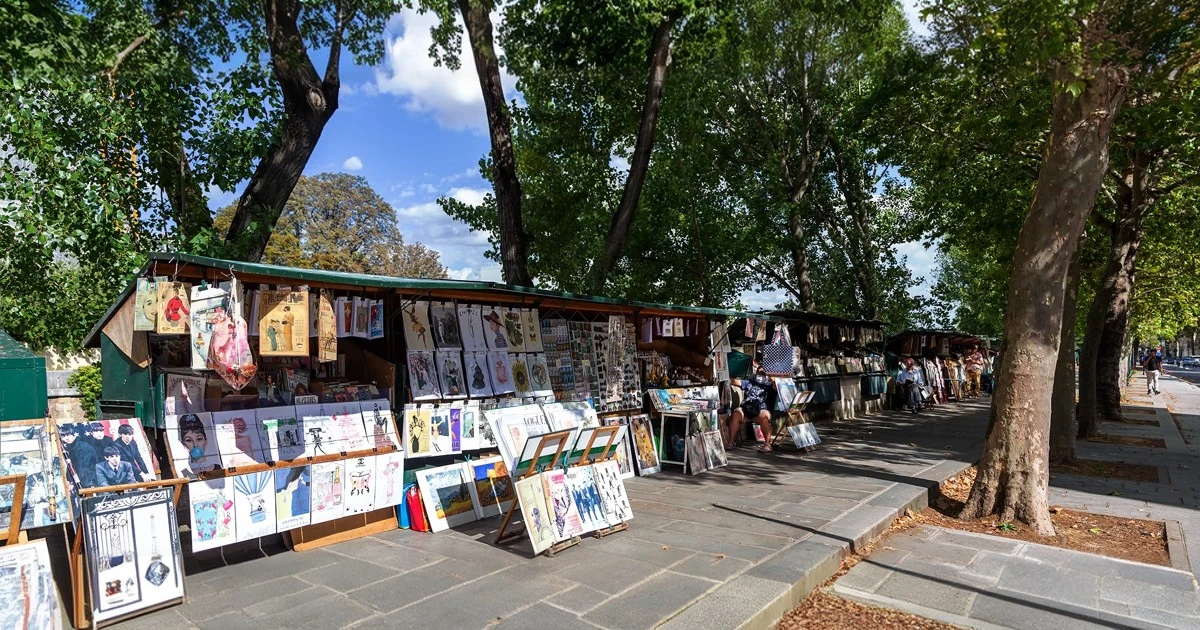
Uniformity protects a specific group better than individuality ever could. Walk along the Seine, and you see a strict visual order. Every box looks the same. This uniformity exists as a requirement rather than an accident. In the early 1900s, the city standardized the stalls to prevent the riverbanks from looking like a chaotic flea market.
Per official technical regulations, the boxes must be painted "vert wagon" (wagon green). This specific shade matches the color of old train carriages, linking the static boxes to the idea of travel and transport. These documents also specify that each box measures two meters long by 0.75 meters wide. The lids must slope downwards. This design choice ensures that pedestrians on the sidewalk can still see the river over the top of the boxes.
Currently, 900 of these metal boxes line the parapets of the Seine. Together, they hold an inventory of approximately 300,000 books. This massive collection makes the riverbank the largest open-air bookstore in the world. The uniformity serves a defensive purpose. By looking like a cohesive piece of urban furniture, the boxes gained protection.
In 1991, UNESCO recognized the banks of the Seine as a World Heritage site. The citation specifically included the Bouquinistes of Paris. This global status makes it incredibly difficult for local politicians to tamper with the boxes. The green paint acts as armor. It signals that these boxes belong to the city just as much as the streetlights and the cobblestones.
Inside the Selection Process
Maintaining an open market paradoxically requires strict gatekeeping. You cannot simply buy a box and start selling. The City of Paris controls the licenses with an iron grip. The application process rivals that of a corporate job. Hopeful candidates must submit a resume and a cover letter detailing their experience and motivation.
Jérôme Callais, the President of the Bouquinistes, emphasizes that candidates must demonstrate a genuine dedication to literature. The city looks for knowledge, not just a desire to sell cheap souvenirs. Callais describes the stalls as an "oasis of humanity" provided through eye contact and conversation.
The demographics reflect this need for patience and experience. A feature published by AOL reports that about 80% of the 230 sellers are over the age of 50. Many enter the trade as a second career or a retirement project. Camille Goudeau, a 35-year-old seller, represents the younger generation. She prefers the independence of the riverbank to "indoor confinement." Her mission focuses on re-engaging lapsed readers who might feel intimidated by a formal bookstore but feel comfortable browsing a street stall.
The permit lasts for five years. It costs nothing, but it demands presence. The city requires sellers to open their boxes at least four days a week. This rule ensures the riverbanks remain vibrant. A row of locked metal boxes offers no culture to the passerby. The city grants the space for free, but the rent is paid in time and effort.
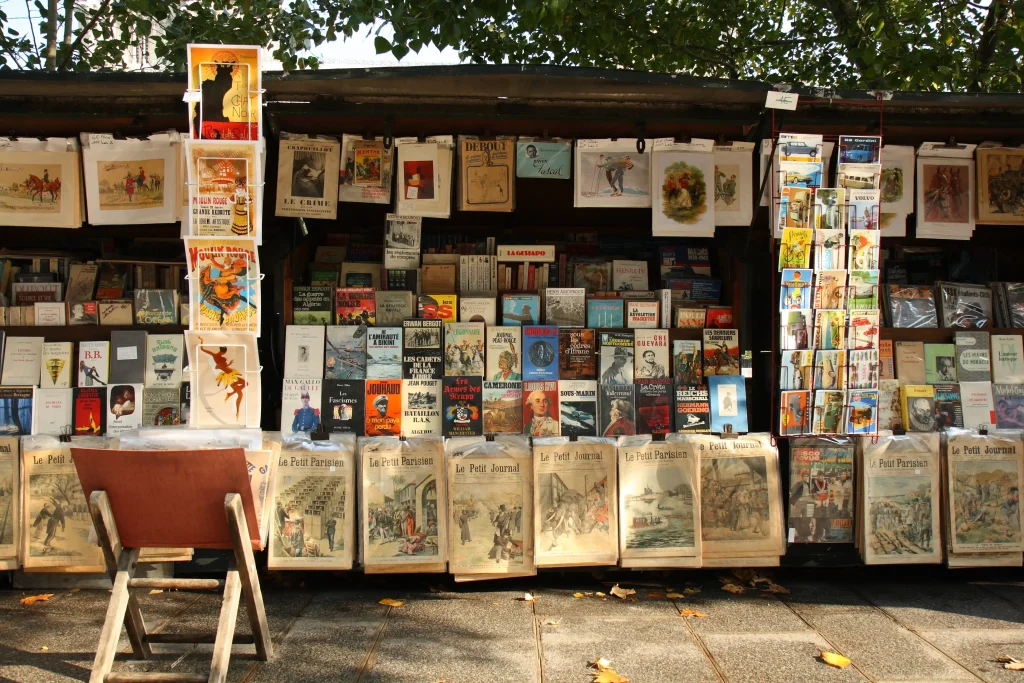
Image by- Benh LIEU SONG, CC BY-SA 3.0
How the Bouquinistes of Paris Define the River
A city defines its character by what it places at its very center. Paris is often described as "a river running between two bookshelves." This geography separates the Bouquinistes of Paris from any other market. They do not operate in a square or a dedicated hall. They cling to the stone ledges of the Seine itself.
The market stretches for roughly three kilometers. On the Right Bank, the stalls run from the Quai du Louvre to the Pont Marie. On the Left Bank, they span from the Quai de la Tournelle to the Quai Voltaire. This specific placement puts them in the path of millions of tourists and locals every year.
A UNESCO source describes the Seine as the only waterway in the world flanked by bookshelves. This physical reality shapes the atmosphere of the district. A local resident of the Latin Quarter lamented that neighborhood identity erodes when intellectual hubs vanish. As fast-food chains replace historic shops, the river stalls remain the last line of defense for the area’s "bohemian" spirit.
The contrast with other markets highlights their unique position. The Georges Brassens Market deals in old books, but it sits under a roof in an old slaughterhouse and only opens on weekends. It attracts serious collectors. The riverside sellers attract the world. They act as the welcoming committee for the city's history.
The Daily Grind on the River
True freedom usually demands working in the rain. The romantic image of the bookstall often clashes with the reality of the work. It is an outdoor job in a city known for grey skies. The "four days a week" rule applies regardless of the season, though authorities grant some leniency for "weather permitting" absences. If a storm hits, the boxes stay locked.
Sellers face the elements constantly. In the winter, the stone embankment amplifies the cold. In the summer, the zinc roofs of the buildings trap the heat. Yet, the sellers persist. Camille Goudeau notes that the stalls serve as a social refuge for lonely individuals. The interaction goes beyond commerce. People stop to talk, to complain, or to ask for directions.
This human connection drives the trade. Jérôme Callais insists that experience and knowledge are essential because the job is advisory. A customer might not know what they want until the seller hands it to them. Do Bouquinistes sell new books? They focus primarily on second-hand books, antiques, and rare finds, though some contemporary reads appear. The inventory includes engravings, stamps, and magazines alongside the hardcovers.
The work is physical. Opening and closing the heavy metal lids requires strength. Hauling stock back and forth is necessary if the boxes are full. It is a labor of love. The zero-rent structure makes it financially possible, but only the seller's stamina makes it operationally possible.
Adapting to Survive the Digital Age
Purists survive by allowing just enough contamination to pay the bills. The book trade faces a lethal enemy in digital convenience. An IPSOS poll indicates that while second-hand purchases are increasing, the market is shifting. Students used to flock to the river for cheap classics. Now, Amazon captures the textbook market, and tablets hold entire libraries.
To survive, the Bouquinistes adapted. The Guardian explains that only one box out of four can display trinkets like keychains or magnets. The other three must remain dedicated to books and prints. This regulation prevents the historic literary market from turning into a generic tourist trap.
The souvenir box often subsidizes the book boxes. A tourist might not buy a vintage edition of Les Misérables, but they will buy a magnet of the Eiffel Tower. That small sale keeps the seller afloat, allowing them to keep the rare books on display. It is a necessary compromise.
Ozan Yigitkeskin admits that passion persists despite career changes and market shifts. The sellers prove resilient rather than stubborn. They blend the old world of antique engravings with the modern need for affordable, quick purchases. They focus on affordability, offering second-hand prices that beat the expensive high-street shops.
Guardians of the Seine's Soul
The Bouquinistes of Paris prove that economic value is not the only metric that matters. In a city that monetizes every square inch of pavement, these 230 sellers hold their ground for free. They pay their way by maintaining the soul of the Seine. They transform a stone embankment into a cultural library that runs for miles.
Their survival is not accidental. It comes from a mix of rigid design standards, strict city selection, and the stubborn will of the sellers themselves. They survived the bans of 1649, the standardization of the 1900s, and the security threats of 2024. As long as the river flows, the green boxes will likely remain, standing as a testament to a city that still believes books are worth more than rent.
Recently Added
Categories
- Arts And Humanities
- Blog
- Business And Management
- Criminology
- Education
- Environment And Conservation
- Farming And Animal Care
- Geopolitics
- Lifestyle And Beauty
- Medicine And Science
- Mental Health
- Nutrition And Diet
- Religion And Spirituality
- Social Care And Health
- Sport And Fitness
- Technology
- Uncategorized
- Videos

