

Bayeux Tapestry Loan: The £800m Risky Return
The worth of a historical object often relies on what someone is willing to pay for it, but sometimes the price tag exists only to suspend the rules of reality. A figure like £800 million does not represent a market transaction; it represents the sheer force required to move a fragile timeline from one country to another. This provisional valuation creates a safety net that commercial banks refuse to weave. Without this massive government-backed promise, the linen would remain locked in France forever.
The upcoming mortgage of the Bayeux Tapestry to the British Museum involves a truck and a crate, yet it triggers a dense network of diplomatic favors, financial loopholes, and engineering feats designed to protect 900-year-old wool. While the public sees a cultural blockbuster, the teams behind the scenes see a logistical nightmare that balances international relations against the physical limits of rotting fabric. The project forces politicians and curators to gamble with an irreplaceable artifact to secure a moment of unity.
The Financial Safety Net
Governments often act as the ultimate insurance agency when the private sector sees too much risk. Commercial insurers would charge premiums so high for this transfer that the exhibition would end before it began.
As reported by The Guardian, the UK Treasury plans to bypass this wall using the Government Indemnity Scheme, allowing the state to act as the insurer to cover costs if disaster strikes. Taking on the risk directly saves museums roughly £81 million every year. According to The Guardian, the provisional liability sits at £800 million, an estimate set for its 2026 return. Christie’s records show this amount dwarfs the auction record for Leonardo da Vinci’s Salvator Mundi, which sold for over $450 million. Officials recognize that no private company could afford to cover a 70-meter strip of embroidered history.
The figure itself is still waiting for a final signature from Chancellor Rachel Reeves. Until that pen hits the paper, the loan remains a theoretical exercise. Treasury spokespeople argue this system is the only way to facilitate high-value cultural access for the public. Without this state-sponsored coverage, the price of sharing history would bankrupt the institutions tasked with preserving it.
A Trade of National Treasures
Generosity in international politics is rarely free; it usually requires a trade of equal weight. The arrival of the Bayeux Tapestry in London acts as the centerpiece of a broader exchange of "soft power" between PM Keir Starmer and President Emmanuel Macron.
The deal ensures that while Britain gets the story of its own conquest, France receives iconic British treasures in return. The British Museum plans to send the Sutton Hoo helmet and the Lewis Chessmen to museums in Rouen and Caen. You might be wondering about the timing of this swap. When will the Bayeux Tapestry be in London? A press release from Gov.uk confirms the exhibition is scheduled to run from September 2026 at the Sainsbury Exhibitions Gallery until July 2027.
This reciprocity turns a museum loan into a diplomatic handshake. Sharing these items reinforces deep Anglo-French bonds. Museum Director Nicholas Cullinan frames this partnership as a model for future international cooperation. The loan fills a gallery while cementing a political relationship during a period of changing leadership and shifting borders.
The Engineering of Fragility
Moving a continuous strip of ancient linen requires treating it as a volatile chemical rather than art. The fabric cannot simply be rolled up and thrown in a van. Logistics teams are preparing a specialized isothermal crate designed to keep temperature and humidity dead flat during the transit. The route involves a truck transport via the Channel Tunnel, avoiding the unpredictability of air travel or rough seas. Engineers plan to use vibration sensors to monitor every bump in the road. Before the real artifact moves, they will conduct a "dry run" with a facsimile to test every stress point on the route.
The sheer length of the object creates a unique challenge. The Bayeux Museum notes that at 70 meters long, the object demands a custom display case that spans the entire gallery. The physical composition—wool yarn embroidered onto linen—reacts poorly to movement. Any flex in the fabric could snap the threads that hold the story together. Engineers aim to move the object without the object "knowing" it has moved.
Threads of Contradiction
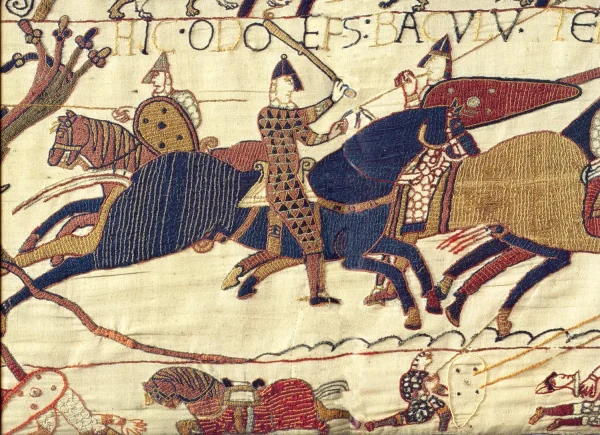
The story stitched into the linen tells one version of history, but the cloth itself tells another. While the world calls it a tapestry, the technical reality is quite different. Is the Bayeux Tapestry actually a tapestry? No, it is technically an embroidery because the design is stitched onto the surface rather than woven into the fabric itself. This distinction matters because embroidery is physically weaker and more prone to fraying. Khan Academy states that most scholars agree the piece was likely made in the 1070s in Kent, England, rather than France. Bishop Odo, the half-brother of William the Conqueror, likely commissioned it to celebrate the Norman victory at the Battle of Hastings in 1066.
This origin theory adds a layer of irony to the loan. The artifact is returning to the land where it was created, depicting the defeat of the people who likely stitched it. While the main narrative serves as Norman propaganda, showing William’s divine right to rule, the borders contain subtle acts of rebellion. English embroiderers included marginalized figures and fables in the margins, suggesting a subtext that undermined their new masters. The return of the cloth brings these buried English voices back to their soil for the 1st time in over 900 years.
The War Over Conservation
Preservation experts often view political gestures as direct threats to physical integrity. A deep divide has opened between government officials who want the loan and conservationists who fear the consequences.
French critics, led by Didier Rykner, argue that the 11th-century fabric is far too fragile to survive the transit. A petition against the move has already gathered over 40,000 signatures. These dissenters believe the risk of irreparable damage outweighs any diplomatic benefit. Smithsonian Magazine highlights that the artifact has not left France since 1945, when it was displayed in the Louvre after surviving a Nazi attempt to take it to Berlin.
On the other side, UK and French government officials insist the move is safe. They rely on the assessment that the linen is stable enough for a carefully managed transport. This clash highlights the tension between using art as a tool for connection and protecting it as a static relic. The renovation of the Bayeux Museum, scheduled from 2025 to 2027, provides the perfect excuse to move the piece. Since it cannot stay in its home during construction, officials argue it might as well travel.
A Blockbuster Ambition
Museums rely on spectacle to drive attendance, and this loan is intended to be a generational event. The scale of the exhibition aims to rival the biggest shows in history. George Osborne, Chair of the British Museum, compares the upcoming Bayeux Tapestry display to the legendary Tutankhamun and Terracotta Warriors exhibitions. The goal is to provide unprecedented accessibility for UK schoolchildren, allowing them to see a pivotal moment in their history with their own eyes. The artifact acts as a physical textbook for the Battle of Hastings.
This ambition justifies the £800 million risk in the eyes of the organizers. They view the potential damage as manageable compared to the educational value. The exhibition goes beyond looking at old cloth to connect a modern audience with the reality of 1066. Placing the embroidery in London hopes to spark a renewed interest in medieval history that a textbook simply cannot ignite.
The Reciprocal Cost
The UK is receiving a loan while emptying its own shelves to pay for it. The exchange requires sending British heritage across the channel to fill the void left in France.
The Sutton Hoo helmet, one of the most famous archaeological finds in Britain, will travel to France as part of the deal. This Anglo-Saxon treasure represents a significant loss for the British Museum’s permanent display during the loan period. Alongside it, the Lewis Chessmen and the Battersea Shield will head to museums in Rouen and Caen. Why is the UK sending art to France? These items serve as collateral to ensure the French public still has access to world-class history while their star attraction is in London.
This swapping of assets creates a temporary cultural merger. It forces curators in both countries to rethink how they tell their national stories without their main characters. The French museums get to host pieces of English history that rarely travel, offering their visitors a unique perspective on the neighbors across the water. It is a high-stakes game of "show and tell" played at the executive level of government.
The Bayeux Tapestry Returns
The movement of the Bayeux Tapestry is an act of defiance against the ravages of time and the caution of accountants. Assigning a provisional value of £800 million acknowledges that some things are effectively priceless, yet they must still carry a price tag to function in the modern world. The loan balances the heavy weight of diplomatic expectation against the delicate reality of ancient linen.
When the crate finally crosses the Channel in 2026, it will carry the ambitions of two nations alongside the embroidery of the Battle of Hastings. Whether the risk pays off depends on the skill of the engineers and the stability of the threads. For nine months, the history of the conquest will return to the site of the defeat, closing a circle that has remained open for nearly a millennium.
Recently Added
Categories
- Arts And Humanities
- Blog
- Business And Management
- Criminology
- Education
- Environment And Conservation
- Farming And Animal Care
- Geopolitics
- Lifestyle And Beauty
- Medicine And Science
- Mental Health
- Nutrition And Diet
- Religion And Spirituality
- Social Care And Health
- Sport And Fitness
- Technology
- Uncategorized
- Videos

